
Introduction: The Rising Stakes of Dealership Data Connectivity
Automotive software providers, marketing agencies, CRM platforms, and inventory specialists face an urgent mandate to establish direct connections with dealership data. Scaling an automotive SaaS business requires fast, secure, and compliant access to dealership management system (DMS) records. Dealerships run on customer transactions, service histories, real-time inventories, and financial ledger data. For vendors serving car dealerships, accessing these pipelines directly is necessary to power digital products and deliver tangible client value. However, the operational economics behind direct DMS connections remain complex and frequently underestimated.
When planning data acquisition strategies, technology executives must balance developer bandwidth, maintenance commitments, API licensing fees, and compliance risks. Deploying dedicated in-house pipelines for dozens of distinct DMS brands demands significant technical overhead. Selecting a standardized dms integration software framework like DealerVault simplifies architecture and lowers barrier costs. Instead of absorbing unbudgeted monthly fee spikes and custom driver patches, vendors need an objective model to evaluate integration expenses before embarking on system expansion.
Deconstructing the Hidden Costs of Direct DMS Integrations
Many technology providers initially attempt to build point-to-point connections directly to individual dealership management systems. While this gives total autonomy over code architecture, it introduces substantial ongoing overhead that rarely appears in initial budget forecasts. Engineering teams must evaluate four distinct cost pillars when calculating total cost of ownership:
- Proprietary Certification and Setup Tariffs: Primary DMS vendors regularly enforce mandatory third-party developer program certifications, application vetting fees, and high per-store setup charges. These upfront expenditures multiply exponentially as vendor client rosters grow across mixed dealership environments.
- Custom Connector Development and Maintenance: The North American dealership market relies on dozens of unique DMS architectures, spanning cloud platforms to legacy terminal databases. Maintaining specialized data parsers, custom extraction routines, and continuous driver updates consumes valuable engineering sprint cycles that should otherwise support core product differentiation.
- Security Audits and Regulatory Compliance: Modern consumer protection statutes like the FTC Safeguards Rule mandate strict controls over customer non-public personal information (NPI). Managing raw data pipelines without intermediary governance requires constant compliance oversight, automated encryption protocols, zero-trust infrastructure, and frequent penetration testing.
- Operational Support and Feed Management: Managing raw feeds across individual dealerships creates endless support tickets. Data breaks, shifted schema fields, interrupted uploads, and credentials expired on local dealership servers consume internal support staff time and delay client onboarding.
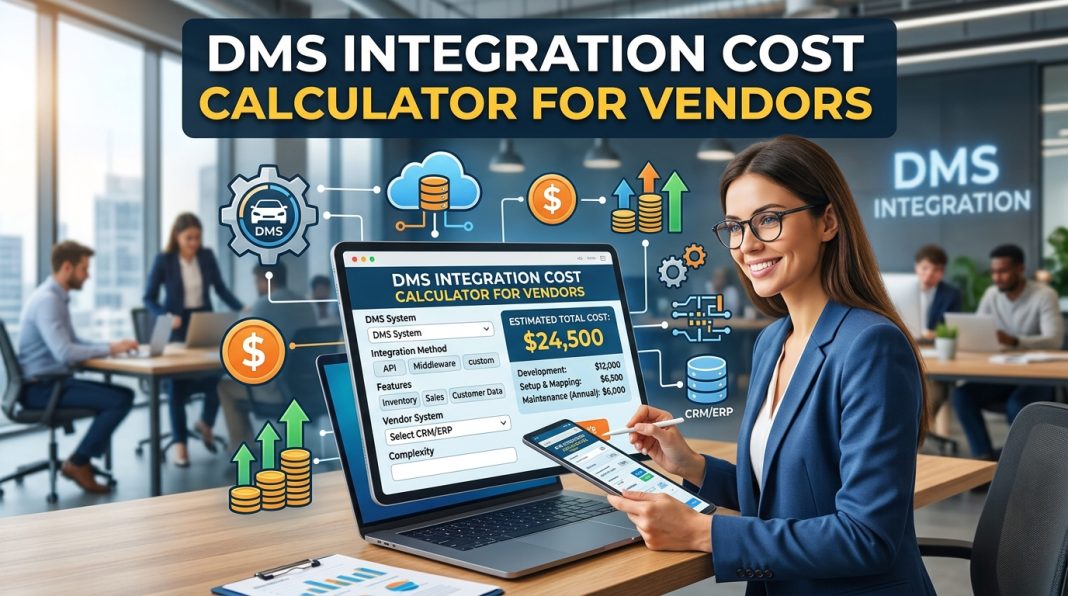
The Interactive DMS Integration Cost Calculator Model
To establish realistic budget estimates, technology providers can use an interactive framework that contrasts in-house custom builds against managed syndication platforms. Evaluating your dealership network through these variable parameters illuminates hidden cost drains and pinpoints cash flow milestones:
A. Input Parameters (Your Baseline Data):
- Number of Active Rooftops / Dealership Accounts ($N$): The total number of dealer locations using your solution.
- Average Number of Different DMS Providers across Your Client Network ($D$): The number of different DMS systems represented across your client base (such as CDK, Reynolds, Dealertrack, Auto/Mate, DealerBuilt, and PBS).
- Internal Engineering Cost per Hour ($E$): Industry standard technical labor benchmarks generally sit between $85 and $125 per hour.
- Upfront Licensing and Certification Fees per DMS Provider ($C$): One-time or recurring annual developer network dues charged by major DMS vendors.
- Monthly Per-Store Integration or Access Fees ($M$): Monthly third-party API or portal connectivity fees.
- Monthly Maintenance and Feed Troubleshooting Hours per Store ($H$): Engineering hours spent monitoring scripts, managing credentials, and resolving data anomalies.
B. Calculation Formulas:
- In-House Annual Setup Cost = (D * Initial Build Hours * E) + (D * C) + (N * Store Setup Fee)
- In-House Annual Maintenance Cost = (N * H * 12 * E) + (N * M * 12) + Annual Compliance Overhead
- Total In-House 3-Year Cost = Setup Cost + (3 * Annual Maintenance Cost
- Managed Feed 3-Year Cost = Standard Flat Syndication Fee per Rooftop + Upfront Certification Charges
Applying this interactive cost model across a sample vendor portfolio of 150 dealerships across 6 primary DMS environments demonstrates why custom point-to-point connections drain resources. In-house custom builds often incur between $65,000 and $120,000 in upfront certification alone, alongside $60 to $150 per store monthly in gateway fees and 25 to 40 monthly engineering support hours, pushing the three-year total ownership cost past $340,000. In contrast, managed syndication converts unpredictable capital sinkholes into flat, transparent operating expenses.
How DealerVault Solves the Data Syndication Equation for Vendors
Authenticom created DealerVault to eliminate data barriers between retail automotive dealerships and the software solutions that empower them. Rather than building and supporting dozens of fractured APIs, technology vendors connect to DealerVault as a unified hub for comprehensive automotive data feeds.
- Centralized Access to Over 45 DMS Platforms: DealerVault interfaces with more than 48 individual DMS types, giving vendors immediate market reach without requiring custom drivers for every newly contracted dealership account.
- Automated Feed Setup and Vendor Dashboard: Through a specialized vendor portal, solution providers can monitor active feeds, inspect pending rooftop setups, review delivery settings, and verify field mapping from an intuitive interface.
- Tailored Delivery and Granular Filtering: Vendors only receive the exact datasets necessary to run their specific applications, whether marketing, inventory, CRM, or service scheduling. Dealerships retain transparent governance, which accelerates feed authorization and eliminates administrative friction.
- Zero Cost to Dealerships: Because DealerVault is completely free for car dealerships, vendors encounter zero client resistance when requesting data access. Dealerships can authorize data feeds without budgeting for third-party access charges.
Accelerating Vendor Growth Through Standardized Data Architecture
In modern automotive retail technology, engineering velocity separates market leaders from lagging providers. Directing top software talent toward writing DMS extraction scripts slows core product development and weakens competitive advantage. Standardizing feeds through a proven data syndication platform converts erratic integration expenses into a predictable operating cost.
By plugging your tech stack into an established data hub, automotive vendors accelerate time to market for newly acquired dealer accounts, minimize customer churn caused by broken connections, and safeguard customer data with enterprise grade security protocols.
About Authenticom
Authenticom is an established leader in automotive data management and syndication solutions, headquartered in La Crosse, Wisconsin. Founded in 2002 by Stephen Cottrell, the company serves as a vital data connectivity powerhouse behind thousands of automotive software applications and retail dealership networks across North America. Through its flagship platform DealerVault, Authenticom powers secure, transparent, and compliant data exchange for over 12,000 automotive dealerships and more than 2,000 vendor partner applications. Authenticom simplifies the retail automotive ecosystem through comprehensive Data Experience Management (DXM) solutions that unify data connectivity, hygiene, governance, and real-time operational performance.