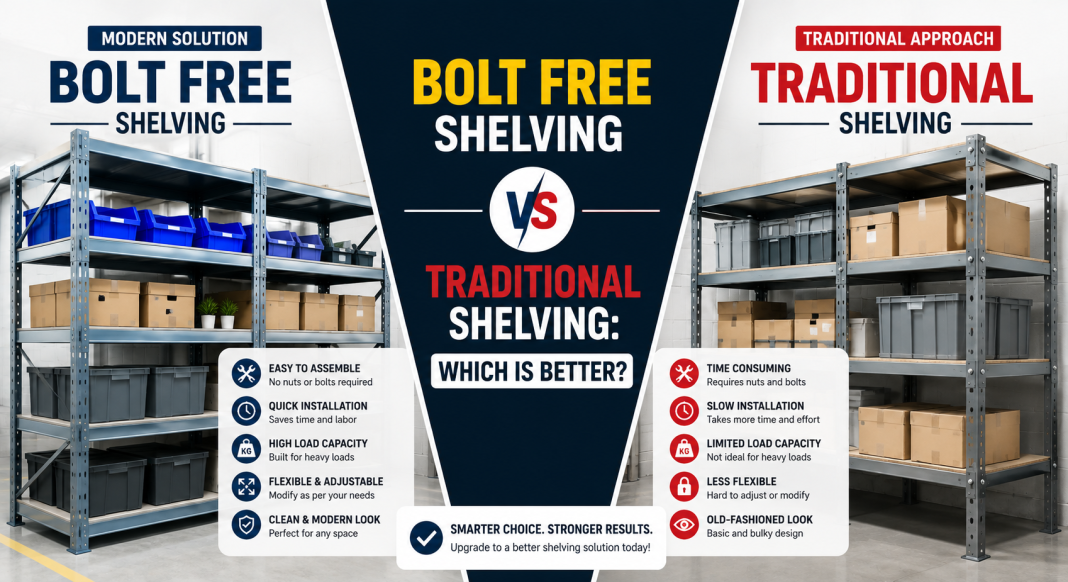

Choosing the right shelving system is an important decision for warehouses, workshops, offices, retail spaces, and storage areas. The shelving you select can affect storage capacity, installation time, accessibility, durability, and long-term costs. Two common options are bolt free shelving and traditional shelving.
While both systems are designed to provide organized and efficient storage, they differ significantly in their construction, installation, flexibility, and maintenance requirements. Understanding these differences can help businesses and homeowners choose a shelving solution that best suits their needs.
NOTE :- Bolt free shelving had offered a convenient way to maximize available storage space without complicated installation. Its adaptable structure had supported different storage requirements while maintaining a neat setup. Organizations had improved their storage efficiency with the right solution. Get in touch with Stormat Systems & Solutions LLC for professional shelving solutions.
What Is Bolt Free Shelving?
Bolt free shelving is a modular storage system designed without traditional nuts, bolts, or complicated fasteners. Instead, its components typically connect using a slot-in, clip-in, or interlocking mechanism. This design allows shelves to be assembled quickly with minimal tools.
One of the biggest advantages of bolt free shelving is its simplicity. Users can generally adjust shelf heights and reconfigure the unit according to changing storage requirements. This makes it particularly useful for warehouses, stockrooms, garages, workshops, and other environments where flexibility is important.
Bolt free systems are also available in different sizes, load capacities, and materials, allowing users to select a configuration based on the type and quantity of items they need to store.
What Is Traditional Shelving?
Traditional shelving usually relies on bolts, screws, nuts, brackets, or other mechanical fasteners to connect its components. These systems have been widely used for decades and remain a popular choice for industrial, commercial, and domestic storage.
Traditional shelving can be highly durable and stable when correctly assembled. Many heavy-duty systems are specifically engineered to support substantial loads and withstand demanding working conditions.
However, installing traditional shelving can require more time and tools compared with bolt free alternatives. Adjusting or dismantling the system may also take longer because individual components often need to be loosened or removed.
Installation and Assembly
Installation is one of the clearest differences between the two shelving types. Bolt free shelving is designed for quick assembly. Components can often be connected by fitting supports into designated slots, reducing the need for extensive tools or specialist assistance.
Traditional shelving generally involves more assembly work. Bolts and screws need to be aligned and tightened correctly, which can make installation more time-consuming. For larger storage projects, this may increase labor costs.
For businesses that need storage installed quickly or frequently reconfigured, bolt free shelving can therefore provide a practical advantage.
Flexibility and Adjustability
Modern storage requirements can change frequently. Bolt free shelving performs particularly well in this area because shelf levels can usually be adjusted without completely dismantling the unit.
This flexibility makes it suitable for storing products of different sizes. A warehouse, for example, may need to accommodate boxes, equipment, containers, and inventory with varying dimensions.
Traditional shelving can also offer adjustable shelves, but changing the configuration may require more effort depending on the design. For permanent storage arrangements, however, this may not be a major disadvantage.
Strength and Load Capacity
Strength is an important consideration when choosing shelving. Traditional heavy-duty shelving has a long history of use in industrial environments and can provide excellent load-bearing performance when properly designed and installed.
Bolt free shelving can also provide impressive strength, particularly when manufactured from quality steel and designed for industrial use. However, load capacity varies considerably between models.
The best choice should therefore be based on the manufacturer’s specified load rating rather than simply assuming one system is stronger than the other. Users should consider both the weight of individual items and the total load placed on each shelf.
Maintenance and Durability
Both shelving systems can provide years of service when properly maintained. Bolt free shelving has fewer conventional fasteners, which can simplify assembly and reduce the need to repeatedly tighten bolts.
Traditional shelving may require periodic inspection of nuts, bolts, brackets, and connections, particularly in busy warehouses where vibration or frequent movement could affect components.
Regardless of the system selected, regular inspections are important. Damaged shelves, overloaded levels, bent components, or unstable frames should be addressed promptly to maintain safe storage conditions.
Cost Considerations
Price is another factor when comparing shelving solutions. The initial purchase price depends on the size, material, load capacity, number of shelves, and manufacturer.
Bolt free shelving may offer savings in installation because it can often be assembled quickly with fewer tools and less labor. Its modular nature can also make future modifications easier.
Traditional shelving may involve higher installation costs in some situations, but it can be a worthwhile investment when a highly robust and permanent storage solution is required.
Therefore, businesses should consider the total cost of ownership rather than focusing only on the initial purchase price.
Which Shelving System Is Better?
There is no universal answer because the better option depends on the intended application. Bolt free shelving is generally better for users who prioritize quick installation, flexibility, easy adjustment, and modular storage. It is particularly useful when storage requirements are likely to change.
Traditional shelving can be better for applications requiring a more permanent setup or specialized heavy-duty construction. It is a proven option for warehouses, industrial facilities, workshops, and other environments where robust storage is a priority.
The key is to evaluate load requirements, available space, frequency of reconfiguration, installation resources, and budget before making a decision.
Final Thoughts
Both bolt free shelving and traditional shelving can provide effective and reliable storage. Bolt free systems stand out for their fast assembly, flexibility, and convenient reconfiguration, while traditional shelving offers established construction methods and a wide range of heavy-duty applications.
For flexible and frequently changing storage needs, bolt free shelving can be an excellent choice. For permanent installations and demanding industrial environments, traditional shelving may be more appropriate.
Ultimately, the best shelving system is the one that balances strength, flexibility, safety, installation requirements, and long-term value for the specific storage environment.
For More Insightful Articles Related To This Topic, Feel Free To Visit: https://dailybusinesspost.com/