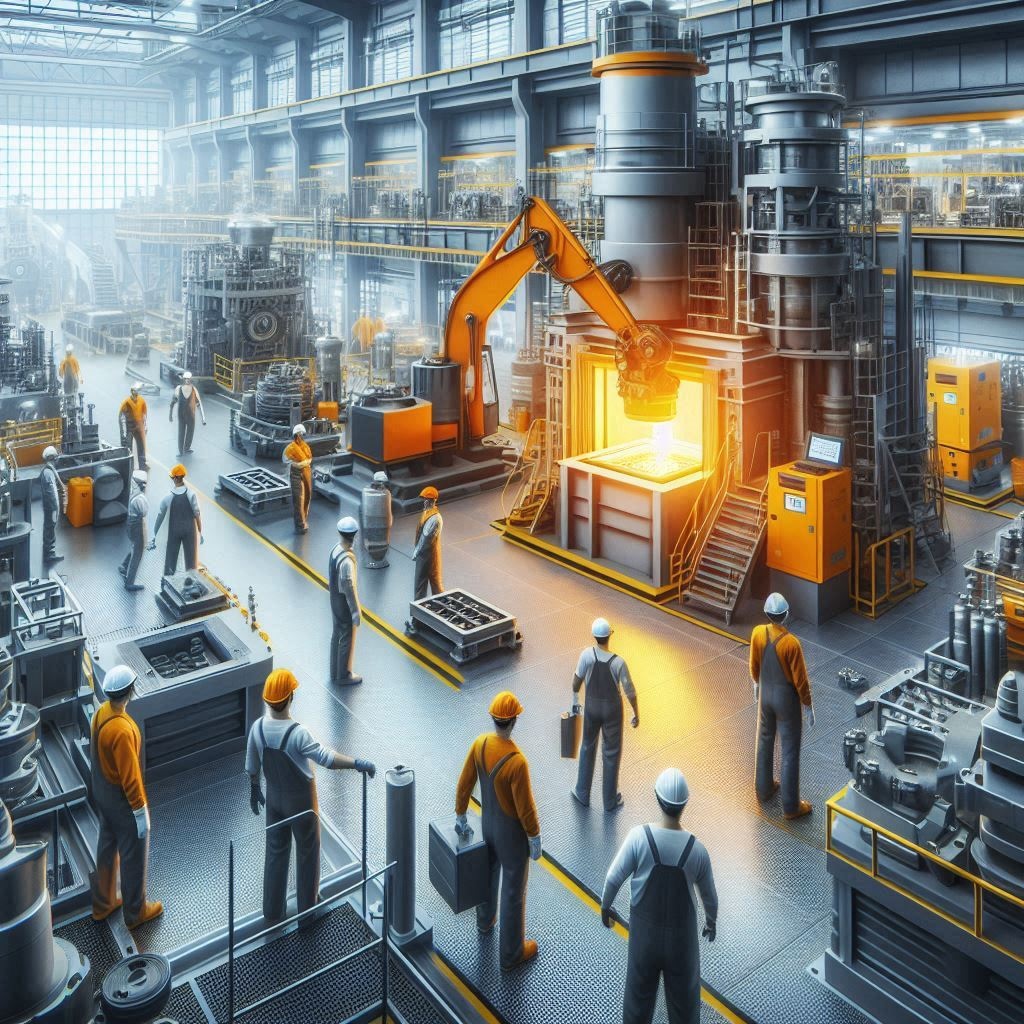

Investment casting foundries are facilities that produce high-precision metal parts using the process of lost wax casting. This technology, which has found formal use for centuries, has several contemporary applications that produce metal parts with unprecedented dimensional accuracy, superior surface finish, and complex shapes, vaporizing the metal parts conventional limit, and exceeds most industries such as aerospace, automotive, oil and gas, energy, and industrial machinery.
Understanding the Investment Casting Process
Investment casting starts with a wax pattern of the part. The part is coated with a ceramic shell to give it a Mold. Then, the wax is melted away, and filled with molten metal, which is allowed to solidify. After the Mold is removed, the final product is revealed. Investment casting allows thin walls, complex shapes, and detailed designs that are hard or impossible to achieve using other casting methods.
Why Investment Casting Foundries are in Demand
Today’s investment casting foundries blend old-school craftsmanship with new-age tools to make precision-engineered components for a variety of industries. Investment casting foundries provide advanced melting, molding, and finishing systems, and can also work with a numerous amounts of alloys, including stainless steel, carbon steel, aluminum, and superalloys. In manufacturing every part, the foundries will use a significant amount of quality control processes that cover everything from internally to non-destructive processes, such as X-rays, ultrasonics, and coordinate measuring machines (CMMs) – to ensure and follow strict standards. The foundry promotes multiple layers of engineering support for their customers, including design review, tooling, and materials, to enhance performance and lower costs. Their flexibility in manufacturing will satisfy customer requests for fully defined custom prototypes or 100,000 piece runs.
Applications Across Industries
Investment casting foundries are an essential provider to industries such as aerospace, automotive, oil & gas, and industrial equipment manufacturing by producing precise components. In aerospace, for example, they manufacture turbine blades, structural parts, and engine components. In automotive, they provide engine manifolds, gearbox housings, and suspension parts. For the oil & gas category, they supply valve bodies, pump impellers, and drilling equipment. In the industrial sector they supply, machine tool parts, conveyor components, gears, etc. These parts are preferred for their lightweight but strong designs, extreme corrosion resistance, and amazing dimensional tolerances. They are essential components for high-performance applications.
Key Benefits of Investment Casting
Investment castings have a lot of key advantages which is why this is such an attractive manufacturing process for complex components that require high tolerances. There are many benefits associated with the design flexibility of investment casting, which allows for complex geometries with very little assembly. In addition, investment casting can use a variety of materials, particularly both ferrous and non-ferrous metals. The process provides very good surface finish, which can limit or eliminate secondary machining operations. Investment castings have very good accuracy, and are often preferred for applications that want tight tolerances. Finally, in terms of value, investment casting is cost-effective because it creates minimal waste and has a better machining cycle time, thus providing the least amount of windage in a production process.
Choosing the Right Foundry
When selecting an Investment casting foundries, businesses should look at supplier industry experience, employee certifications (ISO or AS9100), technical capabilities, and international shipping capabilities. A worthy foundry does not simply manufacture parts; it acts as an engineering partner to the customer, assisting the customer to develop a better design, better performance, and lower costs.
Investment casting foundries are an important part of rapidly providing precision-engineered components to industries around the world. Their ability to marry technology and craftsmanship serves their role well. As the demand for stronger, lighter, more complex metal parts increases, foundries of investment casting will continue to be a bedrock of contemporary manufacturing.



