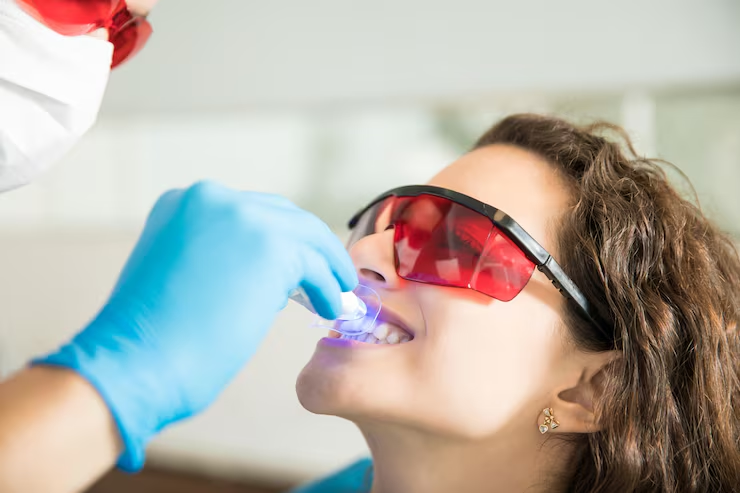
Teeth whitening is one of the most popular cosmetic dental treatments — and one of the most variable in terms of results. Some patients achieve the significant, lasting improvement they were looking for. Others end up with modest changes, unexpected sensitivity, or results that fade faster than expected. The difference almost always comes down to a handful of factors that are worth understanding before starting treatment.
1. A Professional Assessment Before Treatment Begins
The patients most satisfied with whitening results are almost always those who started with a professional evaluation of their specific discolouration. Understanding whether staining is extrinsic or intrinsic, whether existing restorations are present on visible teeth, and whether the enamel is in good enough condition for treatment determines which approach will produce the best result.
Skipping assessment and selecting a product based on advertising is the single most common source of whitening disappointment — and the most avoidable one.
2. The Right Concentration for the Goal
Higher concentration whitening agents produce faster, more pronounced results — but they require professional supervision and appropriate tissue protection. Lower concentrations used in over-the-counter products are safer for unsupervised use but produce more modest and gradual improvement.
Matching the concentration to the treatment goal — significant one-appointment improvement versus gradual controlled brightening — is a decision that professional guidance makes correctly where self-selection frequently doesn’t.
3. Custom-Fitted Delivery for Even Results
Generic whitening strips and trays can’t conform precisely to the unique shape of any individual’s teeth. This produces uneven gel contact — some surfaces well-covered, others barely touched — and uneven results. The gum contact that occurs with ill-fitting trays also increases sensitivity and soft tissue irritation.
Custom trays fabricated from a dental impression ensure consistent, even coverage across every tooth surface and minimise gel contact with the gums. This is one of the most consistent differentiators between professional and over-the-counter results.
4. Sensitivity Management as Part of the Protocol
Tooth sensitivity during and after whitening is the most common reason patients stop treatment early or avoid it entirely. Professional whitening protocols include desensitising steps that significantly reduce this experience — pre-treatment desensitisers, appropriate gel concentration selection for sensitive patients, and post-treatment remineralisation.
Patients who have had difficult experiences with sensitivity from previous self-administered whitening products often find that professionally managed treatment is far more comfortable than they expected.
5. Realistic Expectations Set Before Treatment
Patients who understand what whitening can and can’t achieve before they begin are consistently more satisfied with results than those whose expectations were shaped by marketing imagery. Teeth whitening produces natural-looking improvement — not the unnaturally uniform appearance of heavily filtered images.
The degree of improvement varies by individual — enamel thickness, baseline colour, and staining type all affect the ceiling. A professional consultation sets expectations that are accurate for the specific patient rather than based on idealised before-and-after photography.
6. A Maintenance Plan Built In From the Start
Whitening results are not permanent. Without a plan for maintenance, results that were satisfying at the end of treatment will have faded significantly within a year or two. With a simple maintenance protocol — periodic use of custom take-home trays with maintenance gel — results remain stable for years with minimal effort.
For patients in Colorado Springs, teeth whitening services in Colorado Springs, CO at Robison Dental include all six of these elements — from the initial assessment through to personalised maintenance guidance — ensuring results that genuinely meet each patient’s expectations and last.
FAQs
Q: How long does an in-office whitening appointment typically take?
Most in-office whitening treatments take forty-five minutes to one hour in the dental chair. Add check-in, preparation, and any pre-treatment steps, and a full appointment typically runs ninety minutes.
Q: Can I whiten teeth that have had root canals?
Teeth that have had root canals sometimes darken from the inside — a different mechanism than surface staining. External bleaching has limited effect on this type of discolouration. Internal bleaching — a specialist procedure performed through the tooth’s access opening — is more effective for this presentation.
Q: Does whitening work faster on some people than others?
Yes. Enamel porosity, baseline colour, and staining type all affect how quickly and dramatically bleaching produces results. Patients with thinner enamel or predominantly extrinsic staining typically see faster results than those with thick enamel or intrinsic discolouration.