
Introduction:
The Guided Bomb Market is witnessing rapid expansion as militaries worldwide prioritize precision strike capabilities to enhance combat effectiveness while minimizing collateral damage. Guided bombs — also known as smart bombs — are munitions equipped with advanced guidance systems such as GPS, laser, or inertial navigation, allowing for pinpoint targeting of enemy assets. These weapons have become vital tools in both strategic deterrence and tactical operations across air, naval, and ground platforms.
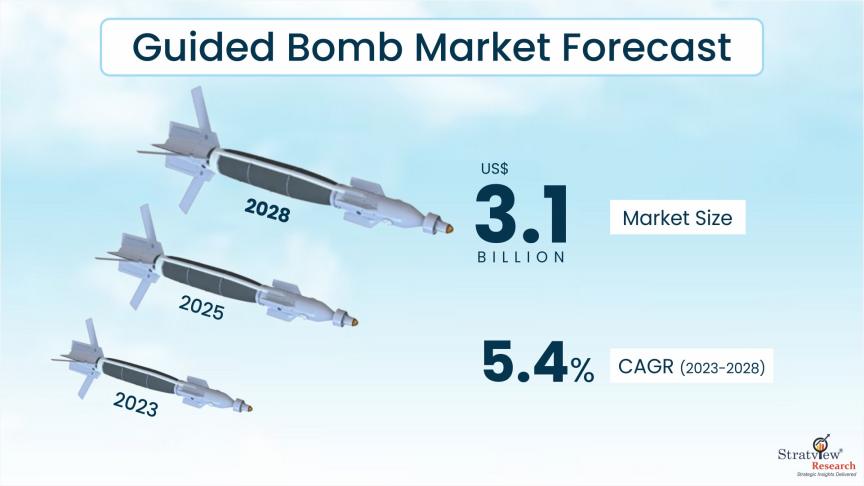
The guided bomb market is projected to grow at a promising CAGR of 5.4% during the forecast period 2023–2028, reaching a value of US$ 3.1 billion by 2028.
To get detail information about the market report, Register Here: https://www.stratviewresearch.com/Request-Sample/3775/guided-bomb-market.html#form
Key Players
There is intense competition in the global guided bomb market, with the top six companies holding nearly 60% of the overall market share. There are several numbers of players in the global market, engaged in the production of guided bombs and precision guidance kits. The competitive scenario is directly dependent on the industry conditions and overall investments in the development of guided bombs. Moreover, the defense industry has witnessed a few mergers and acquisitions in recent years, which has largely affected the market landscape. For example, in April 2020, Raytheon Company and United Technologies Corporation merged their businesses and operations to form Raytheon Technologies Corporation.
The following are the key players in the guided bomb market (arranged alphabetically).
- Boeing
- General Dynamics Corporation
- L3Harris Technologies, Inc.
- Lockheed Martin Corporation
- Raytheon Technologies Corporation
Market Drivers:
Key factors driving growth in the guided bomb market include:
- Shift toward precision warfare: Modern combat scenarios demand surgical strikes with minimal civilian impact, making guided bombs essential.
- Increasing defense budgets: Nations such as the U.S., China, India, and NATO allies are investing in advanced munitions to upgrade their arsenals.
- Rise in asymmetric and urban warfare: Conflicts in densely populated areas require high-precision targeting to avoid unintended casualties and infrastructure damage.
- Advancements in guidance systems: Integration of AI, real-time data linking, and multi-mode guidance is enhancing accuracy, range, and mission flexibility.
- Growing inventory of multirole fighter aircraft and UAVs: The expanding fleet of aircraft capable of deploying guided munitions is increasing demand for smart bombs.
Key Features of Guided Bombs:
- High accuracy: Precision strike capability significantly reduces the number of munitions needed per target.
- Flexible guidance systems: Options include GPS, laser, infrared, and inertial navigation for various battlefield conditions.
- Scalable warheads: Configurable for different mission profiles, from anti-structure to anti-personnel.
- Compatibility with multiple platforms: Deployable from manned and unmanned aircraft, ships, and ground launchers.
- Cost-effectiveness: Compared to cruise missiles, guided bombs offer precision at a lower unit cost.
Future Outlook:
The global guided bomb market is expected to grow steadily over the next decade, driven by geopolitical tensions, modernization programs, and export opportunities. The U.S. remains the market leader, while the Asia-Pacific and Middle East regions are emerging as major consumers due to ongoing military modernization efforts.
Future developments will focus on smart munitions with enhanced autonomy, electronic warfare resistance, and swarming capabilities — making guided bombs even more integral to next-generation military operations.