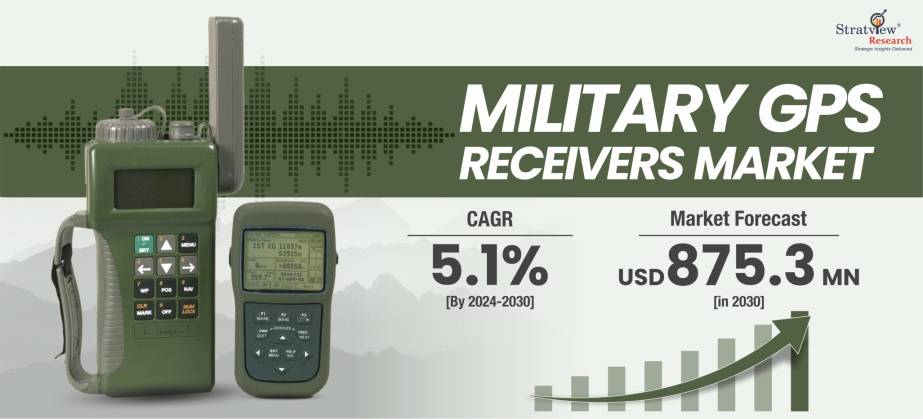

The Military GPS Receivers Market is undergoing steady expansion, propelled by the increasing need for secure, accurate, and jam-resistant navigation solutions across modern defense forces. In today’s digitized battlespace, GPS technology is critical not only for traditional navigation but also for weapons targeting, troop movement coordination, and situational awareness. As adversaries deploy advanced electronic warfare and spoofing technologies, demand is rising for hardened, next-generation military GPS receivers.
“The Military GPS Receivers Market is estimated to grow at an impressive CAGR of 5.1% during the forecast period to reach a value of US$ 875.3 million in 2030”.
To get free sample, Register Here: https://www.stratviewresearch.com/Request-Sample/2882/military-gps-receivers-market.html#form
Market Drivers:
Several key drivers are shaping the growth of the military GPS receivers market:
- Modernization of Armed Forces: Defense forces globally are upgrading their equipment with GPS-enabled systems to improve battlefield effectiveness.
- Rising Threat of GPS Jamming and Spoofing: Increased electronic threats have spurred demand for anti-jam and encrypted GPS receivers capable of operating in contested environments.
- Integration with Advanced Weapon Systems: GPS receivers are now integrated with guided munitions, UAVs, and precision-strike platforms, increasing their criticality.
- Global Defense Budget Increases: Higher spending, especially in the U.S., China, and India, is accelerating procurement of GPS-enabled defense assets.
Key Players
The market is highly concentrated with top companies capturing a lion’s market share. The growth of companies in this market is widely influenced by their financial position, technological expertise, and government support. Most of the players engage in the provision of both P(Y) Code and M-Code GPS receivers. Some of the companies also manufacture ASIC chips for their GPS receiver cards and some of them also supply them to their customers as well.
The following are the major players in the Military GPS Receivers Market (arranged alphabetically)
- BAE Systems
- General Dynamics Corporation
- Hertz Systems
- Israel Aerospace Industries
- Juniper Systems, Inc.
- L3Harris Technologies, Inc.
- Mayflower Communications
- RTX Corporation (Raytheon)
- Thales Group
- Trimble Inc.
Key Applications:
- Infantry and Ground Vehicles: GPS receivers are used in soldier systems, armored vehicles, and command posts for movement tracking and navigation.
- Airborne Platforms: Fighter jets, transport aircraft, and drones rely on military-grade GPS for positioning, targeting, and autonomous operations.
- Naval Vessels: Ships and submarines utilize GPS for precise positioning, navigation, and mission synchronization.
- Precision-Guided Munitions: Missiles, bombs, and artillery rounds use GPS receivers for enhanced accuracy and reduced collateral damage.
Recent Developments:
- In 2024, L3Harris Technologies delivered the first batch of its advanced M-Code GPS receivers to the U.S. Army, offering greater anti-jam capabilities.
- Raytheon Technologies received a contract extension to develop GPS-denied navigation systems integrated with AI for autonomous platforms.
- BAE Systems is testing compact, low-SWaP (Size, Weight, and Power) GPS modules for use in soldier-worn systems and small drones.
Future Outlook:
Future systems will likely feature multi-constellation support (including Galileo and GLONASS), AI-based signal integrity validation, and integration with inertial navigation systems (INS) for GPS-denied operations.
As the battlefield becomes more dependent on digital and autonomous systems, the role of resilient and secure GPS receivers will only grow, making them indispensable tools in the future of warfare.