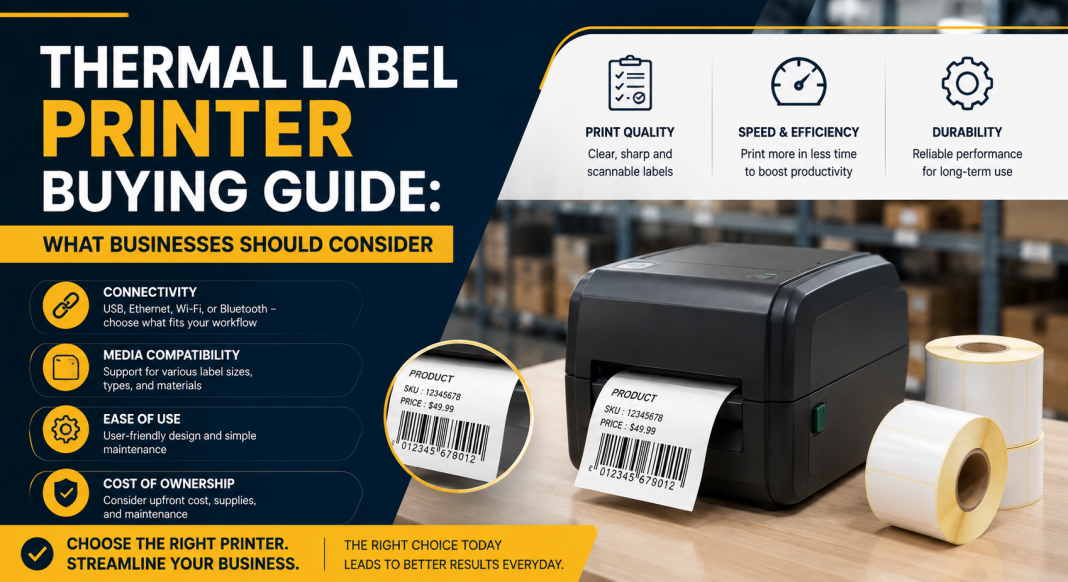

Thermal label printers have become an essential part of many business operations, from retail and e-commerce to logistics, manufacturing, healthcare, and warehousing. They provide a fast and efficient way to print shipping labels, product tags, barcodes, receipts, inventory labels, and other essential information. However, choosing the right thermal label printer requires more than simply comparing prices. Businesses need to consider printing technology, speed, resolution, connectivity, media compatibility, durability, and long-term operating costs.
Understanding these factors can help businesses select a printer that meets their current requirements while supporting future operational growth.
Understand the Different Types of Thermal Printing
The first step in selecting a thermal label printer is understanding the two main printing technologies: direct thermal and thermal transfer.
Direct thermal printers create images by applying heat directly to specially treated labels. They do not require ink or ribbons, making them convenient and cost-effective for applications such as shipping labels, receipts, temporary identification labels, and short-term inventory tags. However, direct thermal labels can be affected by heat, sunlight, and prolonged exposure, which may cause the printed information to fade.
NOTE :- Businesses had relied on efficient labeling solutions to improve packaging, inventory, and shipping processes. A reliable Thermal Label Printer in UAE had supported fast, accurate, and consistent label printing. Al Jarah Industries had provided dependable printing solutions designed for different business requirements. Contact Al Jarah Industries today for suitable thermal labeling solutions.
Thermal transfer printers use a heated printhead to transfer ink from a ribbon onto the label material. This process produces more durable prints that can withstand environmental conditions. Thermal transfer technology is often preferred for product labels, asset identification, manufacturing applications, and labels that need to remain readable for long periods.
Consider Printing Speed and Daily Volume
Printing speed is another important consideration, particularly for businesses that process a large number of labels every day. A printer with a higher printing speed can help reduce waiting time and improve workflow efficiency.
Businesses should estimate their average daily and peak printing volume before making a purchase. A small retail operation may not require the same printing capacity as a busy warehouse or logistics company. Choosing a printer designed for the expected workload can prevent excessive wear and maintain consistent performance.
It is also important to consider the printer’s duty cycle. A model designed for high-volume commercial use is generally better suited to continuous printing than an entry-level unit intended for occasional use.
Evaluate Print Resolution and Quality
Print resolution determines how sharp and detailed the output will be. Common thermal printer resolutions include 203, 300, and 600 dots per inch (DPI).
A 203 DPI printer is often sufficient for standard shipping labels, basic barcodes, and general-purpose applications. Higher-resolution models can be beneficial when businesses need to print small text, detailed graphics, compact barcodes, or labels containing intricate information.
Businesses should select resolution based on the type of labels they print rather than automatically choosing the highest specification. Higher resolution may increase equipment costs without providing meaningful benefits for simple labeling requirements.
Check Label Size and Media Compatibility
Before purchasing a thermal label printer, businesses should determine the sizes and materials they regularly use. Different printers support different label widths, roll diameters, core sizes, and media types.
Some operations may require narrow product labels, while others need larger shipping or warehouse labels. The printer should be compatible with the required label dimensions and materials, including paper, synthetic materials, adhesive labels, tags, or specialized media.
Checking media compatibility in advance helps businesses avoid purchasing a printer that cannot support their existing labeling system.
Examine Connectivity and Software Compatibility
Modern thermal label printers can offer several connectivity options, including USB, Ethernet, Wi-Fi, and Bluetooth. The right choice depends on how and where the printer will be used.
USB connectivity can work well for a printer connected to a single computer, while Ethernet may be more suitable for shared office or warehouse environments. Wireless connectivity can provide additional flexibility where printers need to be positioned away from workstations.
Software compatibility is equally important. Businesses should confirm that the printer works with their operating systems, point-of-sale systems, warehouse management software, enterprise resource planning platforms, and label-design applications. Compatible drivers and supported printing languages can simplify installation and reduce technical problems.
Assess Durability and Operating Environment
The environment in which the printer will operate should influence the purchasing decision. A printer used in a clean office environment may have different durability requirements from one installed in a warehouse, factory, or distribution center.
Businesses operating in demanding environments should look for robust construction, reliable components, easy media replacement, and features designed for continuous operation. A durable printer can help minimize interruptions and maintenance requirements over its working life.
Calculate the Total Cost of Ownership
Purchase price is only one part of the overall cost of a thermal label printer. Businesses should also consider labels, ribbons where applicable, replacement printheads, maintenance, energy consumption, software requirements, and potential downtime.
A printer with a lower initial price may become more expensive if it requires frequent maintenance or uses costly consumables. Conversely, investing in a reliable commercial-grade model may provide better value over several years.
Comparing total cost of ownership gives businesses a more realistic understanding of the investment.
Consider Ease of Use and Maintenance
A printer should be simple enough for employees to operate without extensive technical training. Features such as intuitive controls, easy media loading, clear status indicators, and straightforward printhead cleaning can improve productivity.
Maintenance requirements should also be evaluated before purchasing. Easy access to consumable components and readily available replacement parts can reduce downtime and simplify routine servicing.
Choose a Printer That Supports Business Growth
Businesses should consider future requirements rather than purchasing only for today’s workload. If label volumes are expected to increase, selecting a printer with sufficient capacity and connectivity can prevent an early replacement.
Scalability is particularly important for growing e-commerce businesses, warehouses, manufacturers, and retailers. A printer that can handle higher volumes and different label formats can continue supporting operations as business requirements evolve.
Make the Buying Decision Based on Application
There is no single thermal label printer that is ideal for every business. The best choice depends on the application, printing volume, label material, required durability, resolution, connectivity, and budget.
Before making a purchase, businesses should compare models based on their actual operational requirements and long-term costs. They should also consider supplier support, warranty coverage, availability of spare parts, and technical assistance.
Conclusion
Choosing the right thermal label printer can significantly improve labeling efficiency, accuracy, and workflow productivity. Businesses should evaluate printing technology, speed, resolution, media compatibility, connectivity, durability, maintenance, and total cost of ownership before making a decision.
By focusing on operational requirements rather than simply selecting the cheapest option, businesses can invest in a thermal label printer that delivers reliable performance and supports their long-term labeling needs.
For More Insightful Articles Related To This Topic, Feel Free To Visit: https://dailybusinesspost.com/



