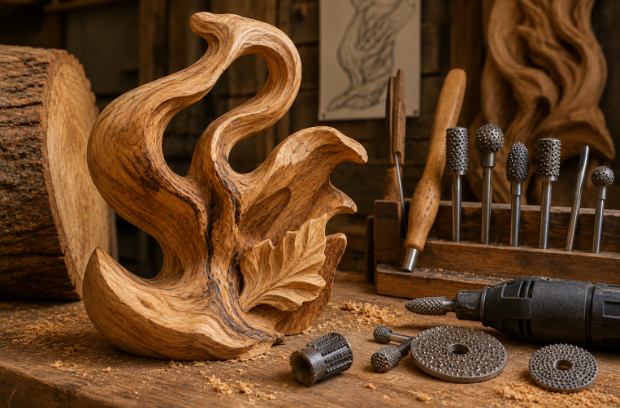

Wood has long been used as a sculptural material because it combines structural strength with natural grain, colour and texture. Unlike materials that begin as uniform blocks, timber carries characteristics shaped by the tree from which it came. Grain direction, density, knots, moisture and species can all influence how an artist approaches a piece. Organic wood carving takes advantage of these characteristics to develop flowing contours, irregular surfaces and forms that often appear inspired by nature. Modern power-carving techniques can complement traditional chisels, gouges and rasps, allowing artists to remove material efficiently while retaining control over the final shape.
What Is Organic Wood Carving?
Organic wood carving is a sculptural approach that emphasises natural-looking curves, flowing transitions and irregular forms rather than rigid geometric shapes. The finished work may resemble branches, waves, leaves, animals, human anatomy or abstract natural structures.
The approach is not limited to one carving method. An artist may begin with an axe or chainsaw for large-scale material removal, move to power-carving tools for shaping, and then use hand rasps, gouges or abrasives for refinement.
Kutzall describes sculptural power carving as a way to work directly with form, flow and texture, including abstract sculptures, figurative work, wall art, installations and mixed-media pieces.
Choosing the Right Wood
Wood species have a major effect on carving technique. The V&A explains that wood hardness is influenced by grain density. Softwoods such as cedar and pine are generally less dense and easier to carve, while hardwoods including oak, boxwood, walnut and limewood can provide greater durability and support detailed carving.
The choice therefore depends on the intended sculpture rather than simply selecting the hardest available timber.
Softwoods can be useful for larger forms because material can be removed relatively quickly. Hardwoods may be better suited to pieces where fine details, durability or a particular grain appearance are important.
Grain direction should also influence the carving process. Working across changing grain can produce different cutting behaviour, while knots and other irregularities can alter the resistance encountered by the tool.
Working With Natural Grain
One of the defining characteristics of wood sculpture is the ability to incorporate the material’s existing structure into the design. Instead of treating grain as something that must always be hidden, sculptors can use it to emphasise movement, direction and visual texture.
A curved grain pattern may reinforce the direction of an organic form, while knots can become intentional focal points. This approach is particularly effective for sculptures created from branches, trunks, reclaimed timber or live-edge pieces.
The V&A notes that the dimensions of a tree trunk can influence the size of a finished sculpture, although additional sections can also be joined when necessary.
From Rough Shaping to Fine Detail
Sculptural carving generally progresses through several levels of material removal. The initial stage establishes the overall silhouette and proportions. At this point, removing large amounts of material quickly can be more important than achieving a smooth surface.
The next stage develops curves, transitions and secondary forms. Once the main structure is established, finer tools can be used to create texture, edges and surface details.
Power carving is particularly useful during this progression because different tool profiles can perform different tasks. Kutzall’s sculptural collection includes shaping discs, dish wheels, contour wheels, hand rasps and burr kits designed for stages ranging from rapid material removal to surface refinement.
How Power Carving Expands Traditional Techniques
Power carving does not have to replace traditional hand carving. Instead, it can shorten the time required for repetitive material removal while leaving hand tools available for controlled refinement.
A rotary tool, flex shaft or angle grinder fitted with an appropriate carving attachment can remove material across larger surfaces than a small hand chisel. This can be particularly useful when working on large sculptures or deeply curved forms.
Kutzall describes its power-carving tools as functioning similarly to rotary chisels, allowing artists to combine the speed of power equipment with hand-guided sculptural control.
This combination can make it easier to move between broad shaping and detailed work without changing the overall artistic process.
Creating Curves, Hollows and Undercuts
Organic forms depend heavily on transitions between convex and concave surfaces. A sculpture may require rounded edges, recessed areas, deep hollows or gradual changes in surface depth.
Different tool profiles can help create these transitions. Dish wheels can be used for concave shaping, while contour wheels are suited to hollows and rounded recesses. Smaller burrs can then help establish details in areas that require more controlled material removal.
Undercuts require particular care because removing material beneath an overhanging form changes the structural strength of the remaining wood. Planning the thickness of delicate sections before making deep cuts can reduce the risk of accidental breakage.
Working With Green Wood
Freshly cut or unseasoned wood contains considerably more moisture than fully seasoned timber. This can make it easier to shape, but it also introduces challenges as the material dries.
The V&A notes that wood can crack when different parts dry at different rates. Sculptors therefore need to consider moisture movement when working with recently felled timber.
Experienced green-wood carvers often manage this process by controlling how quickly moisture leaves the workpiece. Canadian Woodworking recommends techniques such as sealing log ends and slowing moisture loss during the carving process to reduce cracking.
This is especially important for large sculptures because the centre of a substantial piece can retain moisture after the outer surface has begun drying.
Developing Texture and Surface Character
Surface texture can dramatically change how a wood sculpture looks and feels. Smoothly blended areas can emphasise the overall form, while deliberate grooves, ridges and patterned marks can draw attention to specific sections.
Power-carving tools with different coarseness levels can create different surface effects. Kutzall’s sculptural range includes fine, medium, coarse and very coarse options, allowing artists to move from aggressive shaping toward more controlled refinement.
Texture should support the form rather than simply cover the surface with marks. Repeating directional patterns can create visual rhythm, while selectively textured areas can provide contrast against smoother sections.
Safety and Dust Management
Power carving generates airborne wood dust, particularly when abrasive-style cutting surfaces are used. Canadian Woodworking notes that Kutzall-style carbide disks produce dust rather than large chips and therefore require appropriate ventilation.
A suitable dust-extraction system, respiratory protection appropriate to the material and good workshop ventilation are important considerations. Eye and hearing protection can also be necessary when operating powered carving equipment.
Tool speed should follow the manufacturer’s recommendations, and the workpiece should be securely positioned before material is removed. Maintaining control of the tool is particularly important when working around knots, changing grain directions and narrow sections.
Finishing an Organic Wood Sculpture
Finishing begins with evaluating the surface created during carving. Some artists preserve tool marks because they contribute to the character of the piece, while others progressively smooth the surface using abrasives.
The desired finish depends on the sculpture’s purpose. A highly polished surface can emphasise grain and curves, whereas a matte finish may preserve a more natural appearance.
Finishing products should be selected according to the wood species, intended environment and desired appearance. Outdoor sculptures, for example, require different protection considerations from indoor pieces.
Conclusion
Organic wood combines the natural characteristics of timber with sculptural techniques that emphasise curves, texture, movement and three-dimensional form. Wood species, grain direction and moisture content all influence the process, while modern power-carving tools can complement traditional axes, chisels, gouges and rasps.
For artists developing larger or more complex pieces, understanding how different tools remove material can make the transition from rough shaping to detailed refinement more controlled. Combining traditional craftsmanship with modern approaches to wood sculpting also creates greater freedom to explore natural forms, dimensional textures and expressive surfaces without losing the distinctive character of the wood itself.