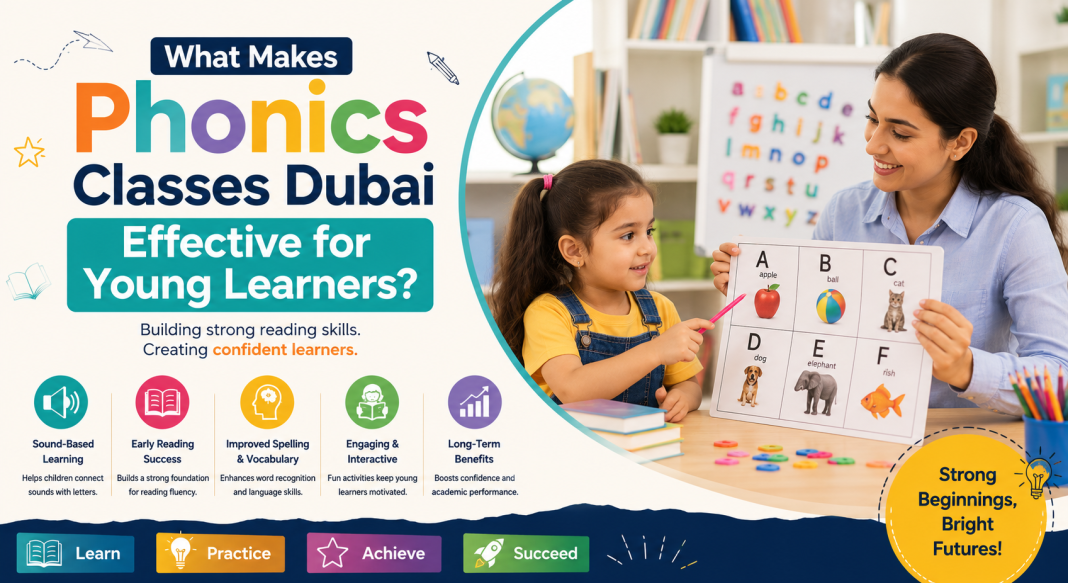

Learning to read is one of the most important milestones in a child’s early education. However, children learn at different speeds and respond differently to traditional teaching methods. Phonics-based learning offers a structured and engaging approach that helps young learners understand the connection between letters and sounds. Phonics Classes Dubai have become a valuable educational option for parents looking to strengthen their children’s early reading, spelling, and pronunciation skills.
By combining systematic instruction, interactive activities, repetition, and age-appropriate teaching techniques, phonics classes can create a strong foundation for lifelong literacy. Understanding what makes these classes effective can help parents choose the right learning environment for their children.
Building a Strong Foundation in Reading
Phonics teaches children how letters and groups of letters represent specific sounds. Instead of asking children to memorise entire words, phonics helps them understand the patterns behind written language. Once children recognise common letter-sound relationships, they can use this knowledge to decode unfamiliar words.
This approach is particularly useful for young learners because it develops reading skills gradually. Children typically begin with simple sounds before progressing to combinations, blends, digraphs, and more complex words. Such a structured progression allows learners to develop their abilities without feeling overwhelmed.
Making Learning Interactive and Engaging
Young children often learn more effectively when lessons involve movement, games, stories, pictures, and practical activities. Effective phonics classes therefore go beyond worksheets and repetitive exercises. Teachers may use flashcards, songs, rhymes, word-building activities, storytelling, and interactive reading exercises to make lessons enjoyable.
An engaging classroom environment can help children remain attentive and participate actively. When learning feels like an enjoyable activity rather than a difficult academic task, children are more likely to practise regularly and develop positive attitudes towards reading.
Developing Phonemic Awareness
One of the key elements of successful phonics instruction is phonemic awareness. This involves helping children recognise and manipulate the individual sounds within spoken words. For example, a child may learn that the word “cat” contains three separate sounds: /c/, /a/, and /t/.
Developing this awareness makes it easier for children to connect spoken language with written symbols. As their ability to identify sounds improves, they become better prepared to blend sounds together and decode words independently.
Supporting Better Pronunciation and Spelling
Phonics is not limited to reading. It can also support pronunciation and spelling development. By learning how sounds correspond to letters, children can begin to understand how unfamiliar words are constructed.
For example, when children learn common sound patterns, they can apply those patterns when attempting to spell new words. This reduces their dependence on memorisation and encourages them to think logically about language.
Phonics instruction can also help children develop clearer pronunciation by encouraging them to listen carefully to individual sounds and reproduce them accurately.
Providing Systematic and Age-Appropriate Learning
Effective phonics programmes follow a logical sequence. Children are introduced to sounds and concepts progressively, allowing them to build new skills on previously learned knowledge. This systematic approach is important because early literacy skills are closely connected.
Age-appropriate teaching is equally important. Younger children may benefit from short activities, visual resources, songs, and games, while older beginners may be ready for more advanced word-building and reading exercises. Adapting instruction to a child’s developmental stage can make learning more comfortable and productive.
Encouraging Confidence and Independence
One of the biggest advantages of phonics learning is that it can encourage children to become more independent readers. When a child learns how to decode a word without immediately asking an adult for help, they experience a sense of achievement.
Repeated success can gradually improve confidence. Children may become more willing to read aloud, attempt unfamiliar words, and participate in classroom activities. This confidence can positively influence other areas of their academic development as well.
Offering Individual Attention
Children do not all progress at the same rate. Some may quickly recognise sounds, while others may require additional practice with blending or pronunciation. Effective phonics classes recognise these differences and provide appropriate support.
Small-group or personalised instruction can allow teachers to identify areas where a child needs additional guidance. Regular feedback also helps parents and teachers understand the learner’s progress and determine which skills require further practice.
Creating a Positive Learning Environment
The learning environment plays an important role in a child’s educational experience. A supportive phonics classroom should encourage children to ask questions, make mistakes, practise sounds, and try again without fear of criticism.
Positive reinforcement can make a significant difference. Praising effort and improvement rather than focusing only on correct answers helps children develop a growth-oriented attitude. Over time, this can make reading practice less intimidating and more enjoyable.
Helping Children Prepare for Academic Success
Strong early literacy skills can support children across their school years. Reading ability affects how easily children understand instructions, complete assignments, learn new vocabulary, and access information from different subjects.
Phonics provides an important starting point by developing decoding, sound recognition, spelling, and pronunciation. Once these fundamental skills become stronger, children can gradually focus more on reading fluency, comprehension, vocabulary, and written communication.
Choosing the Right Phonics Classes Dubai
Parents should consider several factors when selecting a phonics programme. The teaching approach, instructor experience, class size, learning resources, lesson structure, and opportunities for individual practice can all influence effectiveness.
It is also important to look for classes that maintain a balance between structured learning and enjoyable activities. A good programme should challenge children while ensuring that lessons remain suitable for their age and ability.
Conclusion
Effective Phonics Classes Dubai combine systematic instruction with engaging activities, individual support, and consistent practice. By teaching children the relationship between letters and sounds, phonics can strengthen early reading, spelling, pronunciation, and word-decoding abilities.
More importantly, a well-designed phonics programme can help children feel confident about learning. When young learners experience regular progress in a supportive environment, they are more likely to develop a positive relationship with reading. With the right guidance and practice, phonics can become a valuable foundation for stronger literacy and long-term academic success.
For More Insightful Articles Related To This Topic, Feel Free To Visit: https://dailybusinesspost.com/