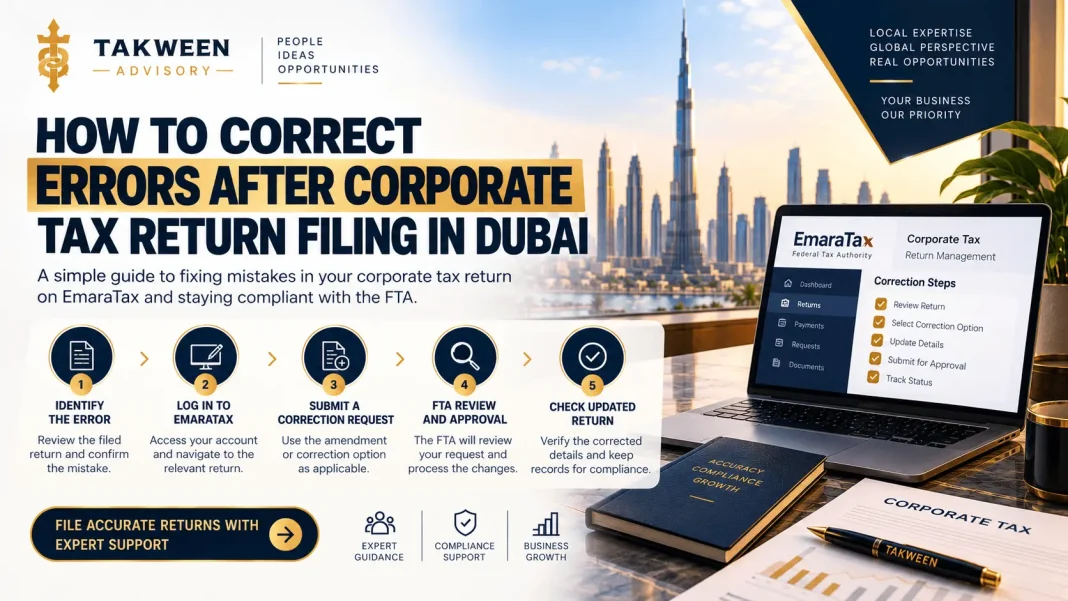

Making a mistake in a filed Corporate Tax return can happen to any business. You may discover an incorrect expense, missing income, an inaccurate tax calculation, or an error in the financial information submitted to the Federal Tax Authority (FTA). The important thing is to identify the mistake, understand its tax impact, and correct it using the appropriate procedure.
For businesses handling Corporate Tax Return Filing Dubai requirements, correcting an error promptly can help reduce compliance risks and avoid additional penalties where applicable. However, not every mistake requires the same correction method. Depending on the circumstances, a business may need to submit a Voluntary Disclosure, correct an eligible error through another Corporate Tax return, or follow the FTA’s prescribed procedure for errors that do not affect the tax payable.
This guide explains how to identify common errors, choose the appropriate correction method, submit the necessary information, and reduce the risk of similar mistakes in future tax periods.
Why Is It Important to Correct a Corporate Tax Return Error?
A Corporate Tax return reports a company’s financial information and calculates its taxable income and tax liability for a particular tax period. If the information submitted is incorrect, the company may have paid too little tax, paid too much tax, or reported inaccurate details without changing the tax amount due.
Leaving an error uncorrected can create problems during an FTA review or tax audit. Incorrect figures may also affect tax losses carried forward, deductible expenses, related-party transactions, or the company’s tax position in subsequent periods.
For example, a Dubai trading company might discover that it failed to include some business income in its original return. If the omission resulted in lower Corporate Tax being calculated than required, the company must assess its correction obligations under the applicable rules.
Similarly, a business might identify a classification error that does not change the amount of tax payable. This still requires attention because the correction procedure can depend on the type of error and the FTA’s applicable requirements.
The safest approach is to investigate the error as soon as it is identified rather than waiting until the next return or an FTA enquiry.
What Types of Errors Can Occur After Corporate Tax Return Filing?
Businesses should first identify exactly what went wrong. This helps determine how to correct the return and whether the mistake affected the company’s tax liability.
1. Incorrect Income or Revenue Reporting
A company may accidentally omit revenue, duplicate an income entry, or report an incorrect amount because of a bookkeeping or reconciliation error.
For instance, a consulting company may discover that an invoice was recorded in its accounting system but was not included correctly in the tax computation.
If the error affected taxable income, the company should recalculate its tax liability and determine the appropriate correction method. The adjustment should be supported by accounting records and relevant documents.
2. Incorrect Expense Deductions
Some businesses mistakenly claim expenses that are not deductible or report an incorrect amount of deductible expenditure.
The UAE Corporate Tax rules determine which expenses can be deducted when calculating taxable income. An accounting expense is not automatically deductible for tax purposes.
If an incorrect deduction reduced taxable income and the Corporate Tax payable, the company must review its obligations under the correction rules. Supporting documents, invoices, contracts, and accounting entries should be checked before submitting an adjustment.
3. Errors in Taxable Income Calculations
Taxable income may differ from accounting profit because certain adjustments are required under the Corporate Tax Law.
A business could make a mistake when calculating exempt income, non-deductible expenses, tax losses, or other tax adjustments. Incorrect treatment of related-party transactions or free zone income may also affect the final calculation.
These mistakes should be reviewed carefully because correcting one figure can affect other parts of the return.
4. Incorrect Company or Tax Return Information
Some errors concern company details, reporting fields, or other information included in the return rather than the calculation of taxable income.
Although these mistakes may not change the Corporate Tax payable, they should not automatically be ignored. Under the current Tax Procedures framework, errors that do not affect the tax due must be corrected through the method prescribed by the FTA for the relevant case.
How to Correct Errors After Filing a Corporate Tax Return in Dubai
The correction process begins with reviewing the original return and determining the tax impact of the mistake. The next step is to identify which procedure applies.
Step 1: Review the Filed Corporate Tax Return
Start by obtaining a copy of the submitted return and the financial records used to prepare it.
Compare the return against the company’s financial statements, general ledger, invoices, expense records, and tax calculations. Identify the incorrect figure, the correct figure, and the reason for the difference.
Avoid changing figures without supporting evidence. A documented review makes it easier to explain the correction and respond to any questions from the FTA.
Step 2: Calculate the Tax Impact
After identifying the error, recalculate the taxable income and Corporate Tax payable using the correct information.
Determine whether the mistake caused the company to pay less tax than required, pay more tax than required, or report incorrect information without changing the amount of tax due.
This distinction is important because the current rules treat these situations differently.
For example, an error that caused underpaid Corporate Tax may trigger a mandatory Voluntary Disclosure requirement. A mistake that did not change the tax payable may need to be corrected through a different route specified by the FTA.
Step 3: Determine Whether a Voluntary Disclosure Is Required
A Voluntary Disclosure is a formal notification to the FTA that certain information previously submitted was incorrect. It is commonly relevant when an error caused the Corporate Tax payable to be lower than the amount required under the law.
Under the UAE Tax Procedures framework, the applicable route depends on the amount of tax difference and the circumstances.
If the error caused the Corporate Tax payable to be understated by more than AED 10,000, the taxpayer is generally required to submit a Voluntary Disclosure within 20 business days from the date the error becomes known.
For an understatement of AED 10,000 or less, the rules generally allow the error to be corrected in an eligible Corporate Tax return, following the prescribed approach. If there is no return through which the error can be corrected, a Voluntary Disclosure is generally required within 20 business days of discovering the mistake.
The threshold relates to the tax difference, not the amount of revenue or expense involved. Where several errors affect the same tax period, their combined tax impact may need to be considered.
Because the UAE updated its Tax Procedures framework in 2026, businesses should confirm the rules and FTA process applicable to their circumstances before submitting a correction.
Step 4: Submit the Correction Through the Appropriate FTA Process
Once the correction method has been identified, the company should use the relevant procedure through the FTA’s EmaraTax platform.
If a Voluntary Disclosure is required, the taxpayer must provide the corrected information and the details requested through the applicable form. The explanation should clearly describe the original error and the adjustment being made.
If the error qualifies for correction through another Corporate Tax return, the business should follow the relevant return instructions instead of assuming that a separate Voluntary Disclosure is always necessary.
Keep a copy of the submission confirmation and supporting documents. A correction is not simply a change to the company’s internal accounting records; where an FTA filing is required, the appropriate official process must be completed.
Step 5: Pay Any Additional Corporate Tax Due
If the correction shows that the company owes additional Corporate Tax, arrange payment within the applicable deadline.
Submitting a Voluntary Disclosure does not automatically settle the additional tax liability. The company should check the amount due, the payment deadline, and whether any administrative penalties or other amounts apply.
If the return originally overstated the tax payable, the company should not automatically assume that a refund will be issued. The appropriate correction or refund procedure must be followed, and any refund remains subject to the applicable rules and FTA review.
What Happens If You Discover an Error of AED 10,000 or Less?
The UAE Corporate Tax correction rules provide a specific route for certain errors that resulted in the Corporate Tax payable being understated by AED 10,000 or less.
In eligible cases, the error can generally be adjusted through the Corporate Tax return for the earlier relevant period whose filing deadline has not yet arrived, or the return for the period in which the error was discovered, whichever is earlier, following the applicable requirements.
If no eligible return is available through which the error can be corrected, the taxpayer generally needs to submit a Voluntary Disclosure within 20 business days of becoming aware of the error.
This rule should not be interpreted as permission to ignore small mistakes. The company should document the calculation, confirm the aggregate tax impact, and check that the proposed correction is permitted.
Where the error does not affect the amount of tax payable, a separate assessment is necessary to determine whether the FTA requires a Voluntary Disclosure or allows correction through another return.
Can You Correct an Error After the Corporate Tax Return Deadline?
Yes, an error can come to light after the original Corporate Tax return deadline. However, the method and timing of correction depend on the circumstances.
If the company discovers that it underpaid Corporate Tax, it should determine whether a Voluntary Disclosure is required and act within the applicable time limit. It should not assume that the original return deadline gives it additional time after the error is discovered.
If the company finds that it overpaid tax or reported information incorrectly without changing the tax due, a different correction route may apply.
The original filing deadline, the date the mistake was discovered, the amount of tax difference, and whether an FTA audit or notification is involved can all be relevant.
If the company has received an audit notification, assessment, or formal communication from the FTA, it should obtain professional advice promptly. The compliance and penalty consequences may differ from those in a case where the company corrects the error before being notified of an audit.
Are There Penalties for Incorrect Corporate Tax Returns?
Administrative penalties may apply when a business submits an incorrect Corporate Tax return, fails to make a required correction, or does not pay additional tax within the applicable timeframe.
The consequences depend on the type of violation, the date it occurred, the tax difference, and the applicable penalty rules. The UAE has updated aspects of its tax procedures and administrative penalty framework in 2026, so businesses should not rely on outdated penalty figures without checking the current provisions.
Correcting a return voluntarily and promptly can be important, but it does not guarantee that all penalties will be waived. The relevant rules determine whether a penalty applies and how it is calculated.
Businesses should therefore avoid delaying a correction simply because they are still estimating its financial impact. They should establish the facts, calculate the difference, and obtain advice on the appropriate reporting and payment steps.
Documents to Keep When Correcting a Corporate Tax Return
A well-supported correction is easier to explain and defend. Companies should maintain the original filed return, the revised tax calculation, financial statements, relevant accounting entries, invoices, contracts, and other records that explain the error.
They should also retain a written explanation stating when the mistake was discovered, how it occurred, how the tax impact was calculated, and which correction procedure was followed.
Where the error involves related-party transactions, tax losses, exempt income, or free zone eligibility, keep the documents that support the treatment applied under the Corporate Tax rules.
These records can help demonstrate that the company reviewed the issue carefully and took steps to correct its tax position. They may also be useful if the FTA requests further information or conducts a tax audit.
How to Avoid Corporate Tax Return Errors in the Future
Preventing mistakes is usually easier than correcting them after filing. Businesses should reconcile their accounting records before preparing the tax return and review major adjustments against the relevant Corporate Tax rules.
A practical review process should include checking revenue completeness, confirming deductible expenses, reviewing exempt income and tax losses, verifying related-party disclosures, and comparing the final return against the company’s financial statements.
The company should also ensure that the person preparing the return has access to accurate financial information and that a suitable reviewer checks the completed return before submission.
Where the tax treatment of a transaction is unclear, seek advice before filing rather than relying on assumptions. Regular bookkeeping and periodic tax reviews can help identify potential issues while there is still time to investigate them.
How Takween Advisory Can Help
Correcting a filed Corporate Tax return requires more than changing an incorrect figure. Businesses need to understand the tax impact, identify the applicable correction procedure, prepare supporting records, and meet the relevant submission and payment requirements.
Takween Advisory supports businesses with company setup and business advisory services in Dubai and across the UAE. Businesses seeking support with Corporate Tax compliance should ensure they work with a qualified UAE tax professional who can review the original return, assess the error, and advise on the appropriate FTA procedure.
A structured review can help businesses address errors more confidently and improve their process for future Corporate Tax Return Filing Dubai requirements.
Frequently Asked Questions
1. Can I change a Corporate Tax return after submitting it?
Yes, errors can be corrected after submission. The appropriate process depends on the nature of the mistake, whether it affected Corporate Tax payable, the amount of the tax difference, and the FTA’s current requirements. A Voluntary Disclosure or an adjustment through an eligible return may be necessary.
2. How long do I have to submit a Voluntary Disclosure in Dubai?
Where an error caused Corporate Tax payable to be understated by more than AED 10,000, the general rule requires a Voluntary Disclosure within 20 business days from the date the taxpayer became aware of the error. For an understatement of AED 10,000 or less, a correction through an eligible return may be permitted; a Voluntary Disclosure is generally required within 20 business days if no eligible return is available. Confirm the applicable procedure before acting.
3. Do I need a Voluntary Disclosure if the error does not affect tax payable?
Not necessarily in every case. The current Tax Procedures framework requires errors with no difference in tax due to be corrected through the method prescribed by the FTA. Depending on the circumstances, this may involve a Voluntary Disclosure or another return-based correction.
4. Will I receive a penalty for correcting an incorrect return?
A penalty may apply, depending on the violation and the applicable rules. Prompt correction is important, but it does not automatically remove every potential penalty. The company’s circumstances and the current provisions should be reviewed.
5. Can I correct an error if the FTA has already contacted my company?
You should review the FTA communication carefully and obtain professional advice. If an audit or formal assessment is involved, the rules and potential penalties may differ from those applicable before an audit notification. Any required correction should be handled in accordance with the relevant procedure.
6. What should I do if I paid more Corporate Tax than required?
First, verify the original calculation and determine whether the error resulted in an overstatement of tax payable or an incorrect refund claim. Then follow the applicable correction or refund procedure through the FTA. A refund is not automatic and remains subject to the relevant rules.
Conclusion
Correcting an error after Corporate Tax return filing in Dubai requires a clear understanding of the mistake, its effect on tax payable, and the procedure prescribed by the FTA. Some errors require a Voluntary Disclosure, while qualifying understatements of AED 10,000 or less may be corrected through an eligible return.
Businesses should review their records promptly, document the tax impact, submit the correction through the appropriate channel, and settle any additional tax within the applicable timeframe. Careful preparation and regular reviews can also help prevent similar issues in future tax periods.



