

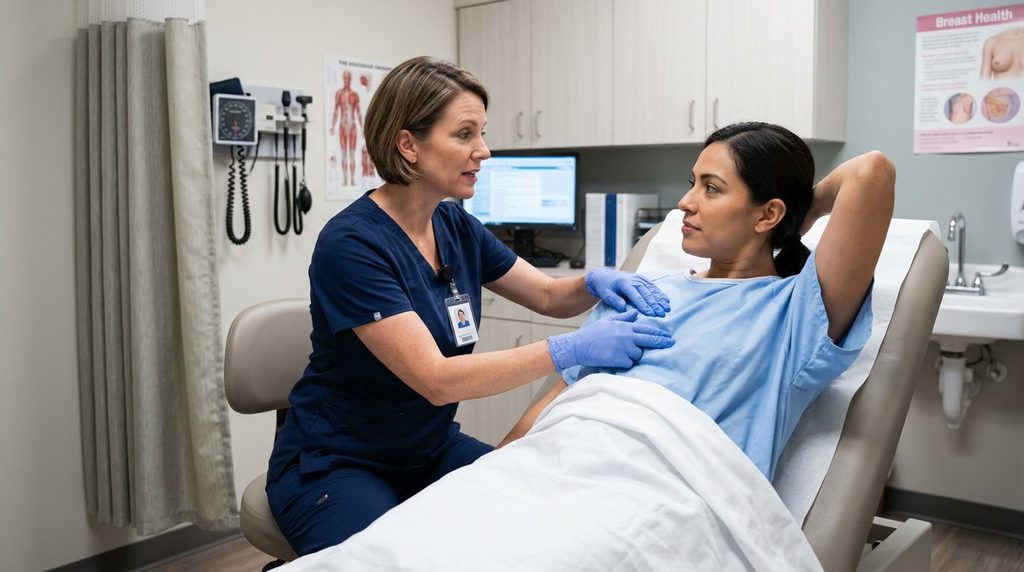
A clinical breast exam is a hands-on check of your breasts and underarms performed by a trained provider. It takes about five to ten minutes. Your breast exam doctor looks for visible changes, then feels the breast tissue and nearby lymph nodes for lumps or other differences. The exam is quick, it involves no needles or radiation, and it’s often done during a routine gynecology visit.
If you’ve never had one, or if you feel nervous about it, knowing what to expect helps. This guide walks through each step a breast exam doctor follows, explains what they’re checking for, and covers what happens if they find something that needs a closer look.
Why a clinical breast exam matters
Mammograms are the main screening tool for breast cancer, but they aren’t the only one. A clinical breast exam gives a trained breast exam doctor the chance to feel changes that may not show clearly on imaging. This is especially useful for women with dense breast tissue.
The exam also helps establish what’s normal for you. Breasts naturally contain lumpy areas, ridges, and glandular tissue. A breast exam doctor who checks you over time can tell the difference between your usual texture and something new.
For younger women who aren’t yet getting mammograms, the clinical breast exam is often the main way a provider checks breast health. It’s also a good time to ask your breast exam doctor questions and talk through any concerns.
Step 1: Talking about your history
The exam starts with a conversation. Your breast exam doctor will ask questions that help them understand your risk and focus the exam. Expect questions about:
- Any lumps, pain, nipple discharge, or skin changes you’ve noticed
- Your menstrual cycle, pregnancy history, and breastfeeding history
- Hormonal medications, such as birth control or hormone therapy
- Past breast biopsies, surgeries, or implants
- Breast, ovarian, or other cancers in your family
- The date and results of your last mammogram
Be as specific as you can. If you’ve felt a lump, tell your doctor where it is, how long you’ve noticed it, and whether it changes with your cycle. These details guide where your breast exam doctor spends the most time.
Step 2: Getting ready for the exam
You’ll undress from the waist up and wear a gown that opens in the front. Many offices offer a chaperone during the exam. You can request one at any time, and you can also ask to have a friend or family member present.
Your breast exam doctor should explain each step before starting. If anything feels uncomfortable, say so. The exam can pause whenever you need.
Step 3: Visual inspection
The first part of the physical exam is visual. You’ll usually sit upright on the exam table while your breast exam doctor looks at both breasts. They may ask you to change positions so that different areas become visible:
- Arms relaxed at your sides
- Arms raised over your head
- Hands pressed firmly on your hips, which tightens the chest muscles
- Leaning forward slightly, in some cases
During this step, your doctor looks for differences between the breasts in size, shape, or contour. They check the skin for dimpling, puckering, redness, swelling, or a texture like an orange peel. They also look at the nipples for inversion, scaling, rashes, or discharge.
Some differences between breasts are normal. Most women have one breast that’s slightly larger. What your breast exam doctor watches for is change, especially changes that show up when you move your arms or flex your chest.
Step 4: Checking the lymph nodes
Next, your doctor examines the lymph nodes that drain the breast. These sit in the armpit and above and below the collarbone. Breast cancer can spread to these nodes, so checking them is an important part of the exam.
While you’re seated, your breast exam doctor will support your arm and gently press into the armpit. They’ll also feel along the collarbone area. Swollen nodes are common and often come from minor infections, but nodes that feel hard, fixed, or enlarged deserve follow-up.
Step 5: Feeling the breast tissue
For the hands-on part, you’ll lie down on your back. Your doctor will ask you to raise one arm above your head. This spreads the breast tissue evenly across the chest wall so it’s easier to examine.
Your breast exam doctor uses the pads of the middle three fingers to press in small circles. They usually apply three levels of pressure at each spot:
- Light pressure to feel tissue just under the skin
- Medium pressure to feel the middle layer
- Deep pressure to feel tissue close to the ribs and chest wall
To make sure nothing is missed, most doctors follow a set pattern. The most common is a vertical strip pattern, moving up and down across the breast like mowing a lawn. The exam area runs from the collarbone down to the bra line, and from the middle of the armpit across to the breastbone. Breast tissue extends farther than many people think, so this full area matters.
The process is then repeated on the other side. Thorough exams take time. A careful breast exam doctor won’t rush this part.
Step 6: Examining the nipple and areola
Your doctor will gently check the area around the nipple for lumps or thickening. They’ll note any discharge, crusting, or changes in the skin.
Routine squeezing of the nipple is no longer standard practice. If you’ve noticed discharge on your own, tell your breast exam doctor. Discharge that’s bloody, clear, comes from one breast only, or appears without squeezing is more likely to need testing.
Step 7: Reviewing findings and next steps
Once you’re dressed, your breast exam doctor will explain what they found. In most cases, the exam is normal, and you’ll simply continue with routine screening.
Your doctor may also use this time to:
- Discuss when to start or continue screening mammograms
- Review your personal and family risk factors
- Talk about genetic counseling if your family history suggests it
- Explain how to stay aware of changes in your own breasts
This conversation is just as important as the exam itself. Ask any questions you have before you leave.
What if your breast exam doctor finds a lump?
Finding a lump can be frightening, but most breast lumps are not cancer. Common benign causes include fluid-filled cysts, fibroadenomas, and fibrocystic changes linked to your hormone cycle.
Still, any new lump needs a proper evaluation. Depending on your age and what the lump feels like, your breast exam doctor may order:
- A diagnostic mammogram, which takes more detailed images than a screening exam
- A breast ultrasound, which shows whether a lump is solid or filled with fluid
- A follow-up exam after your next period, for lumps that may be hormonal
- A biopsy, if imaging shows an area that needs testing
Your provider will explain each step and help you understand your results. Quick follow-up brings peace of mind, and if something serious is found, it allows treatment to begin early.
How often should you have a clinical breast exam?
Recommendations vary based on your age and risk. Many women in their 20s and 30s have a clinical breast exam every one to three years during a routine wellness visit. From age 40 on, many providers offer the exam once a year, often alongside a screening mammogram.
Women at higher risk may need more frequent exams and extra imaging. This includes women with a strong family history, a known genetic mutation, or a history of chest radiation. Your breast exam doctor will help you decide on a schedule that makes sense for your situation.
How to prepare for your visit
A little planning makes the visit more useful:
- Schedule the exam for the week after your period, when breasts are least tender.
- Wear a two-piece outfit so you only need to remove your top.
- Write down any changes you’ve noticed, with dates.
- Bring a list of your medications and family cancer history.
- Have your most recent mammogram results available, if you’ve had one.
Between visits, pay attention to how your breasts normally look and feel. Report any new lump, skin change, nipple change, or persistent pain to your breast exam doctor promptly. You don’t need to wait for your next annual exam.
Conclusion
A clinical breast exam is short, simple, and a useful part of routine breast care. Your breast exam doctor reviews your history, looks for visible changes, checks the lymph nodes, and carefully feels each breast for anything new. When an exam does find something, follow-up imaging usually provides answers quickly.
At Raleigh Gynecology and Wellness, PA, clinical breast exams are part of the routine wellness care we offer women in Raleigh and the surrounding area. Our providers take time to explain each step, answer your questions, and help you plan mammograms and any follow-up imaging you need. If you’ve noticed a breast change or you’re due for a wellness visit, schedule an appointment with our team. We’ll give you a thorough exam and clear guidance on what comes next.


