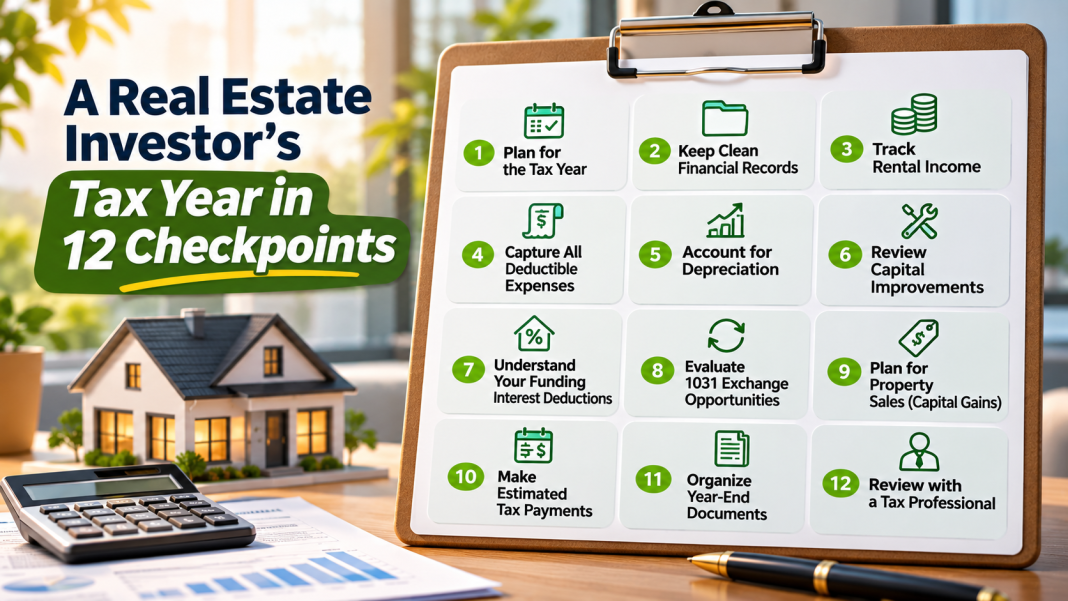

The 12 decisions that shape your tax bill, and when to make each one
Ask most investors when they do tax planning and you’ll hear two answers: “in December” and “right before my CPA’s deadline.” Both are too late for the decisions that matter most. By December, the year’s acquisitions, sales and renovations are mostly locked in. By April, you’re documenting decisions, not making them.
The investors who pay the least tax (legally) don’t work harder in those two months. They spread a dozen small decisions across the year. Here are the 12 checkpoints, what each one decides, and what to have ready when you sit down with your CPA.
Quarter 1: Close Out Last Year
Checkpoint 1: Capture your basis while it’s fresh (early January)
Every depreciation deduction and every future capital gain depends on your basis: what you paid, plus improvements, minus depreciation. The documents that prove it (closing statements, invoices for a new roof, a parking lot repave, unit renovations) are easiest to find in January and nearly impossible to reconstruct a decade later.
Decision: Which of last year’s expenses were repairs (deductible now) and which were improvements (depreciated over time)? Bring to your CPA: Closing statements for every purchase and sale, and a list of capital projects with invoices.
Checkpoint 2: Settle up with the IRS and your contractors (mid-to-late January)
Two deadlines land in January. The fourth-quarter estimated tax payment for the prior year is due January 15. And if your rental activity is a trade or business, Form 1099-NEC goes to contractors by January 31. For payments made in 2026 and later, the reporting threshold rose from $600 to $2,000 under the One Big Beautiful Bill Act, so fewer small vendors need a form.
Decision: Do you owe a catch-up estimated payment to avoid an underpayment penalty? Bring: Total payments per contractor and a W-9 for each.
Checkpoint 3: Decide on cost segregation for last year’s purchases (February)
If you bought a property last year and didn’t order a cost segregation study, February is your last comfortable window to get one done before filing. With 100% bonus depreciation now permanent for qualifying property acquired after January 19, 2025, the first-year deduction from reclassifying carpet, fixtures and site improvements can be substantial.
Already own buildings that never had a study? Ask about a look-back study, which can catch up missed depreciation through a change in accounting method without amending old returns.
Decision: Does the expected deduction justify the study fee, and can you actually use the losses this year?
Checkpoint 4: Get real about your K-1s (March)
Partnerships and S corporations owe K-1s by March 15, but many real estate partnerships and syndications extend to September. If you’re a passive investor in deals, the honest answer is that you probably won’t have every K-1 by April.
Decision: File your individual return once with all K-1s (on extension), or file early and risk amending?
Quarter 2: File, Then Look Ahead
Checkpoint 5: File or extend, and pay either way (April)
Your individual return is due in mid-April, along with the first-quarter estimated payment for the new year. An extension gives you until October to file, but not more time to pay. Estimate what you owe and pay it with the extension.
This is also when many local governments send new assessed values for the coming property tax year.
Decision: File now or extend? And does any new assessment look high enough to challenge?
Checkpoint 6: Use your property tax appeal window (April–June, by state)
Property tax is often an investor’s largest operating expense, and it’s the one most often left unchallenged. Appeal deadlines are short and vary by state and county. In Texas, for example, the protest deadline is generally May 15 or 30 days after the notice is mailed.
Decision: Which properties are assessed above what the market, rent roll or condition supports? Bring: Recent comparable sales, current rent rolls and repair estimates.
Checkpoint 7: Run a mid-year projection (June)
The second-quarter estimated payment is due mid-June, making it a natural point to look at the whole year. Add up income so far, deals you expect to close, properties you may sell and K-1 income you expect.
Decision: Is this shaping up to be a high-income year? The answer determines whether you should accelerate deductions into this year or push them into the next.
Quarter 3: Test Your Assumptions
Checkpoint 8: Check whether your losses are usable (July)
Depreciation can create large paper losses, but under the passive activity rules in IRS Publication 925, most rental losses only offset passive income. The special $25,000 allowance phases out between $100,000 and $150,000 of modified adjusted gross income.
If you’re counting on real estate professional status, check your hours now. You’ll need more than 750 hours and more than half of your working time in real property businesses, plus material participation in your rentals. Short-term rental owners relying on material participation should check their logs too.
Decision: Will your losses offset this year’s income, or will they be suspended? That changes whether a cost segregation study or a big acquisition makes sense before December.
Checkpoint 9: Plan any exit before you list (August)
If you’re thinking about selling, decide how before you list. Depreciation recapture can be a large part of the bill, and a 1031 exchange can defer it, but only if the structure is in place before closing: a qualified intermediary, a 45-day identification window and a 180-day closing deadline.
Decision: Sell outright, exchange, or hold another year?
Checkpoint 10: True up after the K-1s arrive (September)
The third-quarter estimated payment is due in mid-September, around the time most extended K-1s show up. Update your projection with real numbers.
Decision: Do you need to increase or reduce your remaining estimated payments?
Quarter 4: Act Before the Calendar Does
Checkpoint 11: Line up year-end moves (October–November)
The fourth quarter is when timing becomes money. A property must be placed in service by December 31 for this year’s depreciation, which means ready and available for use, not just under contract. Cost segregation firms, lenders and contractors fill their calendars fast.
This is also the time to review gains and losses across your portfolio and decide whether any sales should close this year or next.
Decision: Which acquisitions, renovations and sales need to close before December 31, and who do you need to book now to make that happen?
Checkpoint 12: Execute and document (December)
December is for finishing what you planned, not starting new strategies. Confirm closing and placed-in-service dates, pay deductible expenses that make sense to pay this year, and save every document for January’s Checkpoint 1.
If you want the specific dates behind each checkpoint, including state property tax and franchise tax deadlines for Texas, Real Estate Forum keeps a month-by-month tax calendar for investors.
The Habit Behind the Checkpoints
None of these checkpoints takes long on its own. What makes them work is consistency:
- Schedule them. Put all 12 on your calendar now, each with a one-week warning.
- Meet your CPA quarterly. Four short meetings are worth more than one long one in March.
- Keep entities and properties separate. Separate bank accounts turn Checkpoint 1 from a weekend project into an hour.
- Log hours as you go. A contemporaneous log is far stronger than a reconstruction in April.
- Build your team before you need them. The best tax outcomes come from investors who already know a CPA who works with real estate, a cost segregation firm that answers in October and a lender who closes on time.
Tax planning isn’t one event. It’s twelve small decisions, made on time. Make them on purpose, and the tax return becomes a record of a plan, not a scramble to explain one.
This article is for general information and is not tax advice. Consult a qualified CPA or tax attorney about your situation.