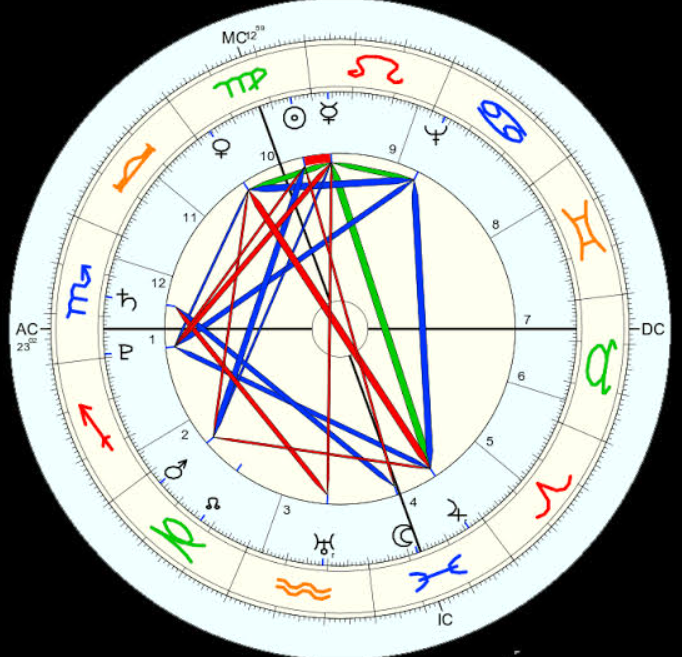

Astrology has fascinated people for generations. From simple zodiac horoscopes to detailed natal charts, many people use astrology to explore personality traits, emotional patterns, relationships, motivations, and different areas of life.
While knowing your Sun sign can be a fun introduction to astrology, a complete natal chart offers much more information. A birth chart calculator can help you generate a personalized astrology chart using your birth date, exact birth time, and birthplace.
Your resulting chart can show the positions of the Sun, Moon, planets, zodiac signs, houses, and major aspects at the time of your birth. Understanding these elements can help you learn how a natal chart is structured and how different astrological traditions interpret it.
This guide explains how a free astrology birth chart works, what information you need, how to understand the major placements, and how beginners can start exploring their natal chart.
What Is a Birth Chart?
A birth chart, also known as a natal chart, is a symbolic representation of the sky at the time and location of a person’s birth.
In Western astrology, a natal chart commonly includes the Sun, Moon, planets, twelve zodiac signs, twelve houses, and relationships between planets called aspects.
Unlike a basic horoscope that may focus on your Sun sign, a complete natal chart contains many different placements. These placements are interpreted together to create a broader astrological profile.
For example, two people can have the same Sun sign but different Moon signs or rising signs. Their planetary placements and houses can also vary because birth time and location influence certain parts of the chart.
How Does a Birth Chart Calculator Work?
A birth chart calculator uses your birth information to determine the astronomical positions used to construct your natal chart.
Most calculators ask for three essential details:
- Date of birth
- Time of birth
- Place of birth
Your date of birth helps determine the positions of the Sun and planets. Your birth time is particularly important for calculating the Ascendant and houses. Your birthplace provides geographical information used to calculate the local horizon and house positions.
After you enter the required information, the calculator generates your natal chart. Depending on the tool, you may see a circular chart wheel, a list of planetary placements, house positions, and aspect information.
What Information Do You Need?
Getting accurate results begins with accurate birth information.
Date of Birth
Enter your full date of birth, including the day, month, and year.
This establishes the date used for calculating the planetary positions in your chart.
Exact Birth Time
Your birth time is especially important for the Ascendant and houses.
If you have an official birth record showing your time of birth, use that information. An estimated time can affect certain parts of the chart.
Birthplace
Select the city or location where you were born.
The calculator uses geographical information about your birthplace to determine the local sky and house placements.
Why Is Birth Time Important?
Birth time can make a significant difference in a natal chart.
The Sun moves slowly through the zodiac, but the Ascendant changes considerably faster. The houses are also calculated according to the time and location of birth.
This means two people born on the same day could have different rising signs and house placements if they were born at different times.
If your birth time is unknown, you can still explore many planetary placements. However, your Ascendant and houses may not be accurate.
Understanding the Sun Sign
Your Sun sign is determined by the zodiac sign occupied by the Sun at the time of your birth.
The twelve traditional zodiac signs are:
- Aries
- Taurus
- Gemini
- Cancer
- Leo
- Virgo
- Libra
- Scorpio
- Sagittarius
- Capricorn
- Aquarius
- Pisces
In traditional astrology, the Sun is associated with identity, self-expression, vitality, confidence, and individuality.
Although the Sun sign is one of the most familiar parts of astrology, it represents only one component of your complete natal chart.
Understanding the Moon Sign
The Moon is traditionally associated with emotions, instincts, habits, comfort, and inner experiences.
Your Moon sign can add another layer to your astrological profile. It may be interpreted as representing how you process feelings and respond to situations on an instinctive level.
Someone with the same Sun sign as you may have a different Moon sign, resulting in a different overall chart interpretation.
What Is the Rising Sign?
The rising sign, also called the Ascendant, is the zodiac sign that was rising over the eastern horizon at your birth.
Astrologers traditionally associate the Ascendant with first impressions, outward behavior, personal presentation, and the way you approach the world.
The rising sign depends heavily on your exact birth time and location. This is one of the main reasons a complete birth chart requires more information than a simple zodiac sign calculation.
The Personal Planets in Your Chart
After exploring the Sun, Moon, and Ascendant, you can examine the personal planets.
Mercury
Mercury is traditionally associated with communication, learning, reasoning, thinking, and information.
Astrologers may examine Mercury’s sign and house to explore symbolic themes related to communication and mental processes.
Venus
Venus is associated with love, attraction, relationships, beauty, pleasure, harmony, and personal values.
Its placement is often considered when discussing romantic preferences and approaches to relationships.
Mars
Mars represents energy, action, motivation, courage, ambition, and assertiveness in traditional astrology.
Its placement may be interpreted as showing how a person approaches challenges and takes initiative.
Jupiter and Saturn
The larger planets also have important traditional meanings.
Jupiter
Jupiter is associated with expansion, growth, optimism, exploration, learning, philosophy, and opportunity.
Its placement can be interpreted as an area where a person may seek growth or broader experiences.
Saturn
Saturn is traditionally connected with responsibility, discipline, structure, boundaries, patience, and long-term development.
Its placement may be interpreted as representing areas where commitment and persistence are emphasized.
The Outer Planets
A complete natal chart may also include Uranus, Neptune, and Pluto.
These planets move slowly through the zodiac. Because of their slow movement, many people born within the same period can share similar outer-planet sign placements.
For this reason, astrologers often associate them with broader generational themes. Their individual significance may become more noticeable when they form aspects with personal planets or important chart points.
What Are the Twelve Houses?
The natal chart is traditionally divided into twelve houses. Each house represents a different area of life.
First House: Self and Identity
The first house is associated with identity, appearance, self-expression, and personal approach.
Second House: Resources and Values
The second house relates to possessions, money, resources, security, and personal values.
Third House: Communication and Learning
The third house is traditionally associated with communication, education, siblings, short-distance travel, and everyday information.
Fourth House: Home and Family
The fourth house represents home, family, roots, private life, and personal foundations.
Fifth House: Creativity and Expression
The fifth house is associated with creativity, hobbies, romance, enjoyment, entertainment, and self-expression.
Sixth House: Work and Routine
The sixth house traditionally relates to daily routines, work habits, responsibilities, and everyday wellbeing.
Seventh House: Partnerships
The seventh house represents one-to-one relationships, partnerships, and commitments.
Eighth House: Transformation
The eighth house is associated with shared resources, intimacy, transformation, and deeper emotional themes.
Ninth House: Exploration and Beliefs
The ninth house relates to higher education, philosophy, travel, beliefs, and expanding one’s worldview.
Tenth House: Career and Reputation
The tenth house is traditionally associated with career, achievements, public reputation, leadership, and ambitions.
Eleventh House: Friends and Community
The eleventh house represents friendships, groups, communities, networks, and future aspirations.
Twelfth House: Reflection and Solitude
The twelfth house is associated with solitude, reflection, hidden matters, and the inner world.
The exact interpretation of houses can vary according to the astrological tradition and house system being used.
What Are Astrological Aspects?
Aspects describe angular relationships between planets and other points in a natal chart.
Some of the most common aspects include:
- Conjunction
- Sextile
- Square
- Trine
- Opposition
Astrologers traditionally interpret aspects as interactions between different planetary themes.
A harmonious aspect may be interpreted as an area of natural expression, while a challenging aspect may symbolize tension or a situation requiring greater awareness. However, interpretations depend on the entire chart rather than one aspect alone.
Exploring Chiron in Astrology
Once you become comfortable with the main planets, you may encounter additional astrological points and objects.
Chiron is a minor body that is included in some modern astrology systems. It is often associated with themes such as vulnerability, sensitivity, healing, and personal development.
If you want to explore chiron birth chart information, use a chart calculator that includes additional points rather than limiting its results to the traditional planets.
Chiron is best interpreted as one element of a complete natal chart rather than as a standalone explanation of personality or life experiences.
How to Calculate Your Free Astrology Chart
Creating a free astrology chart is usually straightforward.
Step 1: Gather Your Birth Information
Find your exact birth date, birth time, and birthplace.
Step 2: Enter Your Details
Enter your information into the birth chart calculator.
Make sure the date, time, and location are correct before generating the chart.
Step 3: Generate Your Natal Chart
Submit the information and allow the calculator to create your chart.
You may receive a circular chart wheel along with a table of planetary positions.
Step 4: Find Your Big Three
Start by identifying your:
- Sun sign
- Moon sign
- Rising sign
These are commonly known as the Big Three.
Step 5: Explore Your Planets
Next, look at Mercury, Venus, Mars, Jupiter, and Saturn.
Learn the traditional meaning of each planet and then consider its zodiac sign and house.
Step 6: Study Houses and Aspects
Once you understand the planets, explore the houses they occupy and the major aspects they form with other planets.
This creates a more complete understanding of how a natal chart is traditionally interpreted.
A Simple Way to Read Your Birth Chart
One easy framework for beginners is:
Planet = what
Zodiac sign = how
House = where
For example, Venus represents relationship and value themes. The sign containing Venus can describe how those themes are traditionally expressed, while the house can indicate the area of life where they are emphasized.
Aspects add another layer by showing how different planetary themes interact.
This framework makes a complicated chart easier to break down into manageable parts.
What If You Do Not Know Your Birth Time?
You can still explore astrology if your birth time is unknown.
Many planetary positions can be determined using your birth date and location. However, the Ascendant and houses are much more dependent on accurate timing.
If you need your birth time, check official documents or ask family members who may know the information.
Some astrology practitioners use techniques designed to estimate a birth time from significant life events. These methods are interpretive and should not be treated as equivalent to a documented birth time.
Birth Chart vs. Sun Sign
A Sun sign is only one placement in a natal chart.
A complete chart can include:
- Sun
- Moon
- Ascendant
- Mercury
- Venus
- Mars
- Jupiter
- Saturn
- Uranus
- Neptune
- Pluto
- Houses
- Aspects
- Additional points
This is why a natal chart can provide a much broader astrological profile than a basic zodiac horoscope.
Can a Birth Chart Explain Personality?
Traditional astrology interprets natal placements symbolically and connects them with personality traits, emotions, motivations, and life themes.
For example, the Sun may be associated with identity, the Moon with emotions, Mercury with communication, Venus with relationships, and Mars with action.
However, astrology has not been scientifically established as a reliable method for determining personality.
It is better to approach natal astrology as a symbolic or reflective practice rather than a scientifically proven personality test.
Can a Birth Chart Predict the Future?
Astrology is not scientifically established as a reliable method of predicting future events.
Some astrologers use natal charts alongside current planetary movements to create interpretations about possible themes or periods. These interpretations are not guaranteed predictions.
For important decisions involving health, finances, legal matters, or other high-stakes issues, rely on appropriate professional advice rather than astrology.
Frequently Asked Questions
What is a birth chart calculator?
A birth chart calculator is an online tool that uses your date, time, and place of birth to generate a natal astrology chart. It can display planetary positions, zodiac signs, houses, and aspects.
Can I calculate my astrology chart for free?
Yes. Many online tools offer free basic natal chart calculations. Some websites may charge for advanced reports or detailed interpretations.
What information do I need?
You typically need your birth date, exact birth time, and birthplace. Accurate information is particularly important for calculating the Ascendant and houses.
What are the Big Three?
The Big Three are the Sun sign, Moon sign, and rising sign. They are commonly used as an introductory framework for understanding a natal chart.
Can I calculate my chart without knowing my birth time?
Yes, but some results may be limited. Many planetary placements can still be calculated, while the Ascendant and houses may be uncertain.
Why does my birthplace matter?
Your birthplace provides geographical information needed to calculate the local horizon and house placements. It can therefore influence your Ascendant and houses.
How many houses are in astrology?
Traditional Western astrology divides the natal chart into twelve houses. Each house is associated with a different area of life.
What does Chiron represent in astrology?
Chiron is a minor body used in some modern astrological systems. It is commonly associated with themes involving vulnerability, healing, sensitivity, and personal growth.
Does my natal chart change?
Your natal chart itself does not change because it represents the planetary positions associated with your birth. Astrologers may compare it with later planetary movements, but this does not alter the original chart.
Is astrology scientifically proven?
Astrology is not scientifically established as a reliable method for predicting personality or future events. It is generally approached as a symbolic, cultural, or reflective practice.
What should I learn first?
Start with your Sun, Moon, and rising sign. Then learn the meanings of the personal planets before moving on to houses and aspects.
Final Thoughts
A birth chart calculator provides a simple way to create a personalized astrology birth chart using your date, time, and birthplace. It allows you to move beyond a basic zodiac sign and explore the many components that make up a natal chart.
For beginners, the best approach is to take your time. Start with the Big Three, learn about the personal planets, and then explore houses and aspects. As you become more familiar with the basics, you can investigate additional points such as Chiron and other advanced chart features.
Astrology is best viewed as a symbolic and reflective tradition rather than a scientifically proven system for predicting personality or future events. With that perspective, exploring a free natal chart can be an enjoyable way to learn about zodiac symbolism and the structure of astrology.