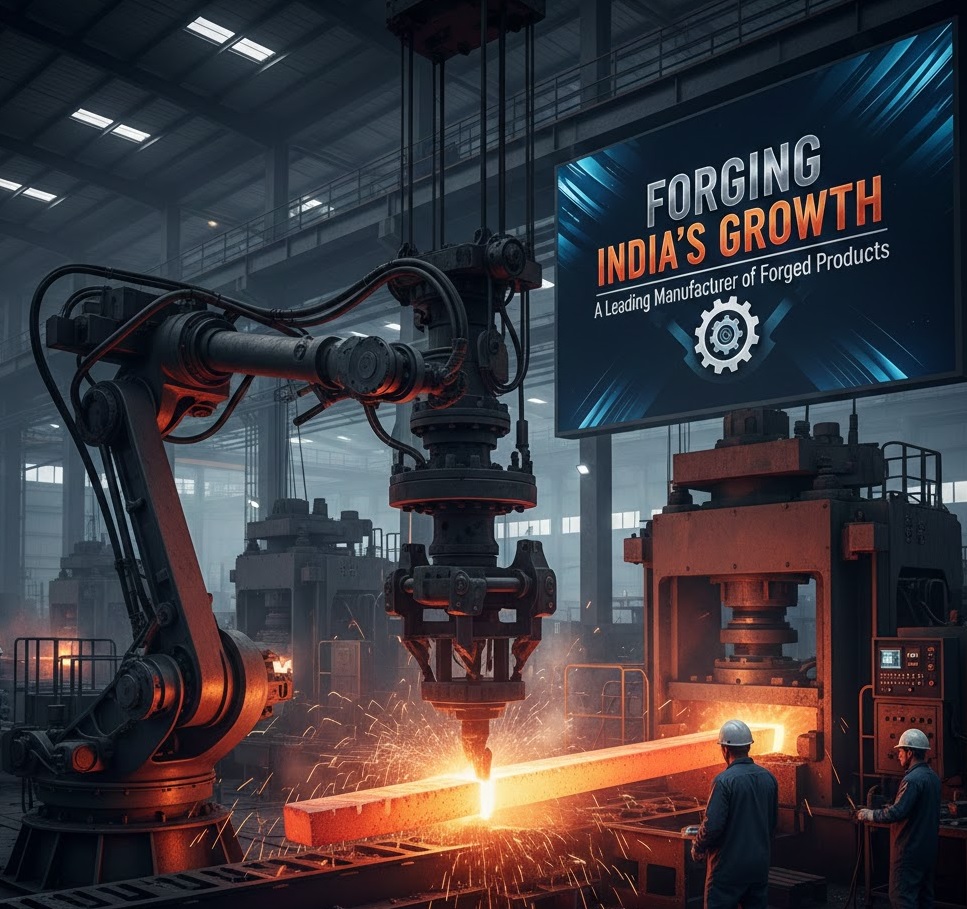

Many manufacturers are moving their operations to India as a result of the nation’s rapidly expanding automotive industry, which is the 4th largest area in the country. This expansion is offering new forecasts for the casting and forging industries. These industries are important for the production of industrial components in sectors like the automobile industry, aerospace industry, and defense industry. Forging is appreciated because of its better strength and durability, particularly when it is done using steel and iron products.
The manufacturing sector of the Indian forging industry has transitioned from being one that relies heavily on labor to one that relies heavily on capital during the course of its history. The amount of money that Indian forging firms are now investing on their plant and equipment is up to 27,833 Crore Indian Rupees.
Forging manufacturer India with its experience in market entrance and extension, assists international enterprises in entering the casting and forging sector of India. This is done by offering strategic insights, creating operations, and pouring growth in this dynamic industry.
The automotive industry in India, today, is going through a period of development, and all of the major manufacturers are shifting their production facilities to this area in order to be quicker to the upcoming consumer markets that will be the quiet significant. Right now, India is the third-largest manufacturer of casting in the complete globe. This would additional open up extra options for the castings and forging sectors, both for production inside the country and for exportation.
Casting and forging are two production procedures that are recognized for giving complicated shapes to the components that are used in industrial settings. The most significant distinction between the two is that forging is most often accomplished via the use of iron and steel metal resources. There is no such thing as a finished industrial product that does not include the procedures of casting and forging. advent with the advent of the industrial revolution, both of these processes have been in existence. Forgings, on the other hand, are favored over castings due to the fact that they have superior directional strength, high impact toughness, fatigue characteristics, and structural integrity.
Why forging is important?
1. Casting and forging are two of the most important engineering processes that produce a wide variety of components to end-user industries. These sectors include railways, automobiles, defense, aerospace, material handling, construction equipment, and mines. In order to maintain its competitive edge and increase income from the automotive industry, the casting and forging industry in India has implemented the necessary measures. This sector has been seeing significant development with the help of both organic and inorganic growth, which has been playing a significant role.
2. Companies that are involved in the forging business are taking the initiative to gain technology, information, experience, and competence in the sector. The Forging manufacturer India has undergone a process of upgrading in order to bring it in line with the methods that are seen in other countries.
3. Given the immense potential, leading local businesses have begun to build up world-scale capabilities by either putting up Greenfield projects or purchasing sick global facilities and turning them around as business solutions for setting up a foreign corporation in India. This is done in order to take advantage of the great potential.
4. In addition, the growing demand for forged goods across a variety of sectors, including aerospace and automotive, has provided Indian producers with new opportunities. Strong export networks and partnerships have been established by India’s forging industry in response to the challenge posed by the fact that businesses all over the globe are looking for dependable suppliers who are capable of delivering items of high quality at costs that are competitive.
5. The weight of an open die forged item may range anywhere from one pound to over 400,000 pounds, but it is only possible to cast the biggest ingot that is really possible. Forgings are often required for their soundness in lieu of rolled bars or castings, or for those pieces that are too big to be produced by any other type of metalworking. This is in addition to the open die parts that are regularly bought.