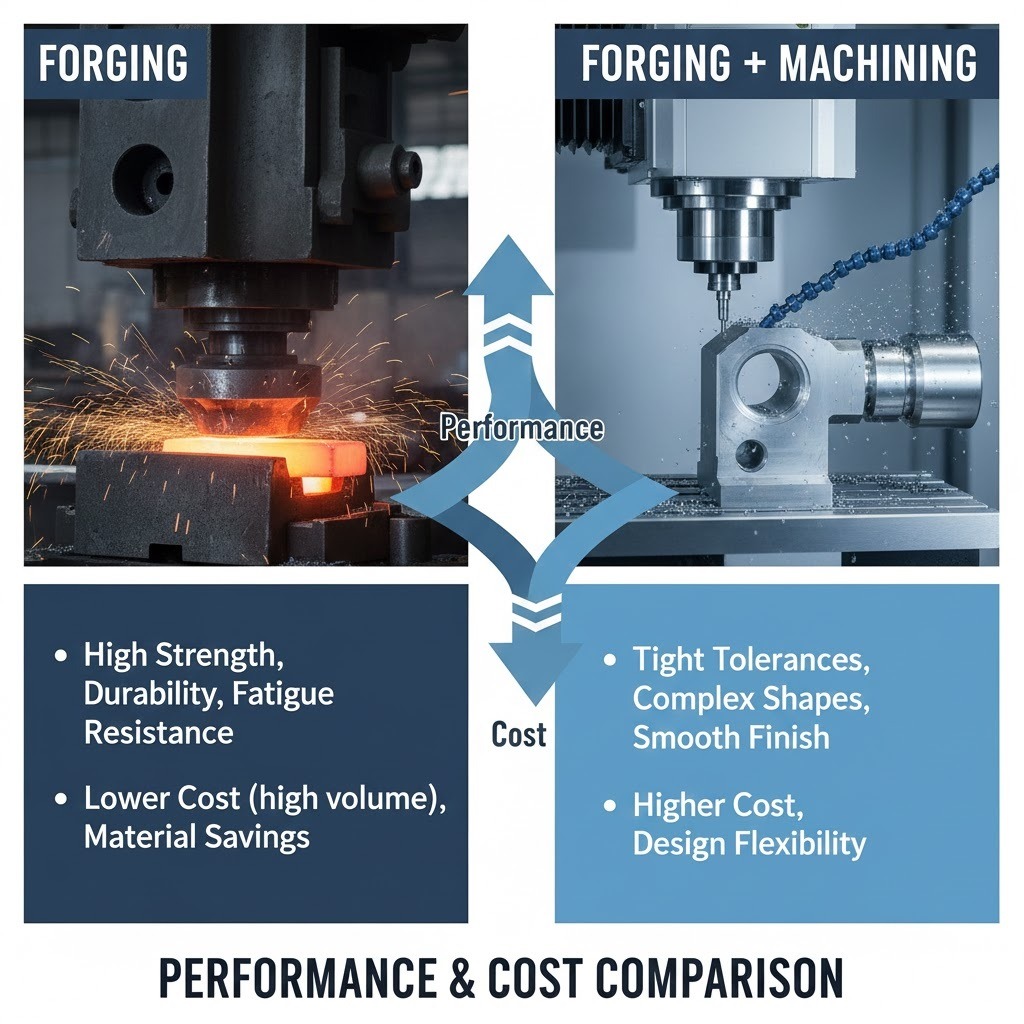

Honestly, I will always remember my first “forging fiasco” when I was a junior procurement lead for an automotive plant in Pune. We had just changed suppliers for a high-volume steering knuckle project. I thought I was a genius because I had managed to get an incredibly cheap price for raw forgings through negotiation. Like, the samples looked great, the ISI (Indian Standard) certificates were all there IS 3469 standard compliance, the whole kit. I thought, “It’s a forging; it’s strong, it’s near-net shape, we’ll just shave off a bit and be done.”
Cut to the assembly line three weeks later. Our CNC operators were almost on the verge of rebellion. The tool wear was at a new high. We were going through carbide inserts at a rate that resembled candy consumption because the raw forged blanks had varying scales and the tolerances were… Let’s just say “optimistic.” What I saved in raw forging cost I ended up paying three times over in lost production time and broken tools.
That, ladies and gentlemen, was my light-bulb moment: Forging vs. Forging + Machining is not just about two different processes; it is about realizing that in 90% of Indian industrial applications and actually, globally, these two aren’t rivals, they are collaborators. But how you balance between them decides whether your project accounts stay positive or whether it leaks money.
The Great Debate: Forging vs. Forging + Machining
When a critical sourcing decision is on the table, it is recognized that there is more at stake than just metal purchase, as what is being effectively bought is performance. However, one key question is how the hammer handing over a piece to the lathe is marked?
1. The Raw Strength of Forging
Forging is the craft of metal shaping through localized compressive forces – generally with heat. That’s the reason why your crankshafts and landing gears aren’t mere castings. Besides, the process enhances the grain structure, consequently aligning it with the part’s shape thus; it obtains better fatigue and impact resistance.
- Grain Flow: Machining a solid bar results in the grain being “cut through” whereas in forging the grain is “bent” to follow the part’s contours.
- When metal has no gaps inside, it holds up under stress. Forged pieces handle heavy loads without failing. Strength comes from solid construction, not guesswork.
2. The Precision of Forging Machining
However, the truth of the matter is that even the finest open-die forging will not provide a mirror finish or a +/- 0.002mm tolerance right from the press. This is forging machining’s field.
Forging machining is a type of tool that is used for forging or shaping forged metal piece through forging techniques like turning, milling, drilling, or grinding as per unique industrial requirements or specification. That rough power gets refined – details emerge when precision meets purpose in modern builds.
Performance Comparison
Picture this. A chunk of solid steel sounds tough, right? Yet shaping every piece from it isn’t always smarter. The reason hides beneath the surface. Metal carries an internal pattern – like wood grain. When forged, that pattern bends along the form, strengthening critical areas. Machining from a billet cuts straight through it. What looks strong on screen loses resilience where it matters. So skipping forging trades hides toughness for convenience. Strength is more than density. It flows.
| Feature | Raw Forging | Forging + Machining | Machined from Solid |
| Strength | Superior | Superior | Moderate |
| Precision | Low (±0.2 to 0.5mm) | High (up to ±0.002mm) | High |
| Surface Finish | Rough (Ra 6.3) | Smooth (Ra 0.6) | Smooth |
| Waste | Minimal | Low | Very High |
Look at the figures I’m talking about. When opting for forging machining you enjoy the combined benefits. From the forged part, you get a 26% higher tensile strength with the “surgical” precision being the handiwork of a CNC machine.
The Cost Comparison: The “Hidden” Budget Killers
Here is where most Indian B2B sector procurement managers stumble. They only see the “Piece Price” and disregard the “Total Cost of Ownership.” Let’s analyze it thoroughly.
The Setup Trap
The tooling cost associated with forging is of a high magnitude. Dies are required and they aren’t cheap. If your production is limited to 50 parts only, just machine them from solid bar stock and be done with it. However, once the 500-unit mark is passed? The cost amortization of those dies will make the forging machining option appear as a discount.
Material Utilization: The Silent Winner
Material waste is definitely the enemy, especially in the Indian scenario where the prices of raw materials (such as high-purity alloy steel) can be quite volatile.
- Machining from Solid: You may end up selling around 60% of your expensive billet as scrap for a negligible amount after it has been turned into “chips” or “swarf”.
- Forging + Machining: Your starting point is a “near-net shape”. You are removing very little material from the surface. So, you have 85-95% material utilization. When you are handling large volumes of material, this is a huge cost-saving factor.
Secondary Operation Costs
Should you happen to purchase a raw forging that is “out of spec” or excessively flashed (i.e., the unwanted metal overflow from the die), your machining costs may soar. A good manufacturer (say those who are good at forging machining) will give you a component that is only a few operations away from their CNC line, thus saving you tool life and reducing the number of passes.
Technical Depth: Navigating the Indian Standards
Language of Bureau of Indian Standards (BIS) is essential if your procurement activities are in India.
- IS 13387: This is your go-to standard for tool steel forgings.
- IS 3469: This specifies the permissible variations for drop, press, and upset forgings.
Let me explain it to you another way. If you don’t indicate “Close Tolerances” under IS 3469, you will automatically receive “Normal Tolerances.” And “Normal” could imply your forging machining operation will take twice as long since there will be more metal to remove. Funny how tough moments teach the most.
Actionable Advice for Your Sourcing Strategy
If you are faced with bifurcated paths. What’s-next kind of situation? Here is my stepwise “Senior Strategist” checklist:
- What comes first? Volume. Building a single test version? Go with machining. Need a thousand units for an international manufacturer? Then forged parts, later machined, might be the actual way to save money.
- Start by comparing net weight to gross weight. Ask your supplier for numbers on flash loss and scale loss. When over one fifth of the material disappears before machining begins, that portion is just wasted cost. It sits there on paper but adds nothing real.
- Finish Specification: Don’t just say “machined.” Is 0.6 required for a bearing surface or can Ra 1.6 be tolerated for a structural bracket? The higher the finish requirement, the more expensive the forging machining will be.
- Make sure that Material Certifications match: For worldwide exports, EN 10204 Type 3.1 certificates are required. They guarantee traceability. If you don’t have them, your high-performance parts are essentially going to be “mystery metal” for a foreign buyer.
- Integration is Key: To be fair, if possible try to get a “one-stop shop.” A manufacturer who does the forging and machining in the same plant is a blessing. It saves everyone involved the trouble of the “blame game” between the forge and machine shops when a part doesn’t fit a jig.
The Human Element: Why Gut Feeling Matters
I personally think that there are occasional instances when the evidence points to one thing whereas the instinct suggests something else. A “perfect” CAD model may fail if the forging company doesn’t consider the metal flow in a particular corner.
You need someone who can see both sides – understand “Science of Forging” and “Art of Machining” too. For example, a person who can say, “See, if we alter this radius by 0.5mm, it will double our die life and also reduce your forging machining cost by 10%.” That’s the kind of knowledge that saves projects.
Conclusion
It doesn’t boil down to which is “better.” Choosing between raw forging and fully machined component comes down to where you prefer to allocate your time and money.
- If you have an in-house machine shop with excess capacity and specialized jigs, then go for Raw Forging.
- If you want a “plug-and-play” component that is ready for the assembly line, guaranteed to meet tight tolerances, and allows you to focus on your core business, then go for Forging + Machining.
Essentially, forging machining is way more than putting “the finishing” on a part. Its real essence is that one of revealing the true potential of metal. The hammer’s strength combined with the computer’s precision is what you obtain.
Going to make a move? Take a look at your existing “scrap rate” for machined parts first. If it is above 15%, most likely, you are a prime candidate for the switch to forging machining. It could just be your most profitable decision for this quarter.