
Microsoft certifications are designed to validate professional expertise across different roles within modern cloud and productivity ecosystems. Among these certifications, the MS-900: Microsoft 365 Fundamentals and MS-102: Microsoft 365 Administrator exams serve distinct purposes for IT professionals working with Microsoft 365 environments.
While both certifications relate to Microsoft’s cloud productivity platform, they target different levels of technical expertise and administrative responsibility. Understanding their differences is essential for IT administrators who want to choose the most appropriate certification path.
This article explains the key distinctions between MS-900 and MS-102, focusing on exam objectives, technical depth, skills required, and the career roles each certification supports.
Understanding the Purpose of MS-900
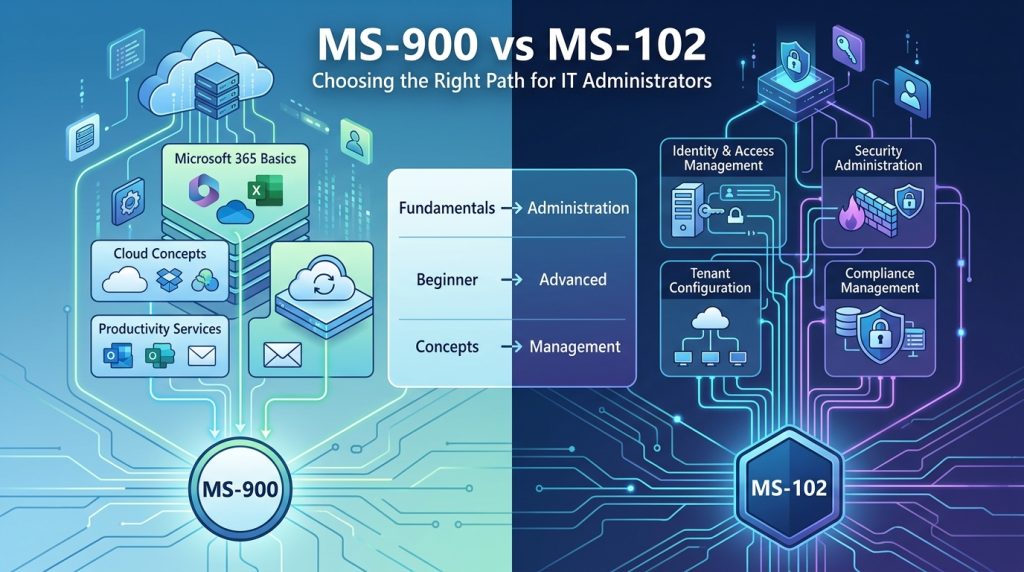
The MS-900 exam is an entry-level certification designed to introduce candidates to Microsoft 365 services, cloud concepts, pricing models, and compliance frameworks. It focuses on conceptual understanding rather than operational administration.
MS-900 is often taken by individuals who are new to Microsoft cloud technologies or professionals who need to understand how Microsoft 365 services function within business environments.
The exam covers high-level knowledge of services such as Microsoft Teams, Exchange Online, SharePoint Online, and Microsoft 365 security and compliance tools. However, it does not require candidates to configure or manage these services.
Instead, the exam emphasizes understanding how Microsoft 365 solutions support collaboration, productivity, security, and compliance across organizations.
Understanding the Purpose of MS-102
The MS-102 exam, known as Microsoft 365 Administrator, is significantly more technical and role-focused. It validates the skills required to deploy, manage, and secure Microsoft 365 environments.
IT administrators responsible for managing enterprise productivity platforms typically pursue this certification. The exam evaluates operational responsibilities such as identity management, tenant configuration, security enforcement, and monitoring.
Candidates must demonstrate the ability to manage Microsoft Entra ID identities, configure security policies, administer Microsoft 365 services, and maintain system availability.
Because of this operational focus, the MS-102 exam requires practical knowledge of Microsoft cloud administration rather than conceptual awareness.
Core Skill Differences Between MS-900 and MS-102
Although both exams relate to Microsoft 365, their skill requirements differ significantly. The following table highlights the main differences between the two certifications.
| Aspect | MS-900 | MS-102 |
|---|---|---|
| Certification Level | Entry-level | Administrator level |
| Focus | Microsoft 365 concepts and services | Administration and management of Microsoft 365 |
| Technical Depth | Conceptual | Operational and technical |
| Target Audience | Beginners and non-technical roles | IT administrators and cloud specialists |
| Required Experience | No prior experience required | Experience with Microsoft 365 administration recommended |
This comparison illustrates that MS-900 introduces Microsoft 365 concepts, while MS-102 focuses on managing those services within enterprise environments.
Exam Content and Domain Coverage
The content structure of both exams reflects their different goals.
The MS-900 exam typically includes topics such as cloud computing fundamentals, Microsoft 365 productivity services, collaboration tools, and compliance features. Candidates must understand the purpose and capabilities of these services rather than their configuration steps.
A detailed collection of Microsoft fundamentals preparation material and practice resources can be reviewed here: www.certempire.com/exam/ms-900-exam-questions
The MS-102 exam, however, evaluates the operational tasks involved in administering Microsoft 365 environments. Topics often include identity and access management, tenant configuration, service administration, and security monitoring.
For example, MS-102 candidates may need to interpret scenarios involving conditional access policies, user provisioning, or compliance configurations within Microsoft 365 environments.
These scenario-based questions require candidates to apply administrative reasoning rather than simply recognizing service descriptions.
Technical Tools and Administrative Responsibilities
Another important difference between the certifications lies in the tools administrators are expected to understand.
MS-900 focuses on general familiarity with Microsoft 365 services and their benefits for organizations. Candidates should understand the capabilities of services such as Microsoft Teams, SharePoint, Exchange Online, and Microsoft Defender at a conceptual level.
In contrast, MS-102 requires operational knowledge of tools used to manage Microsoft 365 environments. These include the Microsoft 365 admin center, Microsoft Entra ID portal, security and compliance dashboards, and policy management interfaces.
Candidates preparing for the Microsoft 365 administrator certification can explore updated study material and practice questions here: www.certempire.com/exam/ms-102-pdf-dumps
Administrators preparing for MS-102 must understand how these tools are used to configure identities, manage devices, enforce security controls, and monitor system activity.
Certification Path Considerations
Choosing between MS-900 and MS-102 often depends on career goals and professional experience.
MS-900 is commonly selected by beginners exploring Microsoft cloud technologies or professionals who interact with Microsoft 365 services in non-technical roles such as sales, support, or project coordination.
MS-102 is intended for professionals responsible for administering Microsoft 365 environments. IT administrators, cloud engineers, and system administrators often pursue this certification to demonstrate their technical capabilities. Many candidates begin with MS-900 to develop foundational knowledge before progressing to more advanced certifications such as MS-102.
Preparation Strategies for Each Exam
Preparation approaches differ significantly for the two certifications.
For MS-900, candidates typically focus on understanding Microsoft 365 service concepts and how they support collaboration, productivity, and security within organizations. Study resources often emphasize conceptual explanations and high-level service overviews.
Preparing for MS-102 requires deeper technical understanding. Candidates must be familiar with administrative tasks such as identity management, tenant configuration, and service deployment.
Hands-on practice within a Microsoft 365 environment can be particularly beneficial for MS-102 preparation because it allows candidates to observe how administrative tools and policies function in real scenarios.
Practice questions also help candidates understand how exam scenarios are structured. Some learners review domain-aligned question sets through platforms such as Cert Empire when preparing for Microsoft certification exams.
Career Impact of Each Certification
Both certifications support professional development but serve different career purposes.
MS-900 demonstrates foundational knowledge of Microsoft 365 technologies and can help professionals enter cloud-related roles or demonstrate familiarity with Microsoft’s productivity ecosystem.
MS-102, on the other hand, validates the technical expertise required to manage Microsoft 365 environments within enterprise organizations. Professionals holding this certification are often responsible for maintaining system availability, enforcing security policies, and managing user identities across cloud platforms.
Because of its operational focus, MS-102 is often associated with roles such as Microsoft 365 administrator, cloud administrator, or IT operations specialist.
Overall Assessment
The MS-900 and MS-102 certifications serve different purposes within the Microsoft certification ecosystem. MS-900 introduces the core concepts and services that define Microsoft 365, making it suitable for beginners or professionals seeking foundational knowledge. MS-102 focuses on the operational responsibilities of managing Microsoft 365 environments, requiring deeper technical expertise and administrative skills. Understanding the differences between these exams helps IT administrators select the certification path that aligns with their experience level and career goals. Whether pursuing conceptual knowledge or administrative specialization, both certifications contribute to a stronger understanding of Microsoft’s cloud productivity platform.
A quick breakdown related to IT exams can be found in Cert Empire’s Facebook post on the subject.
FAQs
1. What is the main difference between MS-900 and MS-102?
MS-900 focuses on conceptual understanding of Microsoft 365 services, while MS-102 evaluates practical administrative skills such as identity management, tenant configuration, and security management within Microsoft 365 environments.
2. Is MS-900 required before taking MS-102?
No, MS-900 is not a prerequisite for MS-102. However, beginners often take MS-900 first to gain foundational knowledge of Microsoft 365 services and cloud concepts.
3. Which certification is better for IT administrators?
MS-102 is generally more relevant for IT administrators because it focuses on managing Microsoft 365 infrastructure, configuring identities, and maintaining security policies within enterprise environments.
4. Is hands-on experience important for the MS-102 exam?
Yes, practical experience with Microsoft 365 administration tools is highly beneficial. Hands-on practice helps candidates understand identity management, security policies, and service configuration tasks tested in the exam.
More insights: Best ISC2 CC Practice Exam Questions for Entry-Level Cybersecurity Candidates