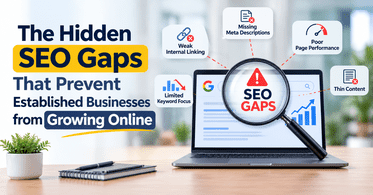
Many established businesses have a professional website, years of industry experience, and a strong customer base. However, despite these advantages, they often struggle to increase their online visibility and attract consistent organic traffic. The reason is not always a lack of content or backlinks. In many cases, small but important SEO gaps prevent websites from reaching their full potential. Working with a Digital Marketing company in Chennai can help businesses identify these hidden issues, improve search performance, and build a stronger online presence.
1. Outdated Website Content
One common SEO gap is outdated website content. Established businesses often create service pages and blog posts when their websites are first launched but fail to update them regularly.
Search engines aim to provide relevant and useful information to users. If your website contains outdated details, old statistics, irrelevant examples, or incomplete service information, it may struggle to compete with websites offering more useful content.
Regular content updates help maintain relevance and provide visitors with accurate information.
How to fix it:
- Review important website pages regularly.
- Replace outdated information with current details.
- Add relevant examples and practical insights.
- Update old blog posts based on search intent.
- Remove unnecessary or repetitive information.
2. Poor Keyword Targeting
Having a website does not guarantee that potential customers will discover your business through search engines. One reason is poor keyword targeting.
Some established businesses focus on broad keywords without considering the actual search behaviour of their target audience. Others target multiple similar keywords on the same page, creating keyword cannibalisation.
An effective keyword strategy should connect the right search terms with the right website pages.
How to fix it:
- Research keywords relevant to your services.
- Understand informational and commercial search intent.
- Identify long-tail keyword opportunities.
- Assign primary keywords to relevant pages.
- Monitor keyword rankings and search performance.
3. Weak Internal Linking Structure
Internal linking is often overlooked during website optimisation. However, it helps search engines understand the relationship between different pages and allows visitors to explore relevant information.
For example, a business offering digital marketing services can connect its SEO service page with related articles about keyword research, technical SEO, local SEO, and link building.
Without proper internal links, important pages may receive limited visibility, and some website pages may become orphan pages.
How to fix it:
- Connect related blog posts and service pages.
- Use descriptive and relevant anchor text.
- Link important pages from relevant sections.
- Identify and fix orphan pages.
- Maintain a logical website hierarchy.
4. Technical SEO Problems
Technical SEO issues can prevent search engines from crawling, rendering, and indexing website content correctly. Even businesses with valuable content may experience poor organic performance because of technical problems.
Common issues include broken links, duplicate URLs, incorrect canonical tags, slow-loading pages, indexing errors, and mobile usability problems.
These issues can become difficult to identify as a website grows over time.
How to fix it:
- Conduct regular technical SEO audits.
- Check indexing reports in Google Search Console.
- Fix broken internal links and redirect errors.
- Review XML sitemaps and robots.txt.
- Implement appropriate canonical tags.
- Improve mobile performance and page speed.
5. Lack of Local SEO Optimisation
For businesses serving customers in specific locations, local SEO is essential. However, many established companies do not fully optimise their local online presence.
They may have a Google Business Profile but lack updated business information, relevant service descriptions, location-based content, and consistent business details across online directories.
This can reduce their opportunities to appear in relevant local searches.
How to fix it:
- Optimise your Google Business Profile.
- Maintain accurate business contact information.
- Create relevant location-specific service pages.
- Encourage genuine customer reviews.
- Keep business details consistent across directories.
- Publish useful local content.
6. Low-Quality Backlink Profile
Backlinks can help search engines understand the authority and relevance of a website. However, not every backlink provides value.
Some established businesses continue using outdated link-building techniques, such as irrelevant directory submissions, excessive reciprocal links, and low-quality guest posting.
A backlink profile should focus on relevance, credibility, and natural link acquisition rather than simply increasing the total number of links.
How to fix it:
- Analyse your existing backlink profile.
- Identify suspicious or irrelevant linking patterns.
- Build relationships with industry-relevant websites.
- Publish useful resources that attract natural backlinks.
- Focus on quality rather than backlink quantity.
7. Missing or Incorrect Schema Markup
Schema markup helps search engines understand specific information on a website. It provides structured information about businesses, services, articles, products, and FAQs.
Many established businesses overlook structured data or use the wrong schema types. This can create opportunities for improvement in how search engines interpret their website content.
How to fix it:
- Implement a relevant organisation or local business schema.
- Use the service schema for appropriate service pages.
- Add Article schema to relevant blog posts.
- Implement BreadcrumbList schema where applicable.
- Validate structured data using Google’s Rich Results Test.
Remember that adding schema does not guarantee rich results or higher rankings, but accurate structured data can improve search engine understanding.
8. Ignoring Search Performance Data
Another hidden SEO gap is making optimisation decisions without analysing actual website performance.
Some businesses continue publishing new content without checking which pages generate traffic, which keywords receive impressions, or why certain pages have low click-through rates.
Google Search Console and Google Analytics provide valuable information that can guide SEO improvements.
How to fix it:
- Monitor organic clicks and impressions.
- Identify keywords with high impressions but low clicks.
- Analyse pages with declining traffic.
- Review user engagement and conversion data.
- Compare competitor performance.
- Prioritise improvements based on measurable results.
Conclusion
Established businesses often have the experience, reputation, and resources needed to grow online, but hidden SEO gaps can prevent them from achieving better search visibility. Outdated content, poor keyword targeting, weak internal links, technical issues, missing schema, and ineffective backlink strategies can all limit organic growth.
The best approach is to conduct a complete SEO audit, identify the most important problems, and implement improvements based on actual website performance. SEO is an ongoing process that requires regular monitoring, useful content, and consistent optimisation.
Partnering with an experienced SEO Company in Chennai can help businesses uncover these hidden gaps, strengthen their website performance, improve keyword visibility, and attract more relevant organic traffic. A well-structured SEO strategy can turn an established business website into a valuable source of long-term online growth.