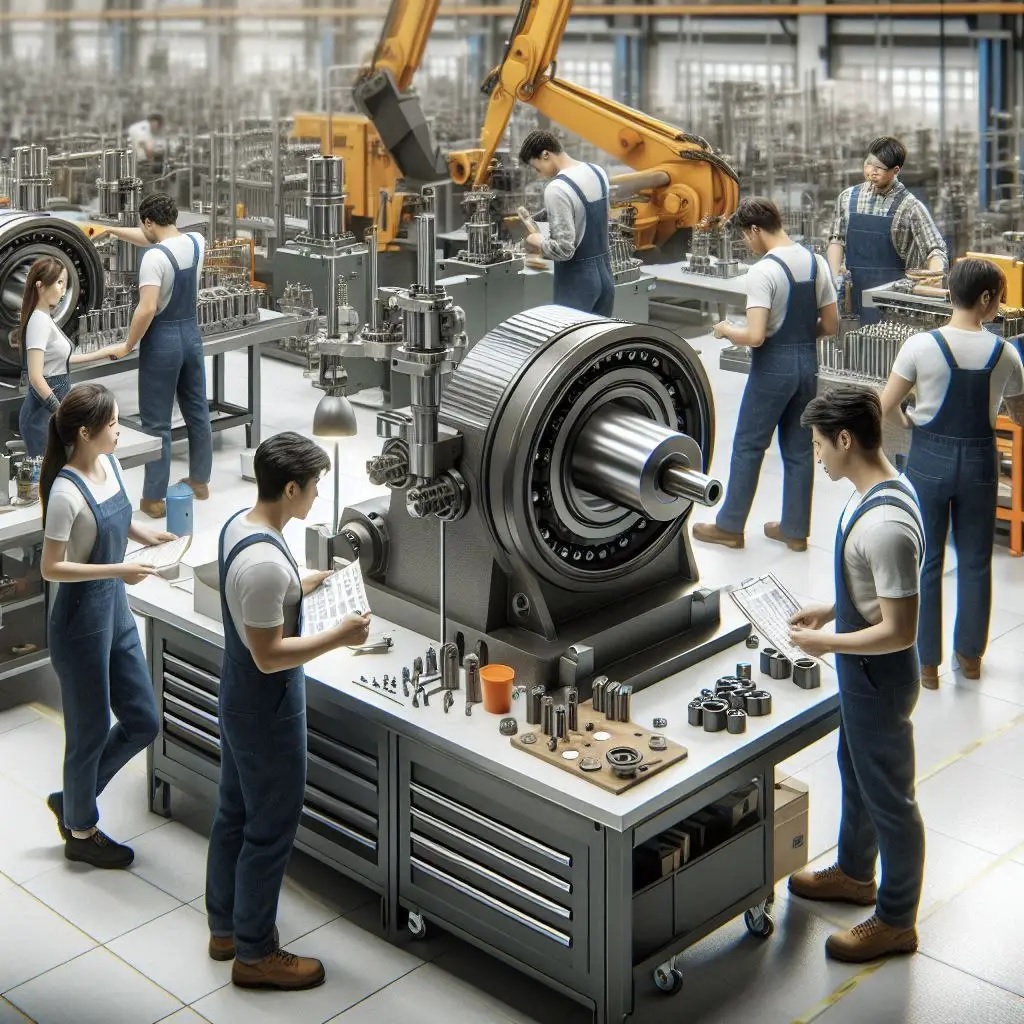

Pillow block more often than not known as plummer block bearings are fairly common bearing types utilized in various different sectors to support rotating shafts with minimal friction in the motion of those parts. The resulting difficulty of designing pillow block bearings is that they require sophisticated engineering, the right materials and supply the serious precision machining to be able to bear significant loads and work at the higher speeds the modern machinery operates at. Even as industries including automotive and agriculture, and construction and food processing, as well as, mining continue to grow, and pillow block bearing manufacturers are continuing to play a critical role.
What is a Pillow Block Bearing?
A pillow block bearing is a mounted bearing assembly, which comprises a housing and an insert bearing. The housing provides the sturdy support of the assembly, while the bearing insert allows for low-friction rotation of a shaft when subjected to radial loads and axial loads. Each unit is made to be mounted quickly, with bearing inserts and dust coverings easily replaced and serviced, making them very useful for industrial systems that don’t stop, or stop only rarely.
Manufacturing Process of Pillow Block Bearings
1. Material Selection
The quality of a pillow block bearing begins with identifying raw materials. For the housing, manufacturers usually use high-quality cast iron, ductile iron, stainless steel or thermoplastic, and for the inserts, manufacturers usually will use chrome steel or stainless steel. The application, environment and load specification determines the best material.
2. Precision Casting and Machining
The housing or shell of a pillow block bearing is typically made by either precision casting or forging. CNC machining assures dimensional accuracy, alignment, and fit with the cartidge (insert) bearing. Machining can also refine surface finish, which is important to the life of the bearing.
3. Heat Treatment
The majority of bearing components undergo heat treatment using carburizing, quenching, and tempering to provide more hardness, strength, and wear resistance. Heat treating is necessary to ensure that the bearing will be able to support heavy loads under high and/or adverse operating conditions.
4. Grinding and Polishing
To ensure optimum performance, the inner and outer race are fine ground and polished. This finishing process reduces friction, increases rotational efficiency, and decreases energy/input loss.
5. Assembly
The insert bearing is installed into the housing and fastened with set screws, locking collars, or eccentric locks, and some advanced designs even provide seals and lubrication systems for even greater protection for contaminants and longer service life.6. Quality Testing
Manufacturers do not take any chances with their bearing testing. Every bearing is tested to ensure it has met the international standard such as ISO, DIN or ANSI. The tests include checking the bearing dimensions, load capacity, noise level, and durability tests in a simulated working environment.
Applications of Pillow Block Bearings
Pillow block bearings are an important component in many industries for portability, reliability, and easy serviceability. In agriculture, pillow block bearings are utilized in harvesters, conveyors, and process, as pillow blocks are pivotal for maintaining the smooth operation of their ongoing operation.
Automotive applications utilize pillow block bearings within transmission systems, as they have proven their reliability under sustained use and heavy loads along assembly lines. Pillow blocks made of stainless-steel are highly preferred in food and beverage applications due to cleanliness and corrosion-resistance. In mining and construction, pillow block bearings are capable of resisting very extreme loads and operate with airborne dust and exposure to the elements. Textile and packaging companies use pillow block bearings in high-speed rollers and conveyor systems, also ensuring previously attained tolerances, repeatability, and with minimal downtime.
Advantages of High-Quality Pillow Block Bearings
Pillow block bearings have many benefits that make them the bearing of choice in many industries. They are simple to use and straightforward to install means easy assembly and easy replacement. Obviously, this feature can save time in equipment changes and reduce down-time in a preventative maintenance situation. Pillow block bearings are built to withstand punishment, handling heavy loads,/ tough environments/ continuous operation with ease. Cost effectiveness is another great benefit when considering the value of a sleeve bearing. Reduced repairs due to an extended service life is always a good thing. One of the best features is the adaptability of pillow block bearings with respect to materials, sizes and sealing options. Pillow block bearings offer a variety of solutions to many different applications in an industrial setting. Pillow block bearings are smooth running because they are produced with precision. This helps eliminate extra vibrations and noises giving you better efficiency and a longer life cycle for your equipment.
Future of Pillow Block Bearing Manufacture
As automation increases and the needs of machinery become more sophisticated, the manufacturer is now investing in better materials, lubrication technologies, and smart bearings with sensors for real time monitoring. Sustainability, including the use of eco lubrication systems and recyclable materials are also becoming noticeable trends in the bearing industry.
Conclusion
Pillow block bearing manufacture is a specialized process that utilizes material science, high technology machining processes, and stringent quality control. A supplier with a sound manufacturing program not only delivers high-quality bearings to the customer, but contributes to longer machine life, reduced downtime, and greater efficiencies to all the related industries. As the continued demands on industries evolve, pillow block bearing manufacturing will continue to evolve, to provide strong, accurate, and reliable solutions to meet challenges in modern engineering.