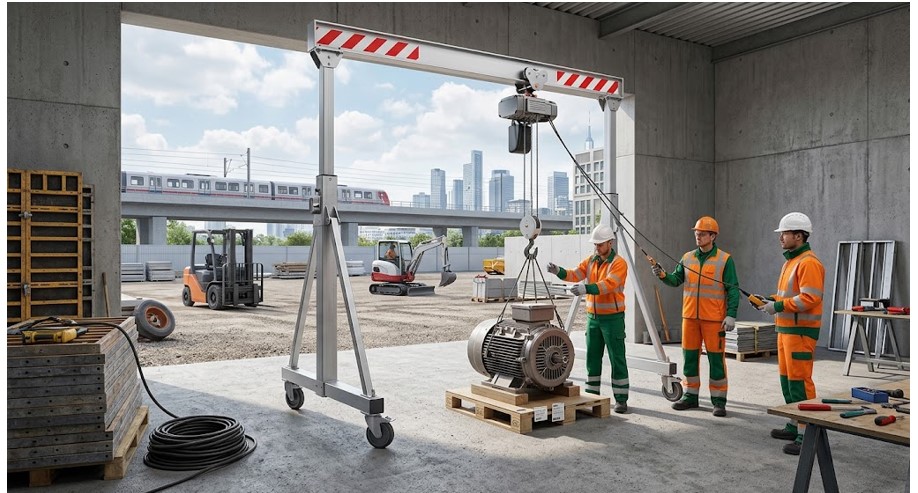

A site layout changes every few months as work progresses, and a fixed crane installation doesn’t make sense for a lifting need that keeps moving location.
A portable gantry crane is built for exactly this situation. This article covers what makes a portable gantry crane different from a fixed installation, when it’s the right choice, and what limitations come with that flexibility.
Is a portable gantry crane a good fit for a site that changes layout often?
Generally, yes, as long as the loads stay within the equipment’s rated range. Unlike a fixed overhead crane, a portable gantry crane can be relocated as the work area shifts, without needing a new structural installation each time.
In one sentence: the flexibility comes with a lower typical load capacity than a fixed installation, so it suits changing layouts more than it suits consistently heavy lifting.
That trade-off, portability against maximum load capacity, is the central decision point. Sites doing lighter, more frequent relocations tend to benefit most. Sites needing to lift consistently heavy loads at a fixed point are usually better served by a fixed gantry or overhead crane instead.
What situations actually call for a portable gantry crane?
Workshops handling varied job sizes, new or expanding factories still finalising their permanent layout, and facilities running short-term projects all commonly use portable gantry cranes rather than committing to a fixed installation too early. They also suit buildings where the structure can’t carry the runway beams a fixed overhead crane needs, since a portable gantry stands on its own legs. The floor still has to take the load, though: the crane and its load are concentrated through a few wheels, so check floor capacity rather than assume it.
This flexibility matters because permanent crane installations involve real commitment, both in cost and in structural planning. A portable option lets a site get lifting capability in place quickly, while a more permanent decision is still being worked out.
What should you check before choosing a portable option?
Rated load capacity comes first, since portable units are typically built for lighter to medium loads rather than the heaviest industrial lifts. Span and height adjustability matter next, particularly if the equipment needs to work across varied load sizes and configurations rather than one fixed task.
Ground surface also matters more than people expect. A portable gantry crane still needs a reasonably level, stable surface to operate safely, and uneven or soft ground can affect stability even though the unit is mobile. It’s also worth confirming how the unit is meant to be moved. Many portable gantries are designed to be repositioned unloaded, not pushed across the floor with a load on the hook.
What are the limitations of a portable gantry crane?
It won’t match a fixed, engineered crane system for maximum load capacity or long-term structural integration into a facility. That’s not a flaw; it’s simply the trade-off for portability. A site expecting to lift consistently heavy loads at a fixed point for years should plan for a permanent installation rather than relying on a portable unit as a long-term substitute.
For businesses in Singapore weighing this decision, Jenmon International’s portable gantry crane, which handles loads from 500 kg to 2,500 kg with either a manual or electric chain hoist, is one option worth reviewing against your specific load and site requirements.
Frequently asked questions
Can a portable gantry crane be used outdoors as well as indoors?
Some can, but don’t assume outdoor suitability based on portability alone. In Singapore’s climate, an outdoor unit’s frame, hoist and electrics are exposed to heavy rain and high humidity year-round, and the unit needs firm, level ground rather than soft or uneven surfaces. Confirm the unit’s weather protection against its specifications before using it outside.
How often can a portable gantry crane realistically be relocated?
There’s no fixed limit, but frequent relocation does mean more frequent setup checks, including ground stability and level positioning, each time it’s moved.
Does a portable gantry crane need the same inspection schedule as a fixed crane?
Yes, portability doesn’t reduce the need for regular inspection, since the lifting mechanism wears in the same way whether the frame is fixed or mobile. In Singapore, statutory lifting equipment must also be examined by an MOM Authorised Examiner, generally at least once every 12 months, and it’s worth confirming with the examiner whether relocating the unit triggers re-examination for its equipment category.
Is a portable gantry crane suitable for a permanent single-location workstation?
It can be, though if the location genuinely never changes, a fixed installation often offers a higher load capacity for a similar footprint, so it’s worth comparing both options before deciding.