

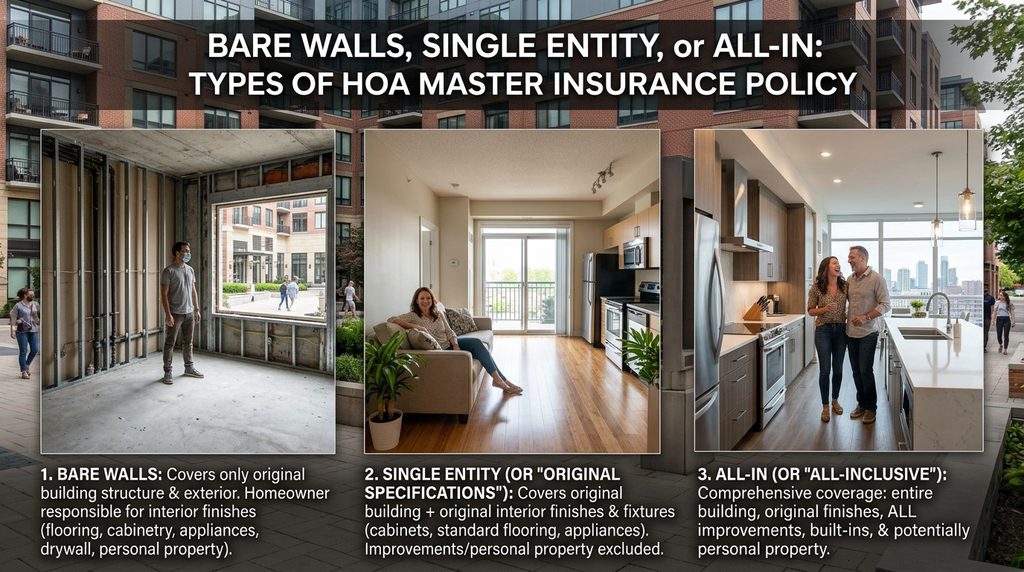
When a pipe bursts in a condo building, the first question is usually the same: who pays? The answer depends on the type of HOA Master Insurance Policy the association carries. Some master policies stop at the studs. Others cover the original kitchen and bathrooms. A few cover almost everything inside the unit walls, including upgrades owners added later.
For board members, property managers, and unit owners, knowing which type you have is the difference between a smooth claim and a dispute. This guide explains the three main types of HOA Master Insurance Policy, how each one splits responsibility between the association and owners, and what boards should review before renewal.
What a master policy does
An HOA Master Insurance Policy is the property and liability coverage an association buys on behalf of all owners. It protects the shared parts of the community, such as the roof, exterior walls, hallways, lobby, elevators, pool, and clubhouse. Depending on the type, it may also cover parts of each individual unit.
The cost is built into the dues every owner pays. That’s why the coverage type matters to everyone. A broader policy costs the association more, which can raise dues. A narrower one keeps dues lower but shifts more of the risk to each owner’s personal policy.
The association’s governing documents usually decide which type of HOA Master Insurance Policy the board must carry. The declaration, bylaws, or covenants spell out what the association insures and what owners insure. State law can also set minimums. In Illinois, for example, the Condominium Property Act generally requires the association to insure the common elements and the units, while excluding improvements and betterments that owners install themselves. Boards should read both their documents and the applicable state law before choosing coverage.
Type one: bare walls
A bare walls HOA Master Insurance Policy covers the building structure and common areas, and very little inside the units. Think of the unit as an empty shell. The master policy covers the exterior walls, roof, foundation, and shared spaces, and usually the unfinished interior walls. Everything else inside is the owner’s job.
Under bare walls coverage, the owner typically insures:
- Drywall and interior finishes
- Flooring, carpet, and tile
- Kitchen cabinets and countertops
- Bathroom fixtures, vanities, and tubs
- Built-in appliances
- Interior plumbing and electrical fixtures within the unit
- Personal belongings
The main advantage is cost. Because the association insures less, the premium is lower, and dues can stay more manageable. The tradeoff is that owners need higher dwelling coverage on their own condo policies, often called HO-6 policies. If an owner underestimates the cost of rebuilding the inside of their unit, they could pay out of pocket after a major loss.
Bare walls coverage is more common in communities where units vary a lot in finishes, since it lets each owner insure their own choices.
Type two: single entity
A single entity HOA Master Insurance Policy covers the building structure, common areas, and the original fixtures and finishes inside each unit, as they were when the building was first built or delivered. Some people call this original specifications coverage.
If the units came with standard cabinets, laminate counters, carpet, and builder-grade fixtures, the master policy covers those items. What it doesn’t cover is anything an owner added or upgraded after the fact. Hardwood floors that replaced the original carpet, granite that replaced laminate, or a remodeled bathroom fall under the owner’s policy as improvements and betterments.
Under single entity coverage, the owner usually insures:
- Upgrades and improvements made after the original construction
- Personal belongings
- Liability for injuries inside the unit
- Loss of use, if the unit becomes unlivable
- Their share of the master policy deductible, if assessed
Single entity coverage sits in the middle on cost. It protects owners from having to rebuild the basic unit after a covered loss, while keeping the association from paying for custom upgrades. Many associations and lenders consider it a reasonable balance.
The challenge is record keeping. To settle a claim, someone needs to know what the original specifications were. Boards should keep a written description of the original finishes for each unit type, along with photos or builder documents if available.
Type three: all-in
An all-in HOA Master Insurance Policy, sometimes called all-inclusive or all-in coverage, covers the building structure, common areas, original fixtures, and improvements and betterments made by owners. In short, it covers nearly everything permanently attached to the unit, whether original or upgraded.
Owners in an all-in community still need personal coverage, but it can be lighter. Under all-in coverage, the owner typically insures:
- Personal belongings such as furniture, clothing, and electronics
- Liability for injuries inside the unit
- Loss of use
- Loss assessment coverage for their share of deductibles or uncovered losses
All-in coverage gives owners the most protection from the master policy and the simplest claims process. The association handles most of the rebuild, which reduces finger-pointing between carriers. The downside is cost. Insuring every upgrade in every unit raises the premium, and those costs flow into dues. It can also create fairness concerns when some owners have made expensive renovations and others haven’t, since everyone shares the cost.
Comparing the three types
Here is how responsibility for common unit items usually splits under each type of HOA Master Insurance Policy. Always check your own governing documents, since wording varies.
| Item | Bare walls | Single entity | All-in |
|---|---|---|---|
| Roof, exterior, and common areas | Association | Association | Association |
| Interior drywall | Owner | Association | Association |
| Original cabinets and fixtures | Owner | Association | Association |
| Owner upgrades and improvements | Owner | Owner | Association |
| Personal belongings | Owner | Owner | Owner |
| Liability inside the unit | Owner | Owner | Owner |
The master deductible and loss assessments
Every HOA Master Insurance Policy has a deductible, and many associations carry deductibles of $10,000, $25,000, or more to control premium costs. Wind and hail deductibles may be set as a percentage of the building’s insured value, which can run into six figures on a large property.
When a covered loss happens, the association may pass the deductible to the owner whose unit caused the damage or spread it among all owners as a special assessment. Your governing documents should explain how this works.
Owners can protect themselves with loss assessment coverage on their personal condo policy. This pays the owner’s share of a covered assessment, such as a portion of the master deductible. Many owners carry only a small default amount, often too low to cover a large deductible. Boards should tell owners the size of the master deductible each year so owners can adjust their own coverage.
Other coverages an association should carry
Property coverage is only one part of an association’s insurance program. A complete HOA Master Insurance Policy program usually includes several other coverages:
- General liability for injuries in common areas, such as a fall on an icy walkway or an accident at the pool
- Directors and officers liability to protect board members against claims tied to their decisions
- Fidelity or crime coverage to protect association funds from theft by board members, employees, or management staff
- Umbrella or excess liability for limits above the primary liability policy
- Equipment breakdown for boilers, elevators, and HVAC systems
- Flood insurance, since flood is excluded from a standard master policy
- Workers’ compensation if the association has employees
Mortgage investors and lenders often have specific requirements for master coverage, including replacement cost limits, fidelity coverage amounts, and maximum deductibles. A policy that falls short can make it harder for buyers to get loans in the community, which affects property values.
How boards should choose and review coverage
Start with the governing documents. They often require a specific type of HOA Master Insurance Policy, and the board has a duty to follow them. If the documents are unclear or outdated, talk to the association’s attorney about clarifying or amending them.
Get a current replacement cost appraisal. Construction costs have risen, and a building insured for its value five years ago may be underinsured today. An underinsured building can leave owners facing large assessments after a major loss.
Communicate clearly with owners. Each year, send a summary of what the master policy covers, where the association’s responsibility ends, and the size of the master deductible. Encourage owners to share that summary with their own insurance agent so their personal coverage fills the gaps.
Review claims history and maintenance. Water damage is one of the most common sources of master policy claims. Regular inspections of roofs, plumbing risers, and water heaters can prevent losses and help keep premiums stable.
Compare options at renewal. Premiums, deductibles, and coverage terms vary between carriers. A broker who works with community associations can show how different structures affect cost and coverage.
Pick the structure that protects your community
Bare walls, single entity, and all-in coverage each draw the line between association and owner responsibility in a different place. Bare walls keeps dues lower but puts more on owners. Single entity covers the original unit and leaves upgrades to owners. All-in covers nearly everything fixed to the unit and costs the most. The right HOA Master Insurance Policy depends on your governing documents, your building, your budget, and what owners expect.
Pro Insurance Group works with homeowners associations and condominium boards to review their governing documents, compare master policy options, and build coverage programs that close gaps between the association and its owners.


