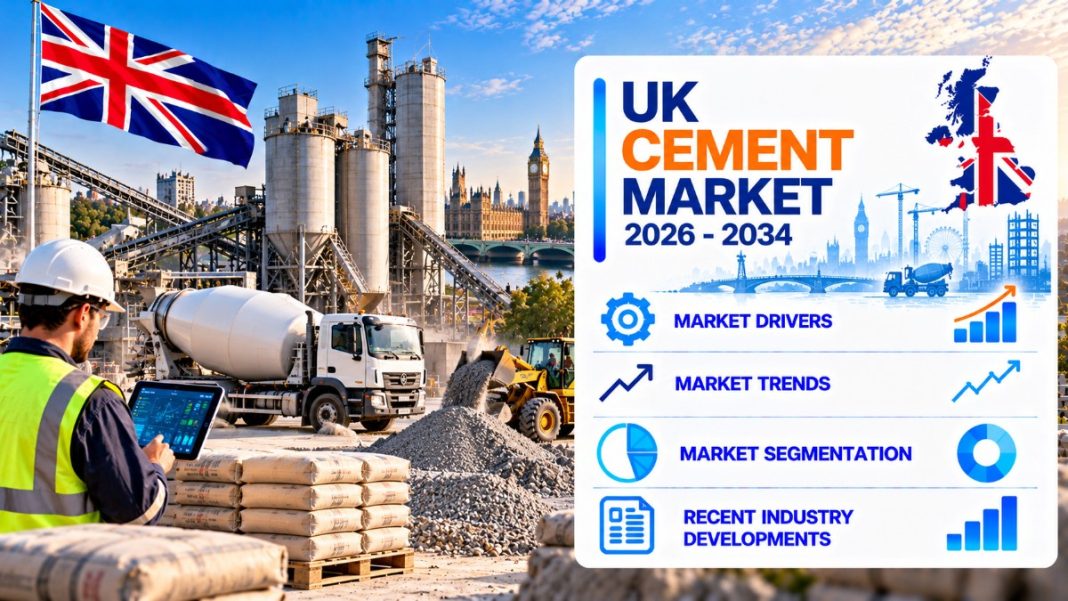

Market Overview
The UK cement market size reached USD 14,130.3 Million in 2025 and is projected to reach USD 21,737.2 Million by 2034, exhibiting a growth rate (CAGR) of 4.75% during 2026-2034. The market is driven by increasing infrastructure investments, government initiatives for green construction, and rising demand in residential and commercial real estate. Innovations in cement formulations and carbon reduction strategies, including carbon capture integration and circular economy practices, are supporting industry expansion and strengthening the UK cement market share across diverse end-use sectors.
Request a Sample Report for In-Depth Market Insights: https://www.imarcgroup.com/uk-cement-market/requestsample
UK Cement Market Summary
- The UK cement market encompasses blended, Portland, and other cement types, serving residential, commercial, and infrastructure construction across the United Kingdom.
- These products are valued as the foundation of construction, with demand increasingly shaped by low-carbon formulations, recycled content, and alternative fuels aligned to the UK’s net-zero targets.
- The ecosystem includes producers such as Heidelberg Materials, Holcim UK, and Tarmac, innovators like Hoffmann Green Cement Technologies and its UK partner Cemblend, and technology firms and research institutions.
- Major segments identified in the market include type, end-use (residential, commercial, infrastructure), and region, spanning ten UK regional groupings.
- The market is benefiting from low-carbon product launches, including Heidelberg Materials’ evoBuild range, which cuts CO₂ emissions by at least 30% or contains 30% recycled content.
- Carbon capture and storage, circular economy practices, and government green construction initiatives are driving sustained market growth across the United Kingdom.
PORTER’S FIVE FORCES ANALYSIS — UK CEMENT MARKET
Bargaining Power of Suppliers
- Technology firms and research institutions supplying carbon capture and storage solutions hold influence because cement kilns are primary sources of CO₂ and producers need scalable systems.
- Alternative fuel suppliers, including providers of waste-derived fuels and clean fuel technology such as Fuelre4m, gain leverage as producers replace fossil fuels.
- Suppliers of fly ash, slag, and construction debris gain relevance as cement composition shifts toward recycled materials and reduced clinker content.
Bargaining Power of Buyers
- Residential, commercial, and infrastructure developers shape demand, with growing preference for low-carbon construction materials influencing purchasing decisions.
- Ready-mixed and precast producers buying Portland limestone cement push suppliers to meet updated BS 8500 standards and lower-emission specifications.
- Investors and regulators expecting low-carbon production methods add pressure on suppliers to demonstrate sustainability credentials.
Threat of New Entrants
- Licensing deals, such as Hoffmann Green Cement Technologies’ agreement with Cemblend Ltd worth up to €2 million in entry fees plus royalties, show how new technologies can enter through partnerships.
- Capital-intensive carbon capture and kiln upgrades and tightening emissions regulation favor established producers over newcomers.
- Clinker-free and low-carbon cement innovations create openings for entrants with differentiated technology that supports UK decarbonisation goals.
Threat of Substitutes
- Clinker-free cement, such as Hoffmann Green’s 0% clinker product, represents a technology-driven alternative to traditional cement.
- Blended and Portland limestone cements substitute for traditional Portland cement, reducing emissions by 7 to 9% in the case of Tarmac’s PLC.
- Recycled-content products that use fly ash, slag, and construction debris compete with conventional formulations while cutting environmental impact.
Competitive Rivalry
- Producers compete on low-carbon innovation, exemplified by Heidelberg Materials’ evoBuild and evoZero, the world’s first carbon-captured net-zero cement.
- Holcim UK and Tarmac compete through clean fuel rollouts, expanded product supply, and acquisitions such as the Sharpness asphalt plant.
- Companies target sustainable product revenue goals, such as Heidelberg’s aim of 50% revenue from sustainable products by 2030, intensifying the race to lead in green cement.
MARKET GROWTH DRIVERS
Integration of Carbon Capture Technology
A significant factor shaping UK cement market growth is the integration of carbon capture and storage technologies within manufacturing operations. In response to stringent emissions regulations and the UK’s net-zero targets, cement producers are deploying CCS solutions to reduce their carbon footprint, collaborating with technology firms and research institutions to implement scalable CCS at industrial sites, especially cement kilns, which are primary sources of CO₂ emissions. This move is environmentally necessary and critical to sustaining long-term profitability as regulatory compliance tightens, aligning with investor expectations for low-carbon production. In October 2024, Heidelberg Materials launched evoBuild in the UK, a global brand for low-carbon and circular construction products that reduce CO₂ emissions by at least 30% or contain 30% recycled content, alongside evoZero, the world’s first carbon-captured net-zero cement.
Growth in Circular Economy Practices
Circular economy principles are becoming increasingly central to UK cement market growth, with leading companies investing in processes that prioritize waste minimization, resource reuse, and energy efficiency. One key development is the replacement of traditional fossil fuels with alternative fuels derived from industrial and municipal waste. In June 2025, Holcim UK rolled out Fuelre4m’s clean fuel technology across more than 200 UK sites after three years of testing, reducing fuel use by 15 to 20% and emissions by up to 23%. Innovations in cement composition now include recycled materials such as fly ash, slag, and construction debris, while zero-waste manufacturing and reduced clinker content support compliance with evolving environmental standards, offering cost advantages and new business opportunities.
Infrastructure Investment and Real Estate Demand
Increasing infrastructure investment and rising demand in residential and commercial real estate underpin cement consumption across the United Kingdom, while government initiatives for green construction steer demand toward low-carbon products. Producers are responding by expanding supply and local presence: in May 2025, Tarmac expanded supply of Portland limestone cement across England and Wales following updates to BS 8500 standards, supporting demand for low-carbon construction materials in ready-mixed and precast applications. In June 2025, Holcim UK acquired an asphalt plant in Sharpness to expand its presence in Gloucester and the southwest region. Together, these moves show construction-sector demand and sustainability requirements shaping how cement and related materials are produced and supplied.
UK CEMENT MARKET SEGMENTATION
Type Insights:
- Blended
- Portland
- Others
End-Use Insights:
- Residential
- Commercial
- Infrastructure
Regional Insights:
- London
- South East
- North West
- East of England
- South West
- Scotland
- West Midlands
- Yorkshire and The Humber
- East Midlands
- Others
COMPETITIVE LANDSCAPE
The UK cement market features a competitive landscape assessed through market structure, key player positioning, top winning strategies, competitive dashboard, and company evaluation quadrant, with detailed profiles of all major companies covered in the full report. Leading producers are differentiating through carbon capture, low-carbon product ranges, clean fuel adoption, and expanded supply of lower-emission cement.
Key players mentioned in the report context include:
- Heidelberg Materials
- Holcim UK
- Tarmac
- Hoffmann Green Cement Technologies
- Cemblend Ltd
REGIONAL ANALYSIS
London: London is covered as a distinct regional market within the report’s segmentation, reflecting the region’s role in national cement demand.
South East: South East is tracked as a distinct regional segment within the report’s cement market segmentation.
North West: North West is covered as a distinct regional market within the report’s segmentation of the UK cement landscape.
East of England: East of England is covered as a distinct regional market within the report’s segmentation of the UK cement landscape.
South West: South West is covered as a distinct regional market, where Holcim UK acquired an asphalt plant in Sharpness in June 2025 to expand its presence in Gloucester and the southwest region.
Scotland: Scotland is covered as a distinct regional market within the report’s segmentation of the UK cement landscape.
West Midlands: West Midlands is covered as a distinct regional market within the report’s segmentation of the UK cement landscape.
Yorkshire and The Humber: Yorkshire and The Humber is covered as a distinct regional market within the report’s segmentation of the UK cement landscape.
East Midlands: East Midlands is covered as a distinct regional market within the report’s segmentation of the UK cement landscape.
Others: Remaining regions are tracked collectively within the report’s segmentation of the UK cement landscape.
RECENT INDUSTRY DEVELOPMENTS
November 2026: The Mineral Products Association reported that non-European cement imports into the UK reached their highest level since records began in 2000. Imports from outside the EU accounted for 29.3% of UK cement imports during January–September 2026, compared with 17.1% in the same period of 2025, following changes in European carbon-border regulations.
November 2026: UK cement producers called for stronger government support after industry data showed domestic cement production had fallen to its lowest level since 1950. Rising energy costs and differences in carbon regulations were identified as major competitive challenges, while imports now account for more than one-third of UK cement sales.
November 2026: The Global Cement and Concrete Association released its 2026/27 Net Zero Action and Progress Report at COP31. The report highlighted developments in carbon capture, alternative fuels, renewable electricity and low-carbon cement, while calling for stronger government policies to accelerate industrial decarbonisation.
September 2026: Heidelberg Materials UK supplied its evoBuild low-carbon concrete for a redevelopment project at 33–35 Piccadilly in London’s West End. The solution combines carbon-captured cement and ground granulated blast-furnace slag, achieving approximately 35% lower carbon emissions compared with conventional CEM I concrete.
September 2026: Low-carbon cement technology developed by Ecocem was used in permanent construction work for the Transpennine Route Upgrade in West Yorkshire. The project marked the first UK application of its ACT technology in permanent infrastructure, reducing reliance on clinker, the carbon-intensive ingredient in conventional cement.
KEY ASPECTS REQUIRED FOR THE UK CEMENT MARKET
- Market Performance: USD 14,130.3 Million in 2025, with a projected trajectory to USD 21,737.2 Million by 2034.
- Market Outlook: A 4.75% CAGR through 2034 indicates robust growth across blended, Portland, and other cement types, serving residential, commercial, and infrastructure end-uses.
- Growth Drivers: Carbon capture technology integration; circular economy practices, including alternative fuels and recycled materials; and infrastructure investment and real estate demand supported by green construction initiatives.
- Competitive Landscape: Producers such as Heidelberg Materials, Holcim UK, and Tarmac compete on low-carbon products and clean fuel adoption, while innovators like Hoffmann Green Cement Technologies enter through licensing partnerships.
- Value Chain Analysis: The value chain stages of the UK cement market are covered in the full report.
- Industry Trends: Low-carbon and carbon-captured cement, such as evoBuild and evoZero; clinker-free and Portland limestone cement; and waste-derived fuels and recycled materials reducing environmental impact.
- Strategic Recommendations: Invest in carbon capture and low-carbon product ranges, expand clean fuel and recycled-content use, and use licensing partnerships and updated standards such as BS 8500 to scale lower-emission cement.
Note: If you need any specific information that is not currently covered within the scope of the report, we will provide the same as a part of customization.
Speak to an analyst: https://www.imarcgroup.com/request?type=report&id=37449&flag=C
Report Format, Delivery, and Customization Details
- Report Format Mode: PDF and Excel
- Report Delivery Mode: Online Delivery
- Report Delivery Time: Report delivered over email; editable PPT/Word version available on special request
- Report Customization Mode: 10% Free Customization
- Post-Sale Analyst Support: 10-12 Weeks
- Report Table of Content: Yes
- Request For Sample Report: Yes