

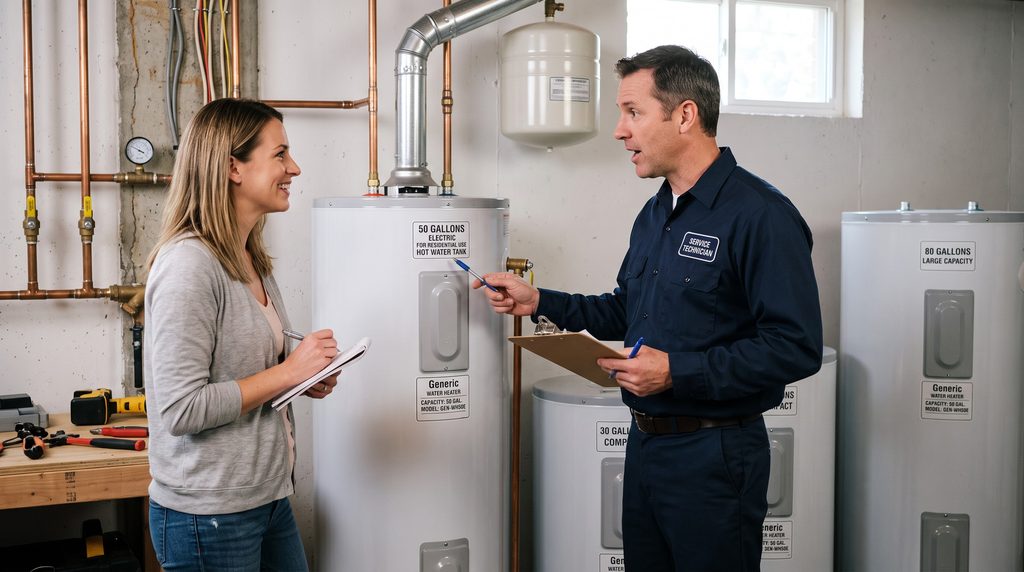
When a water heater fails, the easiest move is to replace it with the same size you had before. Sometimes that’s the right call. Often, it isn’t.
Households change. Families grow, kids move out, a new soaking tub goes in, or someone starts working from home. The tank that fit your needs ten years ago may now run short every morning, or it may be heating far more water than you ever use. Getting the size right is one of the most important parts of a water heater replacement. This guide explains how to choose a tank that matches the way your household really uses hot water.
Why tank size matters
A tank that’s too small leads to the problem everyone dreads: a cold shower halfway through. It also means the heater runs constantly trying to keep up, which adds wear.
A tank that’s too large wastes money in a different way. You pay more up front, and the heater keeps extra gallons hot all day, losing heat through the tank walls even when nobody needs it. That’s called standby heat loss.
The goal of a smart water heater replacement is a tank that covers your busiest hour without heating more water than you’ll use.
Start with household size
The number of people in your home is the simplest starting point. These general guidelines apply to standard tank water heaters:
- 1 to 2 people: about 30 to 40 gallons.
- 2 to 3 people: about 40 to 50 gallons.
- 3 to 4 people: about 50 to 60 gallons.
- 5 or more people: about 60 to 80 gallons.
These ranges are a rough guide, not a rule. Gas water heaters reheat water faster than standard electric models, so a gas household can often get by with a slightly smaller tank. Electric tanks typically need to be a bit larger for the same family. Habits matter, too. A family of four that takes quick showers may use less hot water than a couple who loves long baths.
Look at the first-hour rating
Gallon capacity tells you how much water the tank holds. It doesn’t tell you how much hot water the heater can deliver during a busy stretch. For that, look at the first-hour rating, often shown as FHR.
The first-hour rating is the number of gallons of hot water the heater can supply in one hour, starting with a full tank. It accounts for both the stored water and how quickly the heater can warm fresh water coming in. You’ll find it on the yellow energy label or in the product specifications.
Two tanks of the same size can have very different first-hour ratings. A 50-gallon gas tank with a powerful burner may deliver noticeably more hot water in an hour than a 50-gallon electric tank. When planning your water heater replacement, compare first-hour ratings, not just gallons.
Estimate your peak hour demand
Your peak hour is the busiest hour of hot water use in your home. For most families, it’s the morning rush, when showers, the sink, and maybe the dishwasher are all in use. Sometimes it’s the evening, when baths, dishes, and laundry overlap.
To estimate it, list the hot water tasks that typically happen in that hour. Here are approximate amounts of hot water many common activities use:
- Shower: about 10 to 20 gallons, depending on length and showerhead flow.
- Bath: about 15 to 25 gallons.
- Dishwasher: about 6 gallons per load.
- Clothes washer on a warm or hot cycle: about 7 gallons or more per load.
- Washing dishes by hand: about 4 gallons.
- Shaving or hand washing at the sink: about 2 gallons.
Add up what your household uses in that busiest hour. Then choose a water heater with a first-hour rating that matches or slightly exceeds that number.
Here’s a quick example. A family of four takes three showers in the morning, at about 15 gallons each, for 45 gallons. Someone runs the dishwasher, adding 6 gallons. Two people wash up at the sink, adding about 4 gallons. Their peak hour demand is roughly 55 gallons. A heater with a first-hour rating of about 55 to 65 gallons would serve them well. That one calculation can guide the whole water heater replacement.
Signs your current tank is the wrong size
Your old heater can tell you a lot before you shop for a new one. Watch for these clues:
- Hot water runs out before the last person finishes showering.
- Family members schedule showers around each other to avoid cold water.
- You wait a long time for the tank to recover after laundry or dishes.
- The heater seems to run almost constantly in the morning.
- You rarely come close to using all the hot water, even on busy days.
The first four point to a tank that’s too small. The last one suggests you may be paying to heat water you never use. Bring these observations to your installer. They make a water heater replacement easier to size correctly.
Factors that change the answer
A few other details can push your sizing up or down.
Large or special fixtures. A soaking tub, a multi-head shower, or body sprays can use far more hot water than a standard shower. If you have or plan to add these, size up.
Incoming water temperature. In colder months, the water coming from your well or main line is colder. The heater has to work harder to warm it, which lowers how much hot water it can deliver. Homes in Maryland, Virginia, and West Virginia see this every winter.
Future plans. If you’re expecting a baby, an aging parent moving in, or a bathroom addition, plan for the household you’ll have, not just the one you have today.
Available space. A larger tank needs more room, and taller or wider units may not fit in a tight closet. Gas units also need proper venting and clearances. Measure the space before you settle on a size for your water heater replacement.
Water quality. Hard water and sediment take up space in the bottom of a tank over time and reduce how much hot water it effectively holds. Treating hard well water helps a new tank deliver its full capacity for longer.
What about tankless and hybrid options?
Tank size isn’t the only way to solve a hot water shortage. Water heater replacement is a good time to consider other types.
Tankless water heaters don’t store water. They heat it on demand as it flows through the unit, so they never “run out” in the traditional sense. Instead, they’re sized by flow rate in gallons per minute and by how much they must raise the water temperature. A tankless unit that’s too small will struggle when two showers and a dishwasher run at once. Proper sizing depends on how many fixtures you use at the same time and how cold your incoming water gets. Gas tankless units also need adequate gas line sizing and venting.
Hybrid heat pump water heaters are tank units that use a heat pump to warm the water very efficiently. They recover more slowly than a standard electric tank in heat pump mode, so many households choose a slightly larger tank to compensate. They also need enough surrounding space and airflow to work well.
A professional can compare these options with a standard tank based on your peak demand, space, and fuel source.
Common sizing mistakes to avoid
- Replacing like for like without considering how your household has changed.
- Looking only at gallon capacity and ignoring the first-hour rating.
- Choosing the largest tank available “just in case,” which raises costs and standby losses.
- Forgetting about space, venting, and clearance requirements.
- Undersizing a tankless unit for simultaneous use.
Avoiding these mistakes leads to a water heater replacement you’ll be happy with for years.
Get the size right with Tri-County Pump Service, Inc.
The right tank size gives your household enough hot water during its busiest hour without wasting energy the rest of the day. It starts with an honest look at how your family uses water now and how that might change.
Tri-County Pump Service, Inc. is a family-owned company that has served homeowners across Maryland, Virginia, and West Virginia since 1991. We handle water heater replacement for standard tank, tankless, and hybrid heat pump models. Our team selects the right size, places the unit properly, and connects the plumbing, electrical, or gas lines so your new heater performs well from day one. We also remove and dispose of the old tank.
Because we specialize in well pumps and water treatment, we can also help protect your new heater from hard water, iron, and sediment that shorten tank life. Financing is available, and service work is available 24/7. Schedule service online to plan your water heater replacement with Tri-County Pump Service, Inc.


