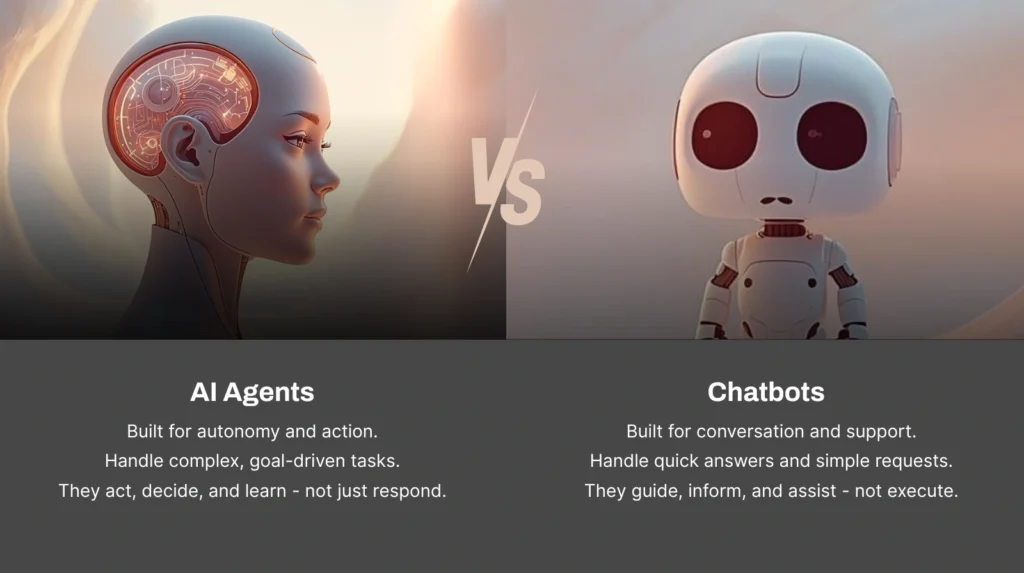

Artificial intelligence has evolved gradually over the last few years as simple rule-based chatbots have now progressed to AI agents capable of planning, reasoning, and acting autonomously. In 2026, this distinction impacts how businesses automate workflows, implement data-driven decisions, and enhance customer experiences.
As organizations are investing more and more in AI-powered systems, understanding the difference between chatbots and AI agents in this scenario has become quite essential for professionals who are looking to pursue AI roles, machine learning, and automation.
In this blog, you will understand the key differences between AI agents and chatbots, along with real-world examples, the core skills required to build chatbots vs agents, and more.
AI Chatbot vs AI Agent: Core Differences Explained Simply
Below are some of the core differences between chatbots and AI agents:
- Interaction Style
AI Chatbots are more conversation-focused, whereas agents are action-focused.
In simple words:
A Chatbot will answer your questions.
An AI agent solves problems.
- Decision-Making Ability
Chatbots tend to operate within predefined logic or trained responses; however, with large language models (LLMs), it offers more fluent replies or customised outputs. On the other hand, AI agents are reported to use reasoning models for choosing the next best action based on goals and objectives.
- Autonomy
Chatbots need continuous user input.
Agentic AI, on the other hand, maintains a long-term memory, thereby allowing it to improve decisions over time.
- Context and Memory
In usual cases, chatbots have short-term context, contrary to AI agents. Hence, AI agents can improve decisions over time thanks totheirs long-term memory.
- Tool Integration
Chatbots might connect to limited systems. However, AI assistant use various databases, tools, APIs, and other AI models actively for completing tasks end-to-end.
Skills Needed to Build Chatbots vs AI Agents
Below are the skills that you need to build for creating a successful AI prompt engineering career:
For Chatbots:
- NLP fundamentals
- Prompt design
- Intent classification
- Conversational UX
For AI Agents:
- Machine learning and reinforcement learning
- Decision modeling
- Tool and API integration
- Model orchestration and evaluation
- Ethical and explainable AI
How Top AI ML Certifications Bridge This Gap in 2026
In 2026, ML and Generative AI certifications, which focus on industry-based skill development and offer capstone projects, can help you bridge the skill gap and give you a competitive edge in the job market. Modern programs primarily emphasize hands-on learning through capstone projects, exposure to Generative AI technologies, and their practical use cases in production environments.
Below are some of the exclusive Generative AI certifications that help learners build strong foundations in AI and ML, gain confidence, and understand real business applications in fields like:
- Natural language processing techniques
- Automation
- Deep learning, and more.
You can explore programs like:
- United States Artificial Intelligence Institute (USAII®) – Certified Artificial Intelligence Engineer (CAIE™)
- University of Texas at Austin’s Online AI & ML Certificate
- University of Adelaide (Australia) – Applied Artificial Intelligence Program
These programs focus more on job-ready skills rather than just theory, which in turn helps to improve employability and career readiness in today’s job market.
Conclusion
Overall, it can be concluded that the evolution from chatbots to AI agents marks a fundamental shift in artificial intelligence. While chatbots are being designed for answering questions, AI agents are focusing on achieving business outcomes. In 2026, recruiters are looking for professionals who can understand and build AI agents for advanced roles in fields like automation, data-driven decision making, and AI. Hence, this is the right time to make a career transition to artificial intelligence with the help of globally accredited AI or Machine Learning Certifications to not just stand out but leverage long-term competitive advantage. Thus, mastering this skill is quite essential and not optional anymore!
FAQs
1. Can a chatbot evolve into an AI agent over time?
Yes. A chatbot can be upgraded into an AI agent by adding memory, decision-making logic, goal-based planning, and tool integrations. However, this requires architectural changes, not just better prompts.
2. Are AI agents suitable for small businesses or only large enterprises?
AI agents are increasingly accessible to small businesses due to cloud platforms and low-code tools. Even small teams can now deploy agents for task automation, analytics, and operational support.
3. Do I need advanced programming skills to work with AI agents?
Basic programming is sufficient to start, but building robust AI agents requires knowledge of machine learning concepts, system design, and model evaluation.
4. How do large language models (LLMs) fit into AI agents?
LLMs often act as the reasoning or language layer within AI agents, helping them interpret goals, generate plans, and interact with tools, rather than just producing conversational responses.
5. What are the risks of relying only on chatbots instead of AI agents? Relying only on chatbots can limit automation and scalability, as they cannot independently execute tasks or adapt decisions based on outcomes, which restricts long-term business impact