
When a vehicle crashes, twists under load, or pulls a heavy trailer, the metal components inside are doing something most people never think about: they are resisting force. Those forces don’t wait politely while engineers debate design theory. They test metallurgy, grain flow, and structural integrity under real-world stress. The difference between sudden failure and engineered survival often comes down to how a component was manufactured.
In modern vehicle design, Forged automotive components are chosen deliberately for strength-critical applications because they behave differently under stress than parts made by casting or machining alone. This is not a marketing statement. It is structural engineering.
This article explains why forged parts matter, how they improve strength and safety, and what makes them preferable over alternative manufacturing in demanding automotive environments.
Forging Isn’t Just Shape — It’s Structural Direction
If you examine a forged part microscopically, you find something important: directional grain flow.
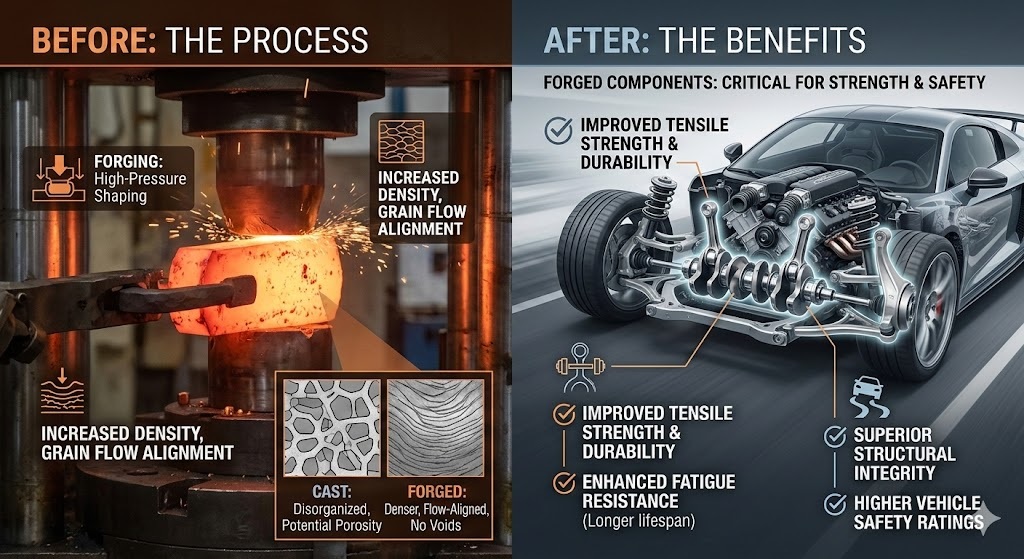
When a component is forged, metal is plastically deformed under controlled pressure. That pressure aligns the internal grain structure along the contours of the part. In simple terms, the metal’s internal network follows the shape of the piece — along load paths, around curves, under bearing surfaces.
This grain alignment matters because most mechanical failures originate where stress and material structure misalign. In cast or machined parts, the internal grain is random or interrupted, which means stress distribution becomes unpredictable. A forged shaft, on the other hand, carries load along the grain rather than across it.
Engineers prefer Forged automotive components for critical load-bearing areas because of this inherent material behavior. It’s like comparing a bundle of straws aligned in the direction of force versus a heap of random sticks.
Fatigue Resistance — The Invisible Advantage
Automobiles don’t operate under constant loads. They operate under cycles. Road vibration, acceleration and braking, steering forces, bumps and potholes — all create cyclical stress.
Fatigue failure is subtle. It starts microscopically and grows over millions of load cycles until a component breaks. Nothing dramatic happens at first. No loud announcement. Just crack growth until the final moment.
Forged parts resist fatigue differently.
Grain flow alignment improves resistance to crack initiation and propagation. Reduced internal discontinuities mean fewer starting points for fatigue cracks. When combined with appropriate heat treatment — quenching and tempering, for example — forged components attain both strength and toughness.
That’s why you find forged parts in:
- Crankshafts
- Connecting rods
- Wheel hubs
- Steering knuckles
- Drive shafts
- Suspension links
These are all components that experience millions of load cycles over a vehicle’s life. The cost of failure here is not just a repair bill — it is often a safety risk.
Impact Resistance and Toughness
Crash scenarios are unpredictable. Structures deform. Components transfer load to other parts of the frame or body. In these events, a material’s ability to absorb energy without sudden failure becomes essential.
Cast metals can be strong, but they can also contain internal porosity or micro-defects that act as stress risers under shock. Machined parts from billet may have directional grain that was interrupted during material removal. These structural discontinuities sometimes become crack initiators under impact loads.
Forging, on the other hand, reduces internal voids because compressive deformation consolidates material. When heat treatment is applied correctly, toughness improves. The result is a component that bends or yields predictably rather than fracturing unpredictably.
For safety-critical parts like steering arms or suspension links, this behavior makes a difference between controlled deformation and catastrophic rupture.
Dimensional Stability Supports Precise Geometry
Safety and strength also depend on fit.
Forged automotive components come off the press closer to final shape than most cast parts. That means less machining, less material removal, and less risk of internal stress relief during finishing. When fewer surfaces are machined away, the mechanical benefits of grain alignment remain intact.
Dimensional precision also supports:
- Better bearing fits
- More accurate assembly alignment
- Reduced tolerance stack-up
- Lower vibration
Precision geometry matters in chassis components, transmission parts, and brake systems. When forged parts maintain consistent dimensions, assembly engineers can plan tighter tolerances without compensating for variation. That contributes to vehicle stability and handling — two attributes that directly affect safety.
Heat Treatment — Turning Strength into Safety
A forged blank is strong, but heat treatment turns strength into usable performance.
Different heat treatments are used depending on the part’s role:
- Quenching to produce a hardened structure
- Tempering to reduce brittleness and improve toughness
- Normalizing to refine grain structure
- Stress relieving to reduce residual stress
Each treatment influences mechanical behavior. Without controlled heat treatment, a forged component can remain inconsistent or unpredictable under load.
At Sendura Forge, tempering cycles are selected based on intended service conditions. Crucially, heat treatment is not applied at random. It is engineered based on material composition and application requirements.
This is a key difference between “strong metal” and “safely strong metal.”
The Difference Between Strength and Safety
Strength is a material property. Safety is a system behavior.
A strong part resists force. A safe system uses strong parts in configurations that prevent failure.
Forged automotive components improve safety not only because they are strong, but because they behave consistently under real-world conditions:
- Fatigue loads
- Impact dynamics
- Temperature variation
- Assembly tolerances
- Wear over time
Consistency is the core reason global OEMs prefer forged parts in load-critical locations.
Weight Optimization Increases Vehicle Performance
Automotive design is always a negotiation between strength and weight.
Heavier vehicles consume more fuel. Lighter vehicles may sacrifice rigidity. Forging allows engineers to push material where it is needed, and remove it where it isn’t.
Near-net forging reduces excess metal that would otherwise be machined away. Designers can specify thinner sections without sacrificing performance because the forging process aligns grain and reinforces structural zones.
This contributes to:
- Better fuel economy
- Lower emissions
- Improved handling
- Controlled deformation behavior
A forged control arm can be lighter than a cast equivalent and stronger at the same time. That combination is valuable in performance, economy, and safety.
Fatigue Life Predictability
Real-world vehicles experience millions of cycles — engine vibration, suspension travel, braking shock, highway oscillation.
A component might see load variations daily that exceed simple static strength requirements.
Average materials can measure high in static tensile tests. But strength under fatigue is another matter.
Forged automotive components behave predictably under repeated stress cycles. Testing data supports this:
- S–N curves (stress vs number of cycles to failure) show extended life
- Fatigue limits are higher
- Scatter in test results is reduced
- Crack initiation delays make endurance predictable
This predictability matters in design validation and safety certification.
Reduced Defects Compared to Alternative Processes
Casting processes, especially sand casting, can introduce internal porosity, shrinkage defects, and cold shuts — all of which act as stress concentrators.
Machining from bar stock eliminates some casting issues but loses grain continuity where material is removed.
Forging reduces these defect sources because:
- Material is consolidated
- Feeders and flash design improve fill
- Controlled forging conditions avoid incomplete sections
When non-destructive testing (NDT) is added — such as ultrasonic inspection or magnetic particle inspection — risk shrinks further.
Safety is not controlled by one process. It is controlled by multiple layers of verification.
Structural Testing Supports Real Safety Claims
Standards in automotive engineering involve extensive validation of components under realistic load scenarios. Testing includes:
- Fatigue testing
- Static load testing
- Impact testing
- Thermal cycling
- Environmental conditioning
Forged automotive components are chosen because they consistently pass these tests with margin. There are no “surprise failures” in certified batches if process control holds.
Batch-level testing builds confidence across a platform — whether it’s passenger cars, SUVs, commercial trucks, or two-wheelers.
Integration with Assembly and Systems Engineering
Safety is a system property. Components don’t operate in isolation. They interact with:
- Suspension geometry
- Steering rack alignment
- Brake actuation systems
- Load paths in crash events
A forged part that arrives with unpredictable geometry complicates this. It introduces variation into the assembly, which must be compensated for elsewhere.
With tight dimensional consistency from forging and downstream machining, assembly variation shrinks. That means predictable behavior under dynamic loads — the sort that occur in emergency braking, evasive maneuvers, or uneven terrain.
Traceability Matters in Automotive Supply Chains
Modern automotive manufacturing involves traceability requirements. Every critical component — especially those affecting safety — must be trackable to material batch, forging cycle, heat treatment process, inspection results, and dispatch date.
This is not optional for OEMs. It is contractual. It affects warranty, recall management, and failure investigation.
A structured producer of Forged automotive components like Sendura Forge maintains documented traceability so that each part can be linked back to its production history.
This transparency is part of safety infrastructure.
Supply Chain Reliability and Audits
Automotive OEMs require supplier audits. They evaluate:
- Process capability
- Quality systems
- Measurement equipment calibration
- Heat treatment controls
- Rework prevention
- Scrap handling
- Documentation
A supplier that can demonstrate consistent process control reduces risk to the vehicle manufacturer.
This is another reason forged components are preferred: not because forging alone is better, but because the systems around forging are mature and audit-ready.
Final Reality: Safety Is Structural
It is too easy to think strength equals safety. It does not.
Safety involves:
- Material behavior under dynamic loads
- Structural alignment
- Fatigue life
- Predictable deformation
- System integration
- Traceable production history
Forged automotive components contribute to safety because they provide:
- Directional grain strength
- Low internal defect probability
- Controlled dimensional precision
- Repeatable mechanical properties
- Audit-friendly production records
This combination reduces engineering uncertainty.
In vehicle structures where failure is not an option — steering, suspension, drivetrain, and crash energy management — forged parts are not a convenience. They are a deliberate choice.
Safety is not an accident. It is engineered, and forging is one of the tools that makes that engineering work.