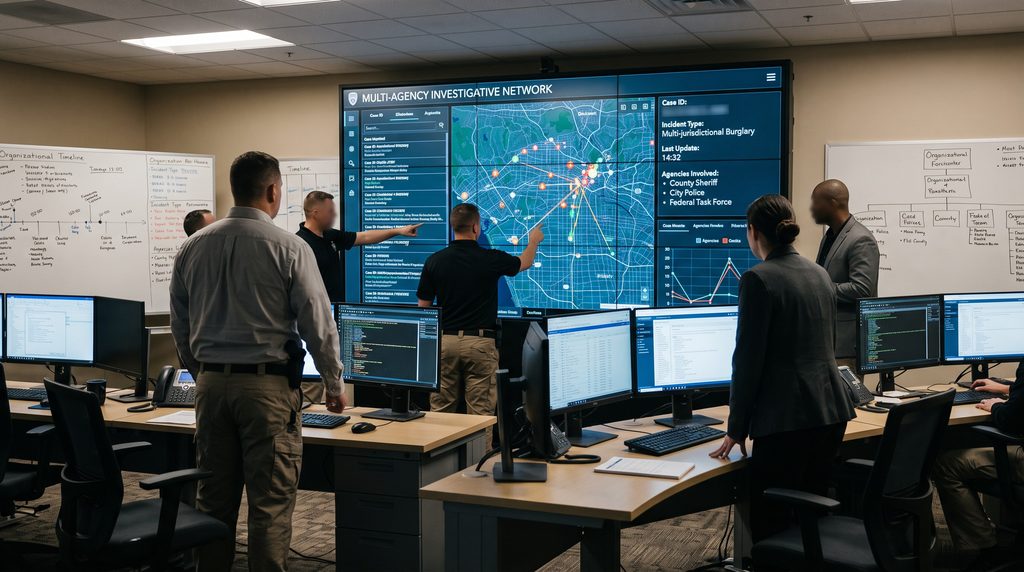
Crime rarely stays inside one jurisdiction. A suspect may live in one county, commit offenses in two others and drive a vehicle registered in a neighboring state. A burglary series can stretch across several towns before anyone notices the pattern. Solving these cases depends on agencies sharing what they know, quickly and securely.
That is harder than it sounds. Agencies use different systems, follow strict security rules and often rely on phone calls and email to fill the gaps. Law enforcement information sharing software closes those gaps. This article explains how it supports multi-agency investigations at each stage, from the first alert to the final case file.
Why information sharing breaks down
Most investigators can point to a case that stalled because information did not move. The causes tend to repeat:
- Records held in separate systems that do not connect
- Requests sent by phone or email with no tracking or follow-up
- Uncertainty about what can be shared and with whom
- Delays waiting for another agency’s records unit to respond
- Duplicate work when two agencies chase the same lead
- Key details, such as photos or identifiers, lost in retelling
Each delay gives suspects time and leaves victims waiting. Law enforcement information sharing software addresses these problems by giving agencies a secure, common way to request, send and track information.
What law enforcement information sharing software does
At its core, law enforcement information sharing software connects agencies to each other and to the shared systems they all rely on. That includes national files such as NCIC, the Nlets network for interstate exchanges, and state criminal justice and motor vehicle systems. A state message switch typically routes this traffic so each request reaches the right destination.
On top of those connections, the software provides tools that investigators and dispatchers use every day:
- Secure messaging between users and agencies
- Encrypted forwarding of responses, images and documents
- Broadcast messages and alerts to multiple agencies at once
- Queries to national, state and interstate systems from one interface
- Workflows for entering wanted persons and confirming hits
- Audit logs that record every transaction
The result is one secure channel for information that used to move through several informal ones.
Stage one: getting the word out
The first hours of an investigation often decide its course. When a suspect flees or a vehicle is used in a crime, neighboring agencies need to know right away.
Law enforcement information sharing software lets agencies send broadcast messages and alerts to the units and jurisdictions that need them. One message can reach multiple departments at once, instead of a dispatcher calling each one. Recipients receive the same details, including descriptions and photos, so nothing is lost in translation. Officers on patrol in other jurisdictions can see the alert on their mobile devices and act on it.
Stage two: identifying people and vehicles
Once investigators have a name, a plate or a partial description, they need records. Law enforcement information sharing software allows authorized users to query state files, national files and out-of-state records through the interstate network.
Speed matters here. When a criminal history response comes back, an investigator should be able to launch follow-up queries straight from that response rather than retyping identifiers. Photos and documents attached to responses help confirm identity. Each step builds a clearer picture of the suspect, their vehicles and their history.
Stage three: coordinating the team
Multi-agency investigations often involve task forces, regional units or informal partnerships between neighboring departments. Coordination can fall apart when each agency keeps its own notes and updates.
Law enforcement information sharing software gives the team a secure place to exchange information. Message threads keep requests and responses together, so anyone reviewing the case can follow the history. Encrypted forwarding lets an investigator pass a response to a partner agency without leaving the secure system. Supervisors can see what has been shared and what is still pending.
Stage four: locating and apprehending suspects
When investigators obtain a warrant, entering it into the national wanted person file makes it visible to agencies across the country. If the suspect is stopped anywhere, the inquiring officer receives a hit.
Law enforcement information sharing software speeds up this step by prefilling entry forms with demographic data from earlier responses, which cuts typing and reduces errors. When another agency gets a hit, the software manages the hit confirmation exchange, so the arresting officer receives a clear, timely answer from the agency that holds the warrant.
Stage five: building the case
A strong case depends on documentation. Prosecutors and defense attorneys may ask how information was obtained, when it was received and who saw it.
Law enforcement information sharing software records every query, message and response in an audit log. That trail shows the chain of information behind key decisions. It also supports compliance with the FBI CJIS Security Policy, which requires agencies to log relevant activity and retain those logs for at least one year. Agencies sharing criminal history information with other agencies must also keep records of those secondary disseminations, and a central system makes that far easier.
Sharing securely and lawfully
Information sharing has limits, and they exist for good reason. Criminal justice information is protected by federal and state rules. Access depends on a user’s role and the purpose of the request. Agencies must protect data in transit and at rest, verify user identities and track who accessed what.
Good law enforcement information sharing software builds these safeguards into the workflow:
- Multi-factor authentication for every user
- Encryption using FIPS-validated cryptographic modules
- Role-based access so users see only what they are authorized to see
- Complete audit logging of queries, messages and forwards
- Support for interagency agreements and dissemination tracking
When security is built in, officers don’t have to choose between sharing quickly and sharing correctly.
An example in practice
Consider a string of catalytic converter thefts across three neighboring counties. One agency recovers surveillance footage showing a pickup truck with a partial plate. Using law enforcement information sharing software, its investigator sends an alert with the vehicle description and image to the other two agencies.
Within hours, an officer in the second county runs a plate during a traffic stop and recognizes the truck from the alert. Records queries link the registered owner to prior arrests in the third county. The three agencies coordinate through secure messages, share reports and identify the suspects. A warrant is entered, and when one suspect is stopped in another state weeks later, the hit is confirmed within minutes. Every step is documented in the audit log for prosecutors.
Without a common system, the same case could have taken weeks to connect, if it was connected at all.
What to look for in a platform
When evaluating law enforcement information sharing software, consider:
- Connections to national, state and interstate systems
- Secure messaging and encrypted forwarding between agencies
- Broadcast tools for alerts to multiple agencies
- Follow-up queries launched directly from responses
- Prefilled entry forms and hit confirmation workflows
- Built-in audit logging and dissemination tracking
- Access from dispatch consoles, desks and patrol devices
- Integration with CAD and RMS
- Alignment with CJIS Security Policy version 6.0
Law enforcement information sharing software from CPI OpenFox
CPI OpenFox builds the systems that help agencies share information securely. Our message switch technology routes criminal justice traffic for state and local agencies, and CPI OpenFox powers mission-critical systems for 31 states and thousands of agencies nationwide.
MessengerNow puts that capability in users’ hands through a secure, browser-based interface. It supports encrypted sharing of messages and data between users and departments, one-click casting of follow-up transactions to relevant units or agencies, and real-time delivery of responses and alerts. Investigators can launch criminal history follow-up queries directly from responses and prefill wanted person entries with existing data. Built-in audit logging keeps every exchange ready for review.