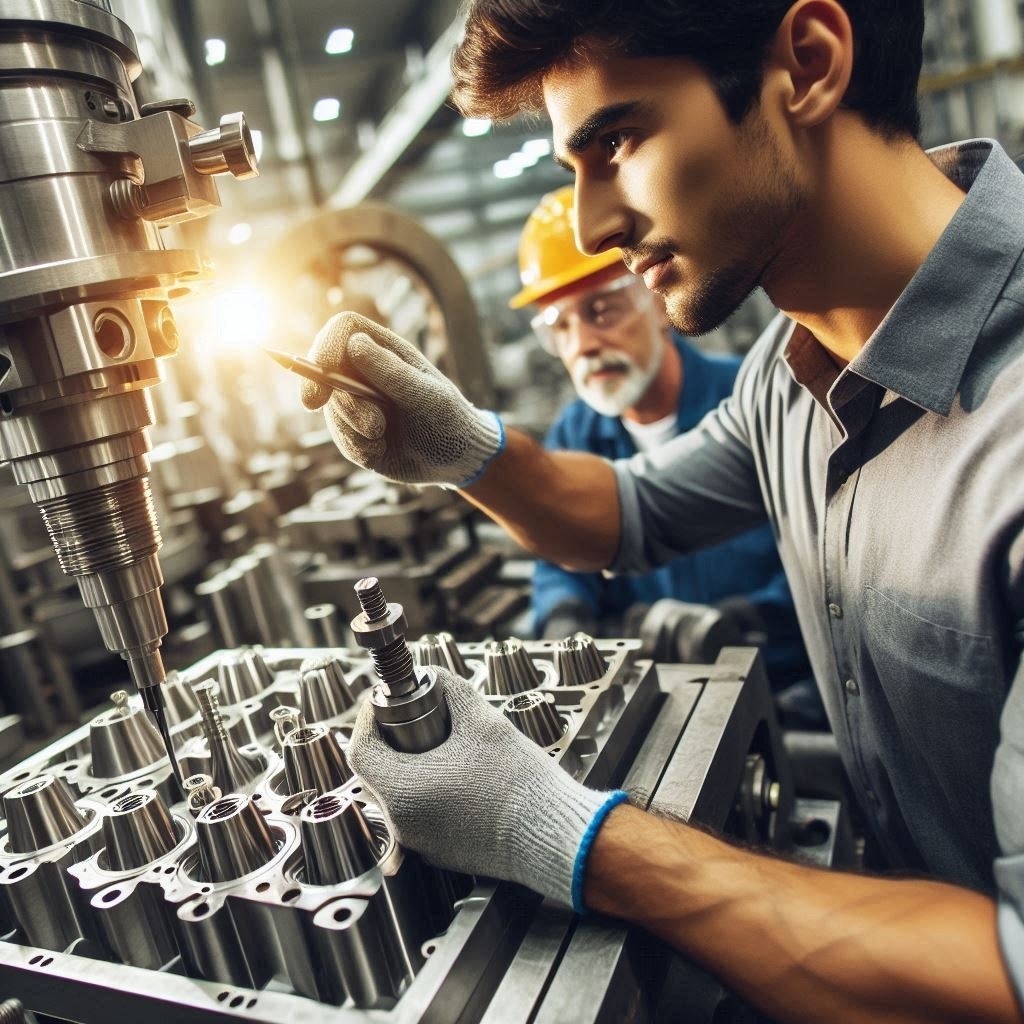

Machined investment casting is a modern manufacturing technique that combines the advantages of investment casting with the advantages of CNC machining. Machined investment casting is used throughout many industries where complex geometries, fine tolerances and superior surface finishes are required. Because machining is combined with casting processes, manufacturers can create a part that meets all specified tolerances with minimal secondary operations.
What is Machined Investment Casting?
Investment casting, or lost-wax casting, is a process that begins with patterns made of wax being coated in ceramic material to create molds. After curing the molds are heated removing the wax, before being poured with molten metal to create shapes that are of an approximate shape.
Although this method offers terrific accuracy, machining is often necessary afterwards to achieve tightly toleranced parts, surfacing, and precise dimensions. Ultimately, resulting in components that are cost-efficient (due to the lower cost of casting) but with superior precision (due to the time spent machining).
Benefits of Machined Investment Casting
Machined investment casting have multiple advantages, contributing to their popularity in many critical applications. Investment castings can accomplish complex geometries including complex shapes and thin-walled parts, which are normally very difficult for conventional methods and it produces machining accuracy with tolerances as low as a few microns. Investment castings use a variety of materials including stainless steel, carbon steel, aluminum, superalloys and many others to meet industry needs.
Investment castings promote less waste by allowing near-net-shape condition as compared to machining parts out of solid blocks. Investment castings can be made in small or large quantities while offering manufacturers flexibility and cost effectiveness.
Industries Served
In several industries, machined investment castings represent reliable components that provide durability, precision, and performance. In the automotive industry, machined investment castings provide important areas like engines, turbochargers, gears, and exhaust systems that require strength and precision. The aerospace industry depends on machined investment castings for lightweight yet very high-performance castings such as turbine blades, fuel systems, and mounting brackets to strict standards. In energy and power, machined investment castings provide vital valve bodies, pump parts, and turbine components that have to withstand high pressures and/or corrosive environments. The defense and marine industries leverage machined investment castings to give strong, corrosion resistant components designed for tough and extreme environments. Lastly, machined investment castings allow for making precision housings, fittings, and gears in industrial machinery to enable efficiency and long-term reliability.
Conclusion
Machined investment casting gives manufacturers the best of both worlds: a cost-effective cast, and an accurate machine. Machined investment casting is reliable, high-performance, and continues to be an important part of facilitating the world’s industries for quality and durability.