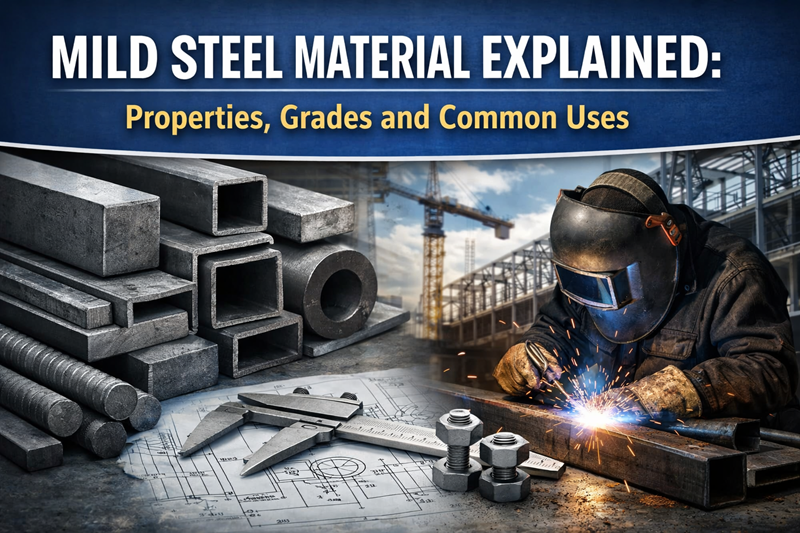

Mild steel material remains one of the most widely used engineering materials in Australia and globally. Its balance of strength, workability, availability, and cost has made it a foundational material across construction, manufacturing, and industrial engineering. From structural frameworks to precision-fabricated components, mild steel continues to support projects that demand reliability without unnecessary complexity.
This article provides a clear and technically grounded explanation of mild steel material, including its defining properties, commonly used grades in Australia, and practical applications. It is written for engineers, designers, fabricators, and technical decision-makers who want a reliable reference to support material selection and specification. For a broader overview of engineering materials, including steels and non-ferrous metals, you can also explore this reference on Mild Steel Material.
What Is Mild Steel Material
Mild steel material is a type of carbon steel with a relatively low carbon content, typically between 0.05 percent and 0.25 percent by weight. This low-carbon composition is what differentiates mild steel from medium and high-carbon steels, giving it superior ductility and ease of fabrication.
Unlike alloy steels, mild steel contains minimal amounts of additional alloying elements. This simplicity makes it predictable in performance and widely compatible with standard engineering processes such as welding, forming, and machining. As a result, mild steel is commonly specified for general-purpose engineering and structural applications where extreme hardness or corrosion resistance is not the primary requirement.
Key Properties of Mild Steel Material
Mechanical Properties
The mechanical behaviour of mild steel material makes it suitable for a wide range of load-bearing and fabricated components. It offers moderate tensile strength, good yield strength, and excellent ductility. These characteristics allow the material to deform under stress rather than fracture suddenly, which is a critical safety consideration in structural engineering.
Its impact resistance also makes it suitable for applications where dynamic loads or vibration may be present, such as machinery frames and industrial supports.
Chemical Composition
Mild steel is primarily composed of iron with a small percentage of carbon and trace elements such as manganese, silicon, and phosphorus. The low carbon content improves weldability and reduces the risk of cracking during fabrication. This predictable chemistry is one reason mild steel is so widely accepted in engineering standards and specifications.
Workability and Machinability
One of the defining advantages of mild steel material is its ease of processing. It can be cut, bent, drilled, machined, and formed using conventional equipment without specialised tooling. These qualities make it highly compatible with laser cutting, press braking, CNC machining, and general fabrication processes.
For engineering workshops and manufacturing environments, this translates into shorter lead times and lower processing costs.
Weldability
Mild steel is considered one of the most weldable steels available. It can be joined using common welding methods such as MIG, TIG, and stick welding without extensive preheating or post-weld heat treatment. This makes it a preferred choice for structural fabrication, repair work, and custom-engineered assemblies.
Common Mild Steel Grades Used in Australia
Australian Standards and Compliance
In Australia, mild steel material is commonly specified according to national standards developed by Standards Australia. These standards define mechanical properties, chemical composition, and testing requirements to ensure consistency, safety, and performance in engineering applications.
Compliance with recognised standards is essential for structural integrity, regulatory approval, and long-term reliability.
Mild Steel Grade 250
Grade 250 mild steel is widely used for general fabrication and light structural applications. It has a minimum yield strength of 250 megapascals, offering sufficient strength for non-critical load-bearing components.
This grade is commonly used in brackets, plates, frames, and fabricated assemblies where ease of fabrication and cost efficiency are priorities.
Mild Steel Grade 350
Grade 350 mild steel provides higher yield strength, typically 350 megapascals, making it suitable for structural and load-bearing applications. It is often specified for beams, columns, and structural plates where higher strength is required without moving to more complex alloy steels.
Despite its higher strength, Grade 350 maintains good weldability and workability, which supports its widespread use in construction and heavy fabrication.
Choosing the Right Grade
Selecting the appropriate mild steel grade depends on several factors, including load requirements, fabrication method, and compliance obligations. Engineers must consider both mechanical performance and processing requirements to ensure the material performs as intended throughout its service life.
Common Uses of Mild Steel Material
Structural and Construction Applications
Mild steel material is extensively used in structural frameworks for residential, commercial, and industrial buildings. Its predictable strength and compliance with Australian Standards make it suitable for beams, columns, supports, and framing systems.
Fabrication and Manufacturing
In fabrication and manufacturing environments, mild steel is used to produce enclosures, panels, brackets, bases, and custom-engineered components. Its compatibility with laser cutting and forming processes allows for high precision while maintaining cost control.
Engineering and Industrial Components
Mild steel is also used in machinery frames, equipment housings, platforms, and general engineering components. Its ability to withstand moderate loads and its ease of repair make it practical for industrial settings.
Mild Steel Material vs Other Steel Types
When compared to stainless steel, mild steel material is significantly more cost-effective but lacks inherent corrosion resistance. Stainless steel is preferred in corrosive or hygienic environments, while mild steel is often chosen when protective coatings or controlled environments are sufficient.
Compared to high-carbon or alloy steels, mild steel offers lower strength and hardness but far greater ease of fabrication. For many engineering applications, this balance makes mild steel the most practical choice.
Advantages and Limitations of Mild Steel Material
Mild steel offers several advantages, including affordability, widespread availability, ease of welding, and compatibility with standard fabrication processes. These benefits contribute to its continued dominance in engineering and construction.
However, mild steel has limitations. It is more susceptible to corrosion than stainless or alloy steels and may require protective coatings such as paint or galvanising. Its strength is also lower than that of specialised alloy steels, which may limit its use in high-stress applications.
Sustainability and Recycling Considerations
From a sustainability perspective, mild steel material is highly recyclable. Steel can be recycled multiple times without significant loss of mechanical properties, supporting circular economy principles in construction and manufacturing.
Many engineering projects benefit from the availability of recycled steel feedstock, which reduces environmental impact while maintaining performance standards.
Standards, Testing, and Quality Assurance
Quality assurance is a critical aspect of using mild steel material in engineering applications. Mechanical testing, chemical analysis, and dimensional inspection are commonly performed to verify compliance with specifications.
In addition to Australian standards, international references such as those developed by ASTM International and ISO are often consulted for global projects and comparative benchmarks.
Frequently Asked Questions About Mild Steel Material
Yes, mild steel can be used outdoors, but it typically requires protective coatings or treatments to reduce corrosion risk.
Mild steel is highly suitable for laser cutting and welding due to its low carbon content and consistent material properties.
The primary difference is yield strength. Grade 350 offers higher strength and is commonly used for structural applications, while Grade 250 is suited to general fabrication.
Mild steel is more cost-effective and easier to fabricate, while stainless steel offers superior corrosion resistance at a higher cost.
Yes, mild steel is fully recyclable and widely reused in construction and manufacturing industries.
Conclusion
Mild steel material continues to play a critical role in engineering, fabrication, and construction due to its balance of strength, workability, and cost efficiency. Understanding its properties, grades, and limitations allows engineers and technical professionals to make informed decisions that support safety, performance, and long-term value.
By selecting the appropriate grade and applying proper design and protection measures, mild steel remains a dependable and versatile material for a wide range of engineering applications.



