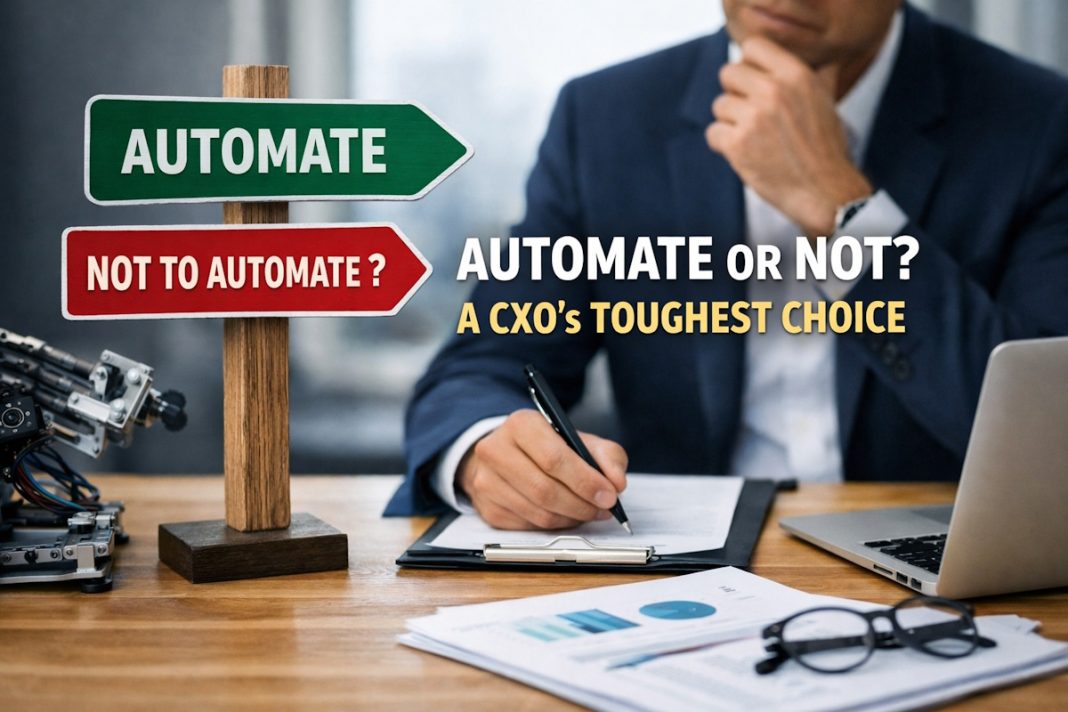

Every CXO today feels the pressure. Faster delivery. Lower costs. Lean teams. Better output. And somewhere in every strategy meeting, the same idea pops up again and again. Automate more.
Sounds simple, right?
Not really.
Because the real challenge isn’t deciding what to automate. That part is often obvious. Repetitive workflows, data processing, system integrations, routine customer responses. Those are easy wins.
The hard call is deciding what not to automate.
And that decision can shape your company’s growth, brand perception, and even team culture.
Let’s break it down in a way that actually helps you make that call.
Automation Isn’t Always the Smart Move
There’s this quiet assumption that automation equals progress. That if something can be automated, it should be.
That’s not always true.
Some processes look inefficient on paper but hold deeper value. They carry context, emotion, or judgment that doesn’t translate well into rules or workflows.
This is where many CXOs slip. They chase speed and forget nuance.
Even when working with tools or platforms supported by teams offering n8n automation services, the goal shouldn’t be to automate everything. It should be to automate wisely.
So before you jump in, ask yourself one simple question.
What might break if we remove the human layer here?
High-Emotion Customer Interactions
Not every customer interaction is just a ticket to resolve.
Some are charged with frustration. Others come with confusion, urgency, or even fear. Think about escalations, complaints, or sensitive account issues.
Automating these interactions often leads to robotic responses. And customers can tell. Instantly.
A scripted workflow might resolve the issue faster, but it can damage trust.
People want to feel heard. Not processed.
So while automation can assist with routing or tagging, the actual conversation often needs a human touch.
If you fully automate this layer, you risk turning moments of friction into moments of churn.
Strategic Decision-Making
Let’s be honest. No CXO wants a system making core business decisions without oversight.
Data can guide. Systems can suggest. But decisions tied to growth, partnerships, hiring, or market positioning require context.
And context is messy.
It includes gut instinct, past experience, timing, and sometimes even risk appetite. These aren’t things you can plug into a workflow and expect reliable output.
Automation can support analysis. It can surface patterns.
But it shouldn’t replace judgment.
Creative Work That Shapes Your Brand
Your brand voice. Your messaging. Your campaigns.
These aren’t just outputs. They are reflections of how your company thinks and communicates.
Automating creative work might save time, but it often strips away originality. You end up with content that sounds like everything else.
Safe. Predictable. Forgettable.
And in crowded markets, that’s a problem.
Sure, workflows can help with approvals, scheduling, and distribution. But the core creative thinking? That needs people.
Complex Exception Handling
Workflows love patterns.
But real businesses? They run on exceptions.
Edge cases. Unusual requests. Unique customer needs. Internal overrides.
When you automate a process that frequently runs into exceptions, you either:
- Build an overly complex system that’s hard to maintain
- Or create a rigid flow that breaks when something unexpected happens
Neither is ideal.
Sometimes, it’s better to keep these processes semi-manual. Or at least human-supervised.
Automation works best when the path is predictable. Not when it constantly needs bending.
Early-Stage Processes
If a process is still evolving, don’t rush to automate it.
This is a common mistake.
Teams identify a workflow, automate it, and then realize a few weeks later that the process itself needs to change. Now they’re stuck updating automation again and again.
It slows things down instead of speeding them up.
First, stabilize the process. Let it run manually. Understand its gaps.
Then automate.
Jumping too early creates more friction than value.
Internal Culture and Team Morale
This one doesn’t get talked about enough.
Over-automation can make teams feel replaceable.
When people start seeing their day-to-day work being handed over to systems, it creates uncertainty. Sometimes even resistance.
And that affects how they perform.
Automation should support teams, not sideline them.
When done right, it removes repetitive work and lets people focus on higher-value tasks. But when pushed too far, it can disconnect teams from their work.
That’s a subtle but real risk.
Compliance and Sensitive Operations
Certain processes carry legal or compliance risks.
Financial approvals. Data access controls. Regulatory reporting.
Automating these without proper checks can backfire badly.
A small error in a workflow can lead to major consequences.
In such cases, automation should assist, not take full control.
Human validation layers are essential.
The Real Role of Automation
So where does that leave you?
Automation is powerful. No doubt.
Platforms supported by teams you might hire n8n developers from can help connect systems, reduce manual effort, and bring clarity to operations.
But the goal isn’t full automation.
It’s thoughtful automation.
The kind that respects the boundaries between speed and sensitivity. Between logic and judgment.
A Simple Framework for CXOs
If you’re unsure whether to automate something, run it through this quick check:
- Does this process rely heavily on human judgment?
- Does it involve emotional or sensitive interactions?
- Is it still changing frequently?
- Are exceptions common and unpredictable?
- Could automation harm trust or experience?
If you answered yes to even two of these, pause.
You might want to rethink automation here.
The Call You Can’t Avoid
At some point, every CXO faces this trade-off.
Speed vs experience. Cost vs control. Automation vs human value.
There’s no perfect formula.
But one thing is clear.
Automating the wrong things can cost more than not automating at all.
So take your time with this decision.
Look beyond efficiency metrics. Think about impact.
Because the smartest companies aren’t the ones that automate the most.
They’re the ones that know when not to.