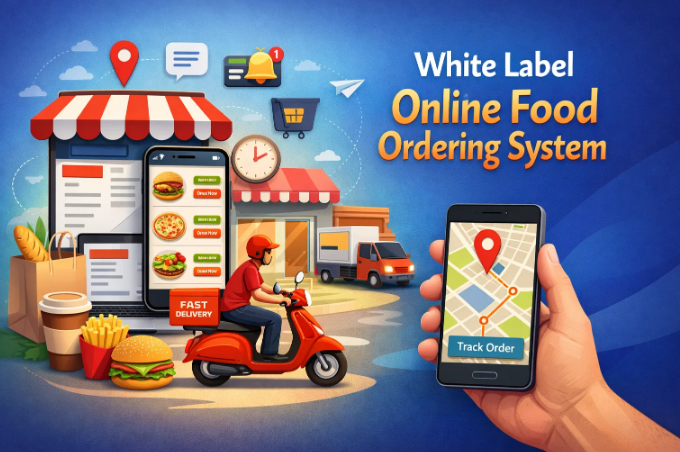

The global food delivery industry has experienced massive growth over the past decade, driven by smartphone adoption, digital payments, and the demand for convenience. Entrepreneurs and businesses are increasingly looking for ways to enter this competitive market without building a platform entirely from scratch. One of the most practical solutions for achieving this goal is adopting a white label online food ordering system.
A white label online food ordering system allows businesses to launch their own branded food ordering and delivery platform using pre-built technology. Instead of investing years into software development, companies can customize an existing solution and bring their product to market much faster. This approach significantly reduces development costs while enabling businesses to focus on growth and customer experience.
The demand for digital ordering solutions continues to grow as restaurants, cloud kitchens, and delivery startups search for ways to control their online presence. Businesses that rely solely on third-party aggregators often struggle with high commission fees and limited control over customer data. By implementing a white label online food ordering system, companies gain full ownership of their platform while offering a seamless ordering experience to users.
This article explores the technology behind white label food ordering platforms, their architecture, features, and how entrepreneurs can launch their own food delivery marketplace using a scalable digital infrastructure.
Understanding the Concept of a White Label Online Food Ordering System
A white label online food ordering system is a ready-made software platform that allows businesses to deploy a food ordering and delivery service under their own brand identity. The underlying technology is developed once but can be customized by different companies with their logos, design elements, and feature configurations.
Unlike traditional custom development, which requires building every component from scratch, white label solutions provide a functional framework that already includes essential modules. These modules often include customer ordering apps, restaurant dashboards, delivery partner applications, and an administrative control panel.
This approach enables businesses to launch quickly while maintaining flexibility in branding and feature customization. The platform behaves as if it were fully built by the company itself, even though the underlying infrastructure is pre-developed.
In many cases, a white label online food ordering system also supports integration with payment gateways, location tracking technologies, and restaurant management tools. These integrations ensure that the system operates smoothly within the digital food delivery ecosystem.
The Growing Demand for Food Delivery Platforms
The global shift toward digital commerce has significantly transformed the restaurant industry. Customers increasingly prefer ordering meals through mobile applications rather than calling restaurants directly. This trend has fueled the rapid expansion of delivery platforms and mobile-based ordering services.
Food delivery marketplaces have become digital hubs where restaurants, delivery partners, and customers interact through a single platform. The technology behind these platforms must support real-time communication, location tracking, and efficient order management.
As the market grows, businesses are exploring alternatives to aggregator platforms that charge high commission fees. A white label online food ordering system provides an opportunity to create an independent marketplace while maintaining full control over operations and branding.
Many entrepreneurs are also building niche platforms targeting specific markets, such as local restaurants, cloud kitchens, or regional cuisines. A multi-vendor food delivery app allows multiple restaurants to join the platform and reach customers through a unified ordering experience.
Key Components of a White Label Food Delivery Ecosystem
A complete food delivery ecosystem involves several interconnected digital products. A white label online food ordering system typically includes multiple applications designed for different stakeholders.
The customer-facing application serves as the primary interface where users browse menus, place orders, and track deliveries. This application is often available on both iOS and Android platforms and may also include a web-based ordering portal.
Restaurant partners require a separate interface to manage menus, update pricing, process incoming orders, and monitor performance analytics. These dashboards allow restaurants to operate efficiently while staying connected to the platform.
Delivery partners use a dedicated driver application to receive delivery requests, navigate routes, and confirm order completion. Real-time GPS tracking ensures that customers can monitor the progress of their orders.
The administrative panel acts as the central control hub for managing users, restaurants, payments, promotions, and system settings. This component ensures that platform operators maintain oversight of the entire ecosystem.
Together, these components form the technological backbone of a white label online food ordering system.
Architecture of a Multi-Vendor Food Delivery Platform
A multi-vendor food delivery app requires a robust system architecture capable of supporting multiple restaurants and thousands of concurrent users. The platform must efficiently manage order routing, restaurant onboarding, payment processing, and delivery logistics.
Modern food delivery systems often rely on cloud-based infrastructure to ensure scalability and performance. Cloud hosting enables the platform to handle spikes in demand during peak meal times without compromising user experience.
The architecture typically includes a front-end layer, an application layer, and a database layer. The front-end layer handles user interfaces, while the application layer processes business logic such as order matching and delivery assignments.
Microservices architecture is increasingly used in large-scale food delivery platforms. By separating functions into independent services, developers can update or scale individual components without disrupting the entire system.
This modular approach is particularly beneficial for businesses deploying a white label online food ordering system, as it supports rapid customization and feature expansion.
Core Features of a White Label Online Food Ordering System
The effectiveness of a white label online food ordering system largely depends on its feature set. The platform must provide intuitive tools for users while offering powerful management capabilities for operators and restaurant partners.
User-friendly menu browsing is a fundamental feature of any food ordering application. Customers should be able to explore restaurant listings, filter cuisines, and view menu items with detailed descriptions and images.
Secure digital payments are another essential component. Integration with multiple payment gateways ensures that customers can pay using credit cards, digital wallets, or online banking.
Real-time order tracking enhances transparency and builds customer trust. GPS-enabled tracking systems allow users to monitor the delivery partner’s location and estimated arrival time.
Push notifications keep customers informed about order confirmations, preparation updates, and delivery status. These notifications also help restaurants and drivers stay synchronized throughout the order lifecycle.
A white label online food ordering system often includes advanced analytics tools that provide insights into customer behavior, order trends, and platform performance.
Technology Stack Behind Food Delivery Platforms
Developing a scalable food delivery platform requires a carefully selected technology stack. Many top food delivery app development companies use modern frameworks and cloud technologies to build reliable applications.
Front-end technologies typically include frameworks such as React, Angular, or Flutter for creating responsive user interfaces. These frameworks enable developers to build cross-platform applications that function smoothly on both mobile devices and web browsers.
The backend layer often relies on programming languages such as Node.js, Python, or Java. These technologies handle the platform’s business logic, database interactions, and real-time communications.
Databases such as PostgreSQL, MongoDB, or MySQL are commonly used to store user data, order information, and restaurant details. Cloud platforms like AWS, Google Cloud, and Microsoft Azure provide infrastructure services that support scalability and high availability.
Location-based services play a critical role in delivery logistics. APIs for maps and geolocation enable route optimization and accurate delivery tracking within a multi-vendor food delivery app.
Role of APIs and Integrations
Modern food delivery platforms depend heavily on APIs to connect various digital services. A white label online food ordering system often integrates multiple third-party APIs to enhance its functionality.
Payment gateway APIs enable secure online transactions while supporting multiple currencies and payment methods. These integrations ensure that the platform can process payments efficiently without storing sensitive financial data.
Mapping and geolocation APIs allow delivery drivers to navigate routes and track customer locations. Real-time location data ensures that orders are delivered quickly and accurately.
Communication APIs facilitate push notifications, SMS alerts, and email updates. These services help maintain continuous communication between customers, restaurants, and delivery partners.
Integration with restaurant management systems is also becoming increasingly common. These integrations allow menu updates, inventory management, and order synchronization across multiple digital platforms.
Security and Data Protection in Food Delivery Platforms
Security is a critical consideration when building a digital ordering platform. A white label online food ordering system must implement strong security measures to protect user data and financial transactions.
Encryption technologies such as SSL and TLS secure communication between the application and servers. These protocols prevent unauthorized access to sensitive information during data transmission.
Authentication systems ensure that only authorized users can access specific platform features. Multi-factor authentication adds an additional layer of protection for administrative accounts.
Data privacy regulations require businesses to implement proper data management practices. Secure storage, access control mechanisms, and data anonymization techniques help protect user information.
Many food delivery app development company teams also conduct regular vulnerability assessments and penetration testing to identify potential security risks.
Scalability and Performance Optimization
A successful food delivery platform must handle thousands of simultaneous orders without performance issues. A white label online food ordering system should therefore be designed with scalability in mind.
Cloud-based infrastructure allows platforms to scale resources dynamically based on demand. During peak hours, additional computing power can be allocated automatically to maintain system performance.
Caching technologies improve application speed by storing frequently accessed data in memory. This reduces the load on databases and ensures faster response times for users.
Load balancing distributes incoming traffic across multiple servers, preventing system overload. This technique is essential for maintaining stability during periods of high user activity.
Performance monitoring tools help developers identify bottlenecks and optimize system performance over time.
Building a Multi-Vendor Marketplace
A multi-vendor food delivery app operates as a marketplace where multiple restaurants can list their menus and receive orders from customers. This model allows platform operators to create a digital ecosystem that connects restaurants with a large customer base.
Restaurant onboarding is a key component of marketplace development. The platform must provide an easy process for restaurant owners to register, upload menus, and manage orders.
Vendor management systems allow administrators to approve new restaurants, monitor performance, and manage commission structures. These tools help maintain quality standards across the platform.
Order routing algorithms ensure that customer orders are directed to the appropriate restaurant based on location, availability, and delivery capacity.
By supporting multiple vendors, a white label online food ordering system enables businesses to create scalable marketplaces that grow as new restaurants join the platform.
The Role of an On-Demand App Development Company
Building and maintaining complex digital platforms often requires specialized technical expertise. Many businesses collaborate with an on demand app development company to implement their food delivery technology.
These companies provide services such as application development, infrastructure setup, system integration, and technical maintenance. Their experience with large-scale platforms helps ensure that the system operates reliably.
An on demand app development company also assists with customization and feature expansion. As businesses grow, new modules such as loyalty programs, subscription models, and AI-driven recommendations can be added to the platform.
Collaboration with experienced developers ensures that a white label online food ordering system remains adaptable to changing market demands.
Future Technologies in Food Delivery Platforms
The food delivery industry continues to evolve as new technologies reshape the digital ordering experience. Artificial intelligence and machine learning are increasingly used to personalize user experiences and optimize delivery logistics.
Recommendation engines analyze customer preferences and suggest menu items based on previous orders. These algorithms improve user engagement while increasing order values.
Predictive analytics can forecast demand patterns, helping restaurants prepare for peak periods. Delivery routing algorithms also benefit from machine learning, allowing drivers to take the fastest routes in real time.
Emerging technologies such as drone delivery and autonomous vehicles may further transform the logistics component of food delivery platforms.
Businesses that implement a scalable white label online food ordering system are better positioned to integrate these technologies as they become commercially viable.
Challenges in Building Food Delivery Platforms
Despite the opportunities, launching a food delivery platform involves several technical challenges. Ensuring reliable performance under heavy traffic conditions requires careful system design and infrastructure planning.
Managing real-time communication between customers, restaurants, and delivery partners can be complex. The platform must maintain synchronization across multiple applications while handling continuous data updates.
Another challenge involves integrating various third-party services such as payment gateways, mapping APIs, and messaging platforms. These integrations must function seamlessly to maintain a smooth user experience.
Security threats, including data breaches and fraudulent transactions, also require constant monitoring and proactive protection strategies.
A well-designed white label online food ordering system addresses these challenges through modular architecture and scalable infrastructure.
Conclusion
The digital transformation of the restaurant industry has created significant opportunities for entrepreneurs and businesses to launch their own food delivery platforms. Instead of building complex software systems from scratch, many organizations are adopting a white label online food ordering system to accelerate their market entry.
These platforms provide a comprehensive technology framework that includes customer applications, restaurant dashboards, delivery management tools, and administrative controls. By leveraging cloud infrastructure, modern development frameworks, and API integrations, businesses can deploy scalable food delivery ecosystems capable of supporting thousands of users.
A multi-vendor food delivery app further expands the platform’s potential by enabling multiple restaurants to operate within a single marketplace. This model fosters a collaborative digital ecosystem where customers gain access to diverse culinary options while restaurants benefit from increased online visibility.
As the industry continues to evolve, technologies such as artificial intelligence, predictive analytics, and advanced logistics solutions will shape the future of food delivery platforms. Businesses that invest in flexible and scalable systems will be better positioned to adapt to these innovations.
Ultimately, a well-implemented white label online food ordering system provides the technological foundation needed to build a modern food delivery marketplace, empowering entrepreneurs to participate in one of the fastest-growing sectors of the digital economy.