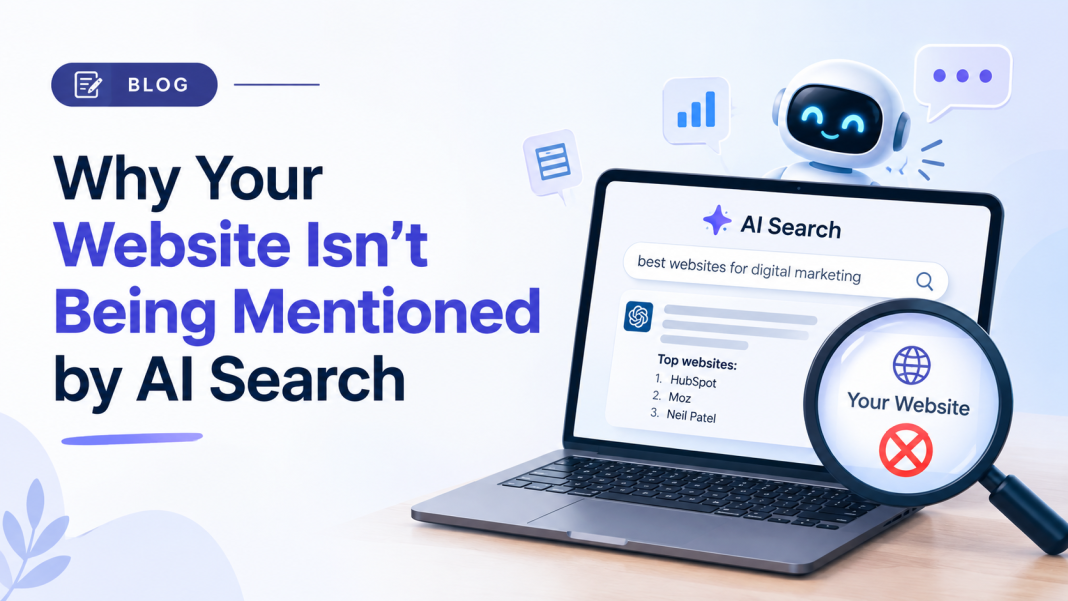

Search is changing.
People are no longer relying only on traditional Google results to find information, products, and businesses. They are increasingly using AI-powered search experiences such as Google AI Overviews, ChatGPT, Microsoft Copilot, and other AI assistants to get direct answers.
This creates a new challenge for businesses:
Your website may rank well in traditional search but still not be mentioned in AI-generated answers.
Why does this happen?
Because AI search doesn’t simply look for pages that rank for a keyword. It tries to understand the topic, the business behind the content, the reliability of the information, and how confidently that information can be used to answer a user’s question.
This is where AI SEO becomes important.
In this guide, we’ll explain why your website may not be appearing in AI search and what you can do to improve your chances of being discovered, referenced, or mentioned.
What Is AI Search?
AI search uses artificial intelligence to understand a user’s intent and generate a direct response instead of simply displaying a list of blue links.
For example, instead of searching:
> “best digital marketing agency for small businesses”
a user might ask an AI search engine:
> “Which digital marketing agencies can help a small business generate leads through SEO?”
The system may analyze information from multiple sources and create a response based on what it considers relevant and trustworthy.
Your goal is therefore no longer only:
“How do I rank for this keyword?”
It is also:
“How do I become a useful and trustworthy source that AI systems can understand and reference?
Why Isn’t Your Website Being Mentioned by AI Search?
There isn’t one single reason.
AI visibility depends on multiple signals, and different AI search systems may use different methods to select and cite information.
Here are some of the most common reasons.
1. Your Content Is Too Generic:
One of the biggest problems is generic content.
If your website says:
> “We provide high-quality digital marketing services to help businesses grow.”
there isn’t much unique information for an AI system to understand or use.
Thousands of websites can say the same thing.
Instead, create content that provides specific information, examples, processes, data, experiences, or insights.
For example:
* How you approach an SEO campaign
* Common problems you’ve identified during SEO audits
* Industry-specific SEO strategies
* Examples of campaign improvements
* Detailed answers to customer questions
* Original research or observations
The more useful and specific your content is, the easier it becomes to establish topical relevance.
2. Your Website Doesn’t Demonstrate Strong Topical Authority:
AI search needs context.
If your website has one article about SEO, another about web design, another about social media, and another about unrelated topics, it may be difficult for search systems to understand what your business is particularly knowledgeable about.
This is why topical authority matters.
Instead of publishing random articles, build content clusters around important topics.
For example, if your business focuses on SEO, your content structure could include:
SEO – Search Engine Optimization
* What Is SEO?
* Keyword Research Guide
* On-Page SEO
* Technical SEO
* Local SEO
* E-commerce SEO
* SEO Audit
* Link Building
* SEO vs PPC
* AI SEO
* GEO
* AEO
These related pages create a stronger topical relationship and help search engines understand your expertise.
👉 Why Businesses Need to Optimize for AI Search, Not Just Google
3. Your Brand Has Weak Entity Signals:
AI systems don’t only need to understand your content.
They also need to understand “who you are“.
This is where entity signals become important.
An entity can be a person, business, organization, product, place, or other identifiable concept.
Your business information should be consistent across relevant online platforms.
For example:
* Business name
* Website
* Services
* Location
* Industry
* Social profiles
* Business directories
* Review platforms
* Author information
If different websites describe your business differently, it can become harder for search systems to confidently connect those mentions to the same entity.
4. Other Websites Don’t Mention Your Brand:
Your website isn’t the only source AI systems can use to understand your business.
External mentions can help establish context around your brand.
For example, your business may be mentioned in:
* Industry publications
* Business directories
* Partner websites
* Interviews
* Podcasts
* Industry blogs
* News articles
* Professional communities
This doesn’t mean you should chase random mentions.
The goal should be to build “relevant and genuine authority” within your industry.
A business mentioned by several credible sources can provide stronger context than a business that only talks about itself on its own website.
5. Your Content Doesn’t Answer Real Questions:
Traditional SEO often starts with keywords.
AI search is increasingly centered around “questions and intent“.
Users may ask detailed questions such as:
> “What is the best SEO strategy for a small manufacturing company?”
or:
> “How long does local SEO take to generate results?”
Your content should provide clear answers to these kinds of questions.
Instead of creating an article simply because a keyword has search volume, think about:
“What problem is the user trying to solve?”
Then create content that solves that problem thoroughly.
6. Your Website Structure Makes Information Difficult to Understand:
Good content isn’t enough if your website is difficult for search engines to interpret.
Make sure important information is clearly structured.
Use:
* Descriptive headings
* Logical page hierarchy
* Internal links
* Clear navigation
* Descriptive URLs
* Structured data where appropriate
* Consistent business information
* Clear author information
For example, an article about local SEO should link naturally to related pages about Google Business Profile optimization, local citations, reviews, and local keyword research.
This helps create relationships between your content.
7. Your Content Lacks First-Hand Experience:
AI-generated content has made the internet much more crowded.
As a result, simply publishing another generic article may not be enough to differentiate your website.
One valuable way to stand out is by including “first-hand experience“.
Instead of saying:
> “SEO can increase website traffic.”
explain what you have actually observed:
* What problems did you find?
* What changes did you make?
* What happened afterward?
* What mistakes did you encounter?
* What would you do differently?
Practical experience gives your content something that generic AI-generated articles often lack.
How to Improve Your AI Search Visibility
So, what should you actually do?
Here is a practical AI SEO framework.
Step 1: Build Topic Clusters
Choose the core topics that are closely related to your services.
Then create supporting content around those topics.
For example:
Core Topic: SEO Services
Supporting topics:
* Technical SEO
* Local SEO
* Keyword Research
* On-Page SEO
* Link Building
* SEO Audits
* E-commerce SEO
* AI SEO
Connect these pages with relevant internal links.
Step 2: Create Answer-Focused Content
Think beyond individual keywords.
Create content that directly answers questions your customers are asking.
Use formats such as:
* How-to guides
* Comparisons
* FAQs
* Checklists
* Step-by-step tutorials
* Definitions
* Case studies
* Expert opinions
Make important answers easy to find.
Step 3: Strengthen Your Brand Entity
Make sure your business information is consistent across the web.
Your website, social profiles, directories, business listings, and other legitimate profiles should clearly describe the same business.
Your website should also clearly communicate:
Who you are → What you do → Who you help → Where you operate → Why you’re qualified
Step 4: Earn Relevant Brand Mentions
Focus on earning visibility outside your own website.
For example:
* Contribute expert insights to industry websites
* Publish original research
* Participate in relevant podcasts
* Build relationships with industry publications
* Create useful resources others want to reference
* Develop partnerships within your industry
The goal isn’t simply to collect backlinks.
It’s to build “recognition and authority around your brand“.
Step 5: Add Original Insights
Don’t just rewrite information that already exists.
Add something new.
This could be:
* Your own data
* Client observations
* Industry analysis
* Expert commentary
* Original examples
* Unique processes
* Case studies
* Lessons learned
Ask yourself:
“Why would someone choose my content over the other 50 pages covering the same topic?”
If you don’t have a good answer, the content probably needs more depth or originality.
AI SEO vs Traditional SEO
AI SEO doesn’t mean traditional SEO is dead.
Technical SEO, crawlability, content quality, internal linking, backlinks, page experience, and other traditional SEO fundamentals still matter.
The difference is that AI search adds another layer.
Traditional SEO focuses heavily on:
“Visibility → Rankings → Clicks”
AI search introduces another goal:
“Understanding → Relevance → Authority → Mentions/Citations”
The two strategies should work together.
A technically strong website with useful content gives you a much better foundation for both traditional and AI-powered search.
Does Ranking on Google Guarantee AI Visibility?
No.
A high Google ranking does not automatically mean that an AI system will mention your website.
AI systems can evaluate information differently, and the sources selected for an AI-generated answer may not simply be the pages ranking first for a traditional search query.
That’s why businesses should start thinking beyond rankings.
Instead of asking only:
“What position do we rank at?”
also ask:
“Is our brand visible when customers ask AI about the products or services we provide?”
How to Measure AI SEO Performance
AI search visibility can be more difficult to measure than traditional rankings.
However, you can start monitoring:
* Brand mentions in AI search
* Citations to your website
* Which pages are referenced
* Questions where competitors are mentioned instead
* Brand visibility across AI platforms
* Growth in branded searches
* Referral traffic from AI platforms
* Relevant third-party mentions
Create a list of important questions your customers might ask AI.
Then periodically check whether your business appears in the answers and which competitors are being recommended.
This can reveal important content and authority gaps.
The Future of SEO Is Bigger Than Rankings
AI search is changing how people discover information.
But the fundamentals remain familiar:
Be useful. Be relevant. Be trustworthy. Be easy to understand.
Businesses that focus only on keywords may struggle to adapt to this new search environment.
Businesses that build strong topical authority, create genuinely useful content, strengthen their brand presence, and demonstrate real expertise will have a stronger foundation for both traditional and AI-powered search.
The goal of AI SEO isn’t to “hack” an AI system into mentioning your business.
It’s to make your business “credible, relevant, understandable, and valuable enough to be considered when people ask important questions.”
And that’s a much better long-term SEO strategy.
Frequently Asked Questions
1. What is AI SEO?
AI SEO is the practice of optimizing a website and its broader online presence to improve visibility across AI-powered search experiences and answer engines.
2. Why isn’t my website appearing in AI search?
Possible reasons include weak topical authority, generic content, limited brand mentions, unclear entity signals, poor content structure, and insufficient first-hand expertise.
3. Is traditional SEO still important for AI search?
Yes. Technical SEO, crawlability, quality content, internal linking, authority, and other traditional SEO fundamentals still provide an important foundation.
4. What is the difference between AI SEO and GEO?
AI SEO is a broader approach to improving visibility in AI-powered search. GEO, or Generative Engine Optimization, generally focuses specifically on optimizing content and brand information for generative AI systems and their responses.
5. How can I improve my chances of being cited by AI search?
Create authoritative and original content, answer real customer questions, strengthen your brand/entity signals, build relevant third-party mentions, improve website structure, and demonstrate genuine expertise.
6. Can small businesses benefit from AI SEO?
Yes. Smaller businesses can build strong AI search visibility by developing expertise around specific topics, answering niche customer questions, creating original content, and building authority within their industry.