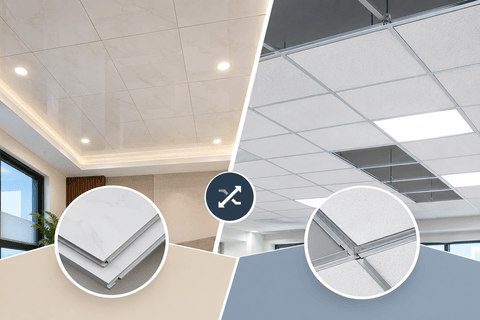

Choosing the right ceiling system can influence the appearance, maintenance, installation time, and overall performance of an interior space. PVC laminate gypsum tiles and T Grid ceiling system are two popular options for commercial and institutional interiors, but they serve different requirements.
Understanding their key differences can help architects, contractors, and building owners make a more informed decision.
What are PVC Laminate Gypsum Tiles?
PVC laminate gypsum tiles are gypsum-based ceiling panels finished with a decorative PVC surface. The laminated finish can provide a clean and attractive appearance while making the surface easier to maintain.
These tiles are commonly considered for offices, retail spaces, healthcare facilities, educational buildings, and other interiors where aesthetics and practical maintenance are important. Depending on the product specification, features such as moisture resistance and different surface finishes can make them suitable for specific interior environments.
What is a T Grid Ceiling System?
A T Grid ceiling system consists of ceiling tiles supported by an exposed metal grid framework. The grid creates a structured ceiling layout and allows individual tiles to be removed when access to services above the ceiling is required.
This makes T Grid systems particularly useful in offices and commercial buildings where electrical wiring, HVAC components, lighting, and other building services need regular access.
PVC Laminate Gypsum Tiles vs T Grid: Key Differences
Appearance
PVC laminate gypsum tiles can provide a smooth, decorative finish and are available in different patterns and surface appearances. T Grid ceilings have a more structured modular appearance because the supporting grid remains visible.
Maintenance and Accessibility
T Grid systems have an important advantage when frequent access to the ceiling void is required. Individual tiles can generally be removed and replaced without disturbing the entire ceiling.
PVC laminate gypsum tiles may be preferable where a more continuous and decorative ceiling appearance is the priority.
Installation
Both systems can support efficient installation, but the installation process differs. T Grid ceilings require accurate framework alignment before tiles are placed. PVC laminate gypsum tiles depend on the selected suspension or installation method.
Applications
PVC laminate gypsum tiles can work well in spaces where design, clean finishes, and easy surface maintenance are priorities. T Grid systems are particularly practical for commercial environments where accessibility and service maintenance are important.
Which Ceiling System Should You Choose?
There is no universal winner between PVC laminate gypsum tiles and T Grid systems. The right choice depends on the project’s design requirements, maintenance needs, access requirements, budget, and building services.
Choose based on long-term functionality rather than appearance or initial cost alone. Considering installation, maintenance, accessibility, durability, and the desired interior finish can help ensure the selected ceiling system delivers better value over its service life.
Conclusion
Both PVC laminate gypsum tiles and T Grid ceiling systems offer useful solutions for modern interiors. PVC laminate gypsum tiles can be a strong choice for attractive and easy-to-maintain ceilings, while T Grid systems are well suited to spaces requiring convenient access to services above the ceiling.
By evaluating the specific needs of the project, architects, contractors, and building owners can select a ceiling solution that balances aesthetics, functionality, maintenance, and long-term performance.