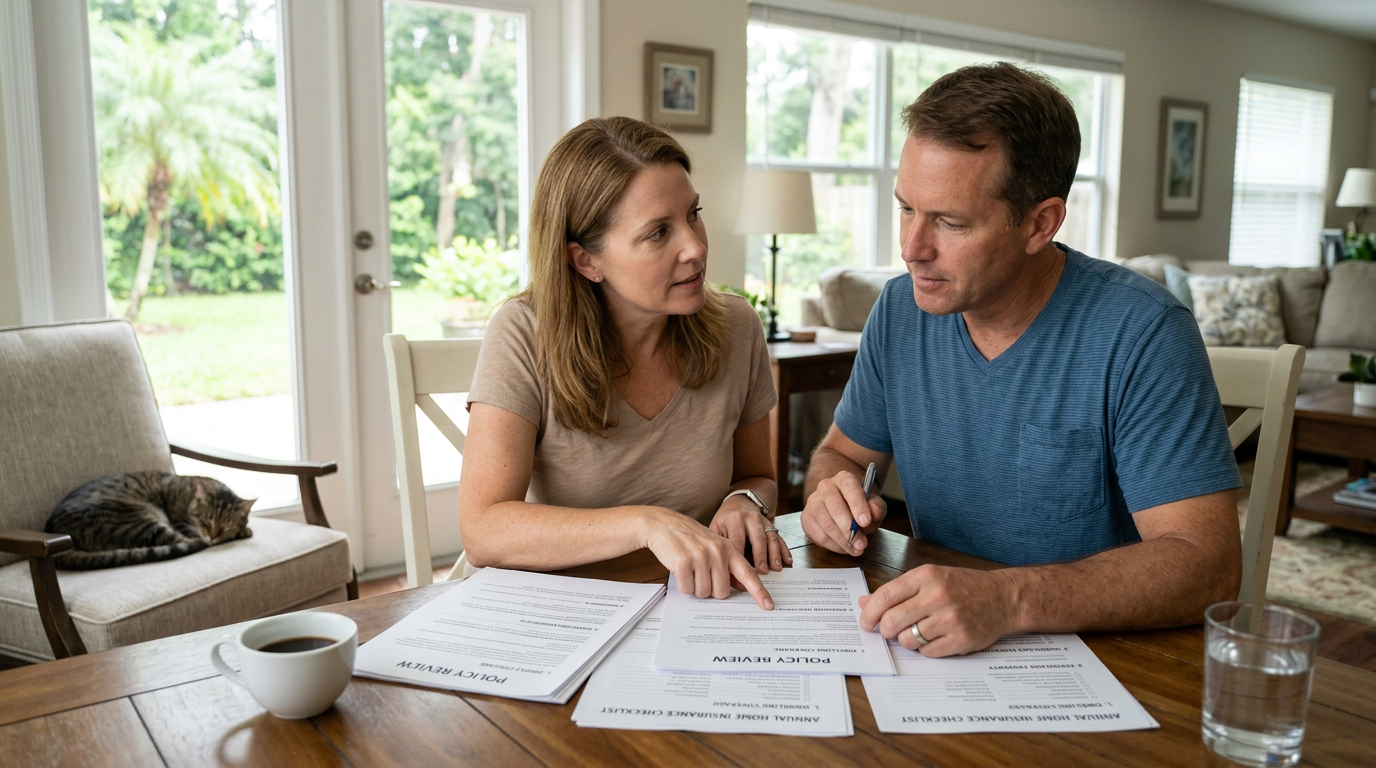
Renewal packets arrive, the premium comes out of escrow, and most homeowners never open the documents. That works fine until a storm comes through and the policy turns out to be different from what they remember.
Policies change more often than people realize. Carriers adjust deductibles, update rebuild estimates, add endorsements, and change what they cover. Your home changes too. A yearly review of home insurance in NE Florida is the simplest way to make sure the coverage still matches the house you live in now.
You do not need to read every page of the policy form. You do need to check a handful of items that drive most claim outcomes on the First Coast. Here are the five that matter most for home insurance in NE Florida, plus a quick checklist you can use each year.
1. Your dwelling limit vs. today’s cost to rebuild
Your dwelling limit is the most the policy will pay to repair or rebuild the structure. It should match what it would cost to rebuild your home today, at current labor and material prices. Market value and purchase price are different numbers and often a poor guide.
Rebuilding costs have risen sharply in recent years. After a widespread storm, they can climb further as contractors and materials fall into short supply across the region. A limit that fit when you bought the house may now leave you short.
At renewal, look for three things:
- Does the dwelling limit reflect a current rebuild estimate?
- Does the policy include extended replacement cost, which adds a cushion above the limit if costs spike?
- How much law and ordinance coverage do you carry? It helps pay for code upgrades required when an older home is repaired or rebuilt.
Florida requires insurers to offer replacement cost and law and ordinance options on homeowners policies. Make sure you know which ones you accepted.
2. Your hurricane deductible in real dollars
Most Florida policies carry a hurricane deductible set as a percentage of the dwelling limit. Insurers must offer options of $500, 2%, 5%, or 10%, with some exceptions for higher-value homes. The percentage can sound small. The dollar figure often is not.
On a $450,000 dwelling limit, a 2% deductible is $9,000. At 5%, it jumps to $22,500. If your dwelling limit went up at renewal, your hurricane deductible went up with it, even if the percentage stayed the same. Florida requires insurers to show the dollar amount on the declarations page, so check that number every year.
Ask yourself a direct question: could you cover that amount after a storm? If not, ask what a lower deductible would cost. Changes to a hurricane deductible may not take effect right away, so make any adjustments well before June rather than when a storm is already forming.
3. Your roof and wind mitigation credits
The roof and the features that protect your home from wind have a direct effect on what you pay for home insurance in NE Florida. Both deserve a look every year.
Start with the roof. Florida law bars insurers from refusing to issue or renew a homeowners policy solely because the roof is less than 15 years old. Once a roof reaches 15 years, an insurer must let you get an inspection by an authorized inspector before requiring replacement, and a report showing at least five years of useful life left protects you from a refusal based on age alone. If your roof is approaching that mark, plan ahead so a renewal does not catch you by surprise.
Next, check your wind mitigation report. Florida insurers must offer discounts for features such as roof-to-wall straps, secured roof decking, hip roof shape, and impact-rated windows and doors. A report generally stays valid for five years. If yours has expired, or if you added hurricane shutters or a new roof since the last inspection, a new report may lower your premium.
4. Your flood coverage
Homeowners policies do not cover rising water from storm surge, river overflow, or heavy rain. On the First Coast, where the St. Johns River, tidal creeks, and the Intracoastal Waterway touch so many neighborhoods, flood coverage deserves its own review.
Each year, confirm:
- Your flood policy is active and renews on time. It often renews on a different date than your homeowners policy.
- Building coverage still fits your rebuild cost. Federal flood policies cap building coverage at $250,000 and contents at $100,000.
- You carry contents coverage, not just building coverage.
- A private flood option would not offer better limits or terms for your home.
If you are insured through the state-backed insurer of last resort, check its flood requirement. It applies to nearly all of its homeowners policies with wind coverage starting January 1, 2027, regardless of flood zone.
If you have no flood policy at all, revisit that decision every year. A new federal flood policy usually takes 30 days to begin, so buying in winter gives you far more protection than buying when a storm is in the forecast.
5. Valuables and changes to your home
Your policy should describe your home as it stands today, along with what is inside it. Standard homeowners policies cap coverage for certain categories, often well below what collectors and families actually own. Jewelry, watches, fine art, firearms, and wine collections commonly fall into that group.
If you bought an engagement ring, inherited artwork, or added to a collection this year, consider scheduling those items on a separate personal property policy or endorsement. Scheduled items are typically insured for a listed value, and many scheduled coverages protect against accidental loss as well as theft. Check the terms before you buy.
Also tell your agent about changes like these:
- A new roof, impact windows, or a generator
- Renovations, additions, or a finished bonus room
- A new pool, screen enclosure, dock, or boat lift
- Renting the home out, even for part of the year
- Starting a business from home
Some changes earn discounts. Others need to be added to the policy so a future claim is not denied.
A quick annual review checklist
Keep this list with your renewal paperwork:
- Compare this year’s premium with last year’s and ask what changed.
- Read any notices about changes to coverage, limits, or deductibles.
- Confirm your dwelling limit matches a current rebuild estimate.
- Write down your hurricane deductible in dollars.
- Check your roof age and wind mitigation report date.
- Confirm your flood policy is active and limits still fit.
- Report valuables, upgrades, renovations, and rentals.
- Make sure your lender has current proof of insurance.
Start this review 60 to 90 days before renewal. That leaves time to request quotes, schedule inspections, and make changes without a gap in coverage.
Review your coverage with Tidal Shield Insurance
An annual policy review takes less time than most homeowners expect, and it can prevent an expensive surprise after a storm. The goal is a policy that matches your home, your belongings, and the risks of life near the water.
At Tidal Shield Insurance, we review home, flood, hurricane, and personal property coverage for families across Florida’s First Coast. Our team in Ponte Vedra Beach shops multiple carriers, explains your options, and walks you through every line before you renew.