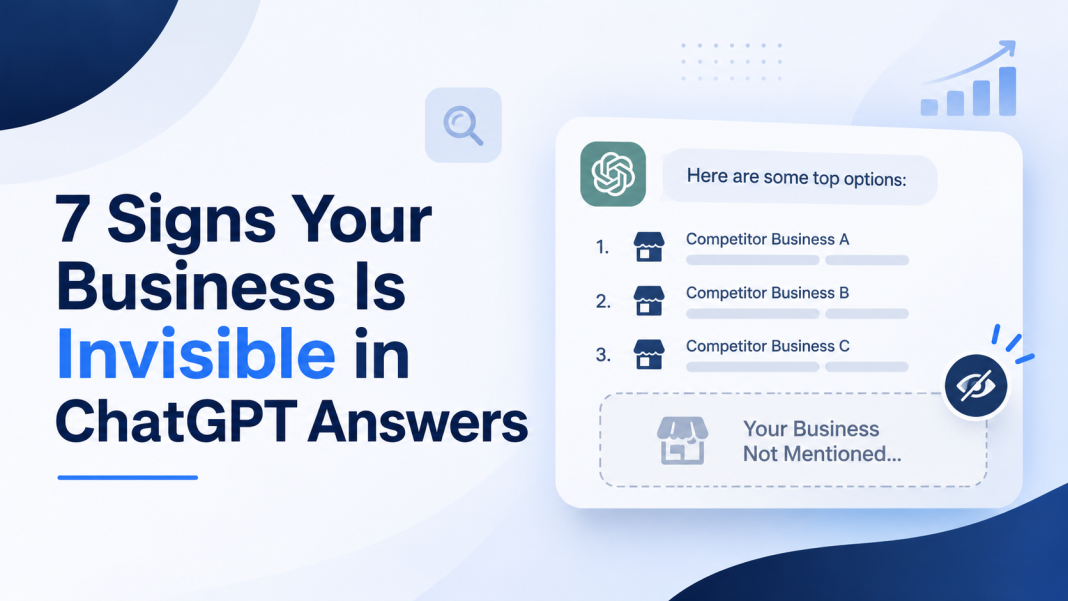

More people now ask ChatGPT which accountant, clinic or software tool to pick instead of scrolling through search results. If your business never comes up in those answers, you are missing people who were ready to buy. If you’d rather have experts handle it, Sytoso offers AI SEO services that help businesses like yours get recommended in ChatGPT and other AI tools. Before that, here are seven signs your business is missing from ChatGPT, and what each one means.
7 Signs Your Business Is Invisible in ChatGPT Answers
ChatGPT doesn’t rank websites the way Google does. It builds answers from what it has learned and what it can find, then names the businesses it understands and trusts. If it can’t do either with yours, you won’t appear.
1. ChatGPT Doesn’t Mention You for Your Own Category
This is the simplest test. Ask ChatGPT a question your customers would ask, such as “best family dentist in Denver” or “top payroll software for small teams.”
If competitors show up and you don’t, that’s your first warning sign. Try five or six versions of the question. One miss can be random. Repeated misses point to a real visibility gap.
2. When It Does Mention You, the Details Are Wrong
Sometimes ChatGPT knows your name but describes you poorly. It might list services you stopped offering, give an old location or confuse you with a similar business.
This usually means the information about you online is thin or outdated. AI fills gaps with guesses, and guesses rarely help you win customers.
3. Your Website Blocks or Hides Content From AI Crawlers
Some websites block AI crawlers in their robots.txt file without the owner knowing. A security plugin, a hosting setting or an old developer decision can be the cause.
Check whether you’re blocking bots like GPTBot or OAI-SearchBot. OpenAI’s crawler documentation explains what each bot does and how to allow it.
Heavy JavaScript is another hidden issue. If your main content only appears after scripts run, many AI crawlers see an almost empty page.
4. Your Business Information Doesn’t Match Across the Web
AI systems compare what different sources say about you. When your name, address, phone number or services differ between your website, Google Business Profile, directories and social profiles, the picture gets blurry.
Look out for:
- Different business names or spellings
- Old addresses or phone numbers on listings
- Service descriptions that don’t match your website
- Duplicate or abandoned profiles
Consistency makes it easier for AI to treat you as one clear, trustworthy entity.
5. Nobody Else Is Talking About You
ChatGPT leans heavily on third-party sources. Reviews, industry directories, “best of” lists, news mentions and community discussions all shape whether a brand gets recommended.
If your website is the only place that describes your business, AI has little reason to believe you’re a strong option. Brands that appear in AI answers usually have a trail of mentions across sites their customers already trust.
6. Your Content Doesn’t Answer Real Questions
Many business websites talk in broad slogans: “quality service,” “customer-first approach,” “solutions that work.” None of that helps an AI answer a specific question.
Content that gets used in AI answers is direct. It explains what you do, who it’s for, roughly what it costs, how long it takes and how you compare with alternatives. Clear headings and short, factual answers make your pages far easier to understand and quote.
7. Competitors Show Up for Searches You Should Own
Watch which brands ChatGPT recommends for your most valuable services. If the same two or three competitors keep appearing, study what they have that you don’t.
Often it’s not a bigger budget. It’s clearer service pages, more reviews, better listings or a few strong mentions on respected sites. These are gaps you can close.
How to Start Fixing the Problem
You don’t need to fix everything at once. Start with the basics:
- Test 10 to 15 real customer questions in ChatGPT and record the results
- Check robots.txt and make sure your key content loads without JavaScript
- Clean up your business details across all major listings
- Rewrite your main service pages to answer common questions directly
- Build genuine mentions through reviews, directories and industry content
Then repeat the ChatGPT tests every month to see what changes.
Conclusion: Visibility Now Means Being Understood
Showing up in ChatGPT isn’t about tricks. It comes down to whether AI systems can access your website, understand what you offer and find enough outside proof to trust you.
If several of these signs sound familiar, your business isn’t invisible because it lacks value. It’s invisible because that value isn’t clear enough yet. Fix the access, the consistency and the content, and you give AI every reason to start recommending you.
FAQs
How do I check if my business appears in ChatGPT?
Ask ChatGPT the questions your customers would ask, such as “best [service] in [city].” Try several versions and note whether your business is named, how it’s described and which competitors appear instead.
Why does ChatGPT recommend my competitors and not me?
Competitors usually have clearer website content, more consistent business listings, more reviews or more mentions on trusted third-party sites. AI recommends the brands it understands best and sees confirmed across multiple sources.
Can blocking AI crawlers stop my business from showing in ChatGPT?
Yes. If your robots.txt blocks bots like GPTBot or OAI-SearchBot, ChatGPT may not be able to read or cite your pages. Check your settings and allow the bots you want to reach your content.
Does ranking on Google mean I’ll show up in ChatGPT?
Not always. Google rankings help, but ChatGPT also weighs how clearly your content answers questions and whether other sources mention you. A page can rank well and still be skipped in AI answers.
How long does it take to become visible in ChatGPT?
It depends on your starting point. Technical fixes like unblocking crawlers can help within weeks, while building reviews and third-party mentions usually takes a few months of steady work.