
Introduction
Legacy mobile app development is becoming a drag on enterprise execution. Long release cycles, fragmented codebases, manual testing, and slow maintenance make it harder to launch features at business speed. The problem is delayed time-to-market, higher delivery costs, and comparatively slower response to changing customer expectations.
This is why enterprise mobile app development is moving toward AI-assisted development. Some of the top-performing companies using AI in software development are seeing 16% to 30% improvements in productivity, time-to-market, and customer experience, along with 31% to 45% gains in software quality.
AI mobile app development is far beyond faster coding. It supports requirements analysis, code development, test automation, defect detection, enterprise app modernization, and release readiness. This blog explains why legacy delivery is breaking down, what AI-assisted development means, and how enterprises can move toward faster mobile app delivery.
What AI-Powered App Development Actually Looks Like?
Before we walk through how AI app development is transforming each SDLC layer, it is worth restating the principle that AI doesn’t replace the developers but elevates them. The enterprises winning at mobile app development in 2026 are the ones treating AI as a force multiplier at every step of the software development process.
Phase 1: Requirement Gathering and Analysis
Traditionally, this phase was handled by business analysts (BAs) with whiteboards, stakeholder interviews, and spreadsheets. They used to spend weeks turning fuzzy executive priorities into product requirement documents. AI has compressed this loop through contextual scoping. Organizations have started using AI Agents to ingest market research reports, competitor mobile app teardowns, internal documentation, support tickets, and CRM data simultaneously to surface feature gaps.
The second shift is feasibility modeling. Machine learning models trained on historical sprint velocity, defect rates, and team composition now accurately predict the true cost of a proposed feature.
Phase 2: UI/UX Design and Architecture Planning
Earlier, a UI/UX designer would draft wireframes, gather feedback, iterate, and then hand off to a developer. The first change in this step is the introduction of generative UI/UX. Designers now use AI tools to generate layouts as per brand guidelines, WCAG standards, and platform-specific design systems (Material 3, iOS Human Interface Guidelines). The downstream effect is faster stakeholder alignment and fewer rework cycles.
On the architecture side, the shift is toward structural optimization. AI assists architects in selecting the most efficient tech stack for a given problem based on pattern-matching across thousands of comparable enterprise projects. This is what keeps modern mobile app development from accumulating technical debt on day one.
Phase 3: Development (Coding)
This is the layer where AI-powered mobile app development has produced the most measurable transformation. Developers now work alongside coding agents, such as GitHub Copilot, Cursor, and Claude Code, powered by LLMs and embedded directly in their IDEs. These AI agents generate boilerplate, draft complex algorithms, scaffold unit tests, and suggest implementations.
The second use case is legacy refactoring. When enterprises leverage AI to migrate aging codebases to modern mobile app development frameworks, the entire modernization timeline shifts. What once required a multi-quarter migration project with specialized engineers is now an incremental, AI-accelerated effort that runs in parallel with new feature development.
Phase 4: QA and Testing
QA teams used to write test cases manually, run regression suites that took hours, and ship releases knowing that some percentage of edge cases might not have been tested. Autonomous test suites have changed this math. AI now examines a codebase, identifies edge cases that human testers routinely overlook, and writes scripts to validate them.
Another shift is self-healing tests. For example, if a button’s element ID or a screen layout changes, the AI infers intent from the surrounding test logic and updates the script automatically.
Phase 5: Deployment
In the classic deployment workflow, a release engineer manages a pipeline and responds after an anomaly occurs in prod. Intelligent CI/CD has flipped this dynamic. AI now continuously monitors the deployment pipeline, flagging risky code changes before they reach production based on factors such as cyclomatic complexity, historical defect correlation, and dependency impact analysis.
Phase 6: Maintenance and Feedback Loops
Log intelligence is the first lever AI pulls at this mobile app development phase. Modern observability platforms run AI across millions of error logs, stack traces, and telemetry events to surface the root cause of a crash, often before a developer opens a ticket.
The second lever is sentiment integration. AI scans app store reviews, support transcripts, social media mentions, and in-app feedback to identify themes and prioritize them against business impact.
Why Enterprises are Ditching Legacy Development for AI-Assisted Mobile App Development?
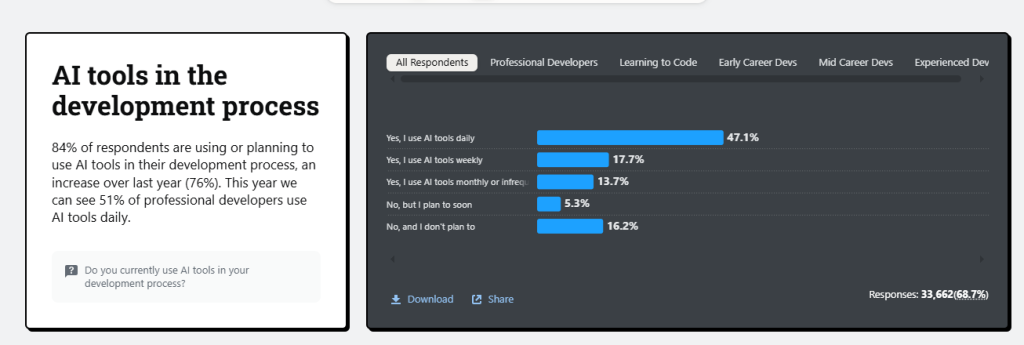
The shift toward AI app development is a dominant reality, with nearly 88% of organizations now adopting AI to accelerate their software development lifecycles. This momentum is clearly evident in its benefits and in how it is reshaping dynamics within specific industries. Let’s have a look.
1. Accelerated Product Launch
AI-augmented teams are fundamentally redefining speed to market by consistently shipping 2-3x faster than teams bound by legacy software delivery models. This compression is driven by a massive surge in developer efficiency, with nearly 78% of developers reporting significant gains in their daily productivity when utilizing AI coding tools. By automating boilerplate generation, manual testing, and repetitive integration tasks that historically consumed the lion’s share of engineering hours, AI enables developers to shift their focus toward higher-order problem-solving and innovation.
2. Cost Compression
With AI ROI jumps to 42%, the economics of mobile app development have fundamentally inverted, shifting the focus from headcount to high-leverage output. In the current landscape, a lean team of five senior developers, augmented by AI tooling, may outperform a traditional team of twelve developers, thereby compressing headcount costs. This cultural shift is supported by substantial financial incentives, such as $3 in rewards for every $1 spent on AI. Consequently, CFOs who once viewed mobile as a sunk expense are reframing it as a high-leverage strategic asset.
3. Improved Code Quality
AI-powered mobile app development elevates software quality through a shift-left approach, enabling AI-driven testing to catch more defects earlier in the cycle. By utilizing AI-generated test suites and self-healing scripts that automatically adapt to code changes, enterprises can measurably reduce their defect escape rates. In fact, organizations have reported up to 40% reduction in testing cycles while improving defect detection rates by 35%. For regulated industries like banking and healthcare, this improved code quality ensures a consistent defense against compliance incidents and technical failures.
4. Built-In Intelligence
In legacy app development practices, features such as predictive analytics and natural language processing were often treated as third-party bolt-ons. Today, AI-assisted mobile app development enables built-in intelligence, with smart capabilities coded into the application’s core. By leveraging AI-assisted pipelines, developers can implement behavioral models and agentic interfaces as standard components, ensuring that the app is natively capable of learning and adapting to user intent.
Common Concerns with AI-Generated Code and How to Resolve them?
AI-generated code can improve development speed, but it also brings valid concerns. This section explains the key risks associated with using AI in the development workflow and how you can address them.
1. Security and IP Risk with AI-Generated Code
Security and privacy remain major concerns when using AI co-pilots in mobile app development. In fact, 56.1% of developers worry about data security and privacy while using them. These concerns usually stem from the risk of code leakage, exposed proprietary logic, or risky snippets entering the codebase unnoticed. The concern is valid because a GenAI Code Security Report tested over 100 LLMs across Java, Python, C#, and JavaScript and found that 45% of AI-generated code introduced vulnerabilities. Together, these risks make security one of the biggest barriers to AI adoption in software development workflows.
Modern enterprises reduce this risk by treating AI output as untrusted input from the start. This means every AI-generated commit must pass mandatory Static Application Security Testing (SAST) and Software Composition Analysis (SCA). It also means AI-generated code should be restricted in high-risk modules such as authentication, encryption, and payment processing unless senior engineers review it.
2. Compliance Adherence
Decision-makers often worry that AI will bypass strict regulatory guardrails. This question splits into two parts: how the AI tooling itself handles data, and how the resulting application meets regulatory requirements.
For the tooling, enterprises need to choose AI providers that offer zero-data-retention agreements, run inference in compliant regions, and provide the audit trails that frameworks like SOC 2 Type II require. For the application, AI-assisted development actually improves compliance posture in most cases. To address this, organizations implement AI-assisted pipelines that automatically tag data and generate audit-ready documentation throughout the SDLC.
3. Vendor Lock-In
This concern is legitimate, but the deeper lock-in risk lies in proprietary AI services embedded inside the app itself. This may include a recommendation engine that supports only one cloud provider, a vector database with a non-portable schema, or an LLM API with custom prompt formats.
The resolution is an architectural discipline. Enterprises building today design can abstraction layers between their application logic and any specific AI provider, use open standards where they exist, and maintain the option to swap providers without rewriting the core product.
4. Team Upskilling
There is a misconception that AI replaces the need for senior talent. But in reality, it will change how you hire mobile app developers today by shifting the focus to AI-augmented developers. However, given current dynamics, the skills gap between app developers who use traditional practices and those who use AI in development is significant.
To mitigate this challenge, organizations must stop treating upskilling as a one-time training event and must include it as an ongoing process. Under this activity, junior developers must be paired with AI-augmented workflows, run regular internal showcases of AI-assisted techniques, and measure productivity improvements at the individual level to make the value of upskilling visible.
Closing Thoughts
Throughout the blog, we have seen that AI-powered mobile app development is not a future consideration. It is already reshaping the enterprise mobile app development approach of building, modernizing, testing, and releasing mobile apps in 2026.
This shift is becoming mainstream as more engineering teams adopt AI code assistants. One report predicts that 90% of enterprise software engineers will use these tools by 2028, compared with less than 14% in early 2024. Because mobile apps these days are all about launching quickly with an intuitive UI, embedding intelligent features, and providing customers with an immersive, personalized experience. As AI-powered app development becomes more common, technical execution will matter as much as speed. Organizations that plan to modernize or build mobile apps must hire mobile app developers who can apply AI responsibly, maintain code quality, and build apps that adapt to changing business and customer needs.