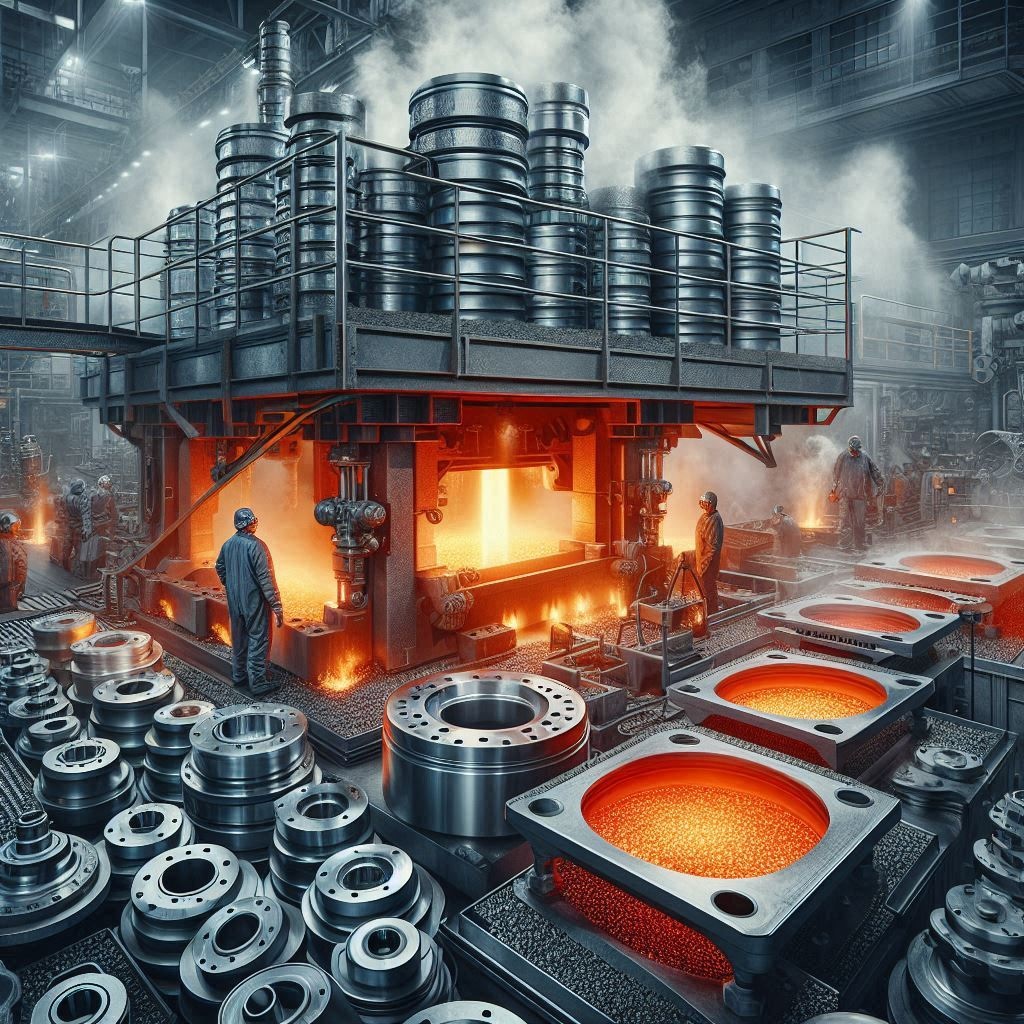

Flanged Flanges are an important part of piping systems found in all types of industries: Oil & Gas, Power Generation & Distribution, Petrochemical, Water Treatment. Flanges must also be able to survive very high pressure, significant temperature differences, and corrosive environments. Heat Treatment is a key element in the manufacturing of flanges that give them the right mechanical properties and performance. Each stage of the manufacturing process (heating & cooling) has a significant impact on the ultimate strength, hardness, ductility, and overall durability of forged flanges due to the fact that they are subjected to multiple cycles of heat treatment.
Importance of Heat Treatment in Forged Flanges
Heat treatment is a precise method for heating and cooling metals to change the metal’s properties without changing their form. Forged flange heat treatment is essential for refining the grain structure, relieving metal internal stress, and increasing wear/corrosion resistance. Heat treated forged flanges will have improved mechanical properties; greater ductility and toughness; enhanced machinability for future processes; and higher resistance to fatigue and cracking.
In addition, heat treatment assures that material properties remain consistent throughout the flange. Therefore, creating heat treated forged flanges allows for use in many types of industrial installations with high quality assurance and reliability.
Common Heat Treatment Techniques for Forged Flanges
Forged flanges are one type of forged product created through heat treatment by heating the metal to an appropriate temperature and then letting it cool as much as possible in a controlled heated environment (the furnace). This slow cooling process works to soften the metal for easy machining and forming, as well as increase the ductility of the flanges. It is very important in relieving internal stresses due to forging or machining, thereby increasing the dimensional stability of the forged flanges. The benefits of annealing can be observed in both stainless steel and alloy steel forged flanges because these materials require enhanced workability and/or uniform mechanical properties to facilitate further processing and to ensure long-term reliable performance.
Normalizing
Normalizing is a process performed by heating up forged flanges to above the critical temperature and then cooling them in an open environment (air). This controlled cooling of the flanges allows for refinement of the grain structure thereby increasing mechanical properties (toughness, strength, etc.). During FKFW, all of the grain structure irregularities created by the forging process are also reduced creating a more consistent material. When comparing the process of annealing to the process of normalizing, normalizing produces a stronger & more uniform microstructure, making normalizing an ideal treatment for carbon steel flanges utilized in a variety of challenging production environments.
Quenching
Through quenching the heat treatment of forged flanges can be performed quickly by introducing large amounts of cold media (such as water, oil or air), cooling them to their desired dimensions rapidly after being heated to a high temperature. When cooled quickly, the hardness and strength of the flanges are increased tremendously and the wear resistance is improved as compared to other materials of similar application; however, due to the quenching process, there are also potential concerns about brittleness and internal stresses that may be developed during the quenching operation. Therefore, in most cases, quenching is followed by a tempering operation to ensure the combination of strength and toughness of the final component is optimal for use.
Tempering
After being quenched, the heat treated flange is tempered. Tempering will reduce brittleness that was produced by the rapid cooling of the flange and retain enough hardness strength from forging the flange. In order to accomplish this, the flange must first be heated to a certain lower temperature before cooling it down in a controlled manner. By allowing the cooled flange’s internal structure to stabilize, the process of tempering increases the toughness of the flange and also relieves any internal stresses within the flange. Tempering also establishes a combination of hardness and ductility. These mechanically modified properties make tempering combined with quenching a frequently used process for the production of high-strength flanges that have the capability of providing excellent performance under conditions of high demand.
Stress Relieving
Stress relieving is a method of heat treating forged flanges where they are subjected to a relatively low heat treatment followed by slow cooling in a controlled ambient atmosphere. The stress-relieving process reduces residual stress that has developed from the forging and machining processes and has the potential to result in deformation or fracture during service. When the internal structure of the flange has been stabilized through stress relieving, dimensional tolerance will be increased and operational performance will be uniform under load conditions. Stress relieving is particularly important for large and complex forged flanges, even very minor internal stress may greatly affect the accuracy and dependability of the flange.
Case Hardening
Case hardening is a heat treatment that modifies only the surface of a forged flange so that it has a hard surface for wear resistance and a ductile core to resist fracture from impact or stress. A case-hardened flange will have hardened outer surfaces while retaining soft inner cores, thus giving the flange the ability to absorb impact and stress without failing. Case hardening treatment provides a very high degree of hardness on the part’s surface and creates greater resistance to wear and abrasion while maintaining the part’s overall strength structurally. This surface treatment offers the most significant advantage when the flanges will experience a lot of friction as well as contact stresses and/or extreme operating conditions.
Factors Affecting Heat Treatment
Many significant parameters impact the effectiveness of heat treating forged flanges. The following attributes play a role in the overall quality and performance of forged flanged fittings: material composition, heating temperature, holding time, cooling rate, cooling medium, flange size, and thickness. The carbon content in an alloying material and elements will affect its response during heat treatment. The heat treatment process must thus ensure that proper care is taken regarding the heating and cooling temperatures to ensure the proper microstructure changes will occur within the material. Furthermore, the cooling method used (i.e., air, oil or water) will greatly affect the hardness of the flange and thus affect the development of internal stresses in the flange. Larger and thicker forged flanges require more carefully controlled heating and cooling cycles to meet the uniform characteristics; therefore, all of these parameters must be monitored to prevent defects (i.e., cracking, warping, uneven hardness) that could negatively impact the desired mechanical properties.
Applications of Heat-Treated Forged Flanges
Flanges that have been heat treated or forged are found in a lot of different industrial environments where their durability and high quality are very important. In the oil and gas industries, these flanges will be found in high-pressure pipelines. In drilling machinery, they can also be used. Power plants use heat treated or forged flanges in various steam and turbine processes. The chemical industry also needs heat treated or forged flanges in order to safely handle corrosive materials and for long-term durability. In marine applications, such as shipbuilding and offshore structures, heat treated or forged flanges provide strength and resistance to harsh environments. Water treatment facilities also use heat-treated or forged flanges in high strength piping to maintain their performance and efficiency over time.
Conclusion
Forged flanges can benefit from various heat treatment processes, such as anneal, normalizing, quench, temper, and relieve stress, which improve performance and increase longevity. These processes are used to help ensure that forged flanges comply with high levels of demand for industrial longevity. The appropriate use of these various processes by manufacture can also result in producing forged flanges of superior quality to withstand harsh environmental conditions. The continuing need for stronger and more efficient components throughout the various industries will only increase the necessity of using advanced heat treatments in forging technology.




