
Key Takeaways
- Understand the two programs first: Social Security offers two separate disability programs — SSDI and SSI — and your eligibility for each depends on different criteria.
- File as early as possible: Waiting to apply delays your benefits start date, even if you are eventually approved.
- Document everything from the beginning: Medical records, treatment history, and physician statements are the backbone of every successful claim.
- Expect the first denial: Most initial applications are rejected, but denials can be appealed — and appeals have higher approval rates.
- Know when to get legal representation: An attorney does not charge upfront fees and can significantly improve your odds at the hearing stage.
Filing a disability claim in Tampa — or anywhere in Florida — is not as straightforward as most people expect. The Social Security Administration denies the majority of initial applications, and many applicants spend months, sometimes years, trying to understand why.
If you or a family member is dealing with a disabling condition that prevents full-time work, this guide covers the core things you need to know before, during, and after the application process.
SSDI vs. SSI: Understanding the Difference Before You File
SSDI (Social Security Disability Insurance) applies to workers with a sufficient work history, based on earned work credits accumulated over their career.
SSI (Supplemental Security Income) applies to low-income individuals, including those with limited work history, based on financial need plus a qualifying disability.
Some people qualify for both. If you have worked for most of your adult life but currently have very limited income and assets, you may receive payments from both programs simultaneously.
The Social Security Administration has a five-step evaluation process to determine whether your condition qualifies as a disability under federal law. Your condition must prevent substantial gainful activity and is expected to last at least 12 months or result in death.
The Florida Filing Process: What to Expect
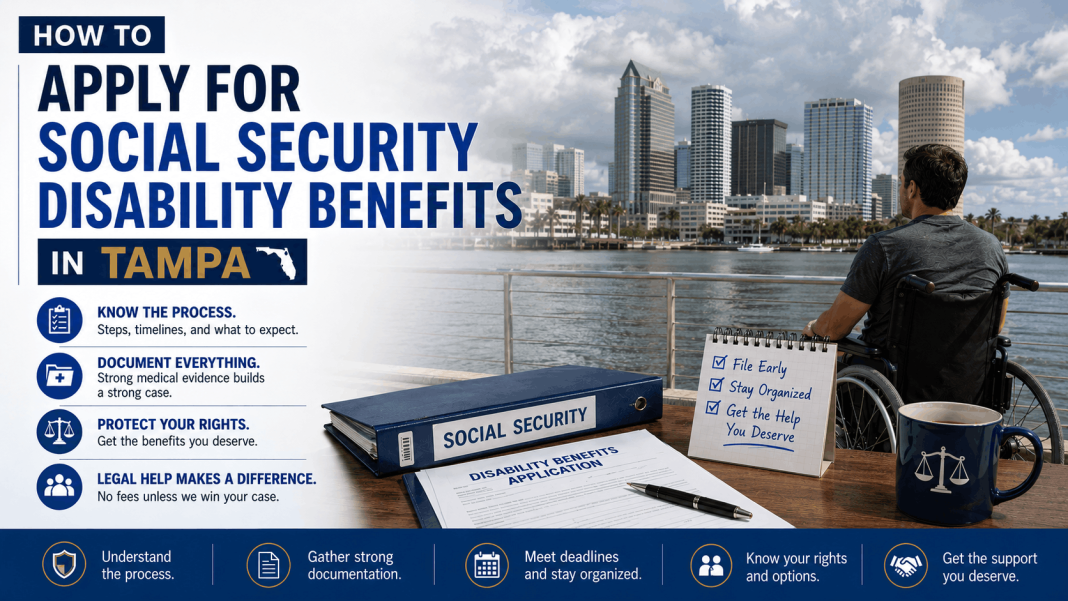
You can file your claim online at SSA.gov, by phone, or in person at your local Tampa Social Security office. Most applicants start online because it creates a clear paper trail from day one.
After submission, your case is forwarded to Florida’s Disability Determination Services (DDS), which evaluates your medical records and contacts your doctors directly. Generally, the opening phase requires anywhere from three to six months for processing.
What is important is that you do not stop receiving medical treatment while your case is pending. A gap in your medical records can be interpreted as evidence that your condition has improved, even if it has actually not.
If your initial application is denied, you have 60 days to request reconsideration. If reconsideration is also denied, the next step is a hearing before an Administrative Law Judge (ALJ), where the process becomes significantly more complex and where legal representation makes the greatest difference.
When to Consider Working With a Disability Lawyer
Many applicants try to handle the process on their own — and that is completely understandable. However, there are specific situations where working with a legal representative becomes more than just helpful.
Consider reaching out to disability lawyers in Tampa if:
• Your initial application has already been denied
• Your condition involves multiple diagnoses that are difficult to document
• Your treating physician has not provided a detailed functional assessment
• You are approaching the hearing stage and have never testified before a judge
• You are unsure whether you meet the non-medical requirements for SSDI (work credits) or SSI (income limits)
Social Security disability attorneys in Tampa work on a contingency fee basis. This means they receive no payment unless your case is approved, and even then, the fee is capped by federal law — currently at 25% of your back pay, up to $9,200. There is no risk in consulting one.
A team like the social security lawyers in Tampa at Nationwide Disability Representatives can review your case and advise on realistic next steps — without a financial commitment from your end.
Common Reasons Tampa Applications Get Denied
Missing clinical evidence: Emergency room visits alone won’t suffice for the SSA; they want to see a history of care from your regular doctors. Continuous notes from a specialist matter the most in these cases.
Missed deadlines: Missing the 60-day appeal window essentially closes your current claim and forces you to start over.
Not meeting technical criteria: An SSDI claim can fall through if your recent work credits fall short. Similarly, an SSI claim will be denied if your countable resources exceed the program’s rigid maximums.
Final Thoughts
The thorough nature of this process makes it slow-moving and, quite frankly, frustrating at times.
To successfully deal with the Social Security disability system, you must be patient, keep your documentation perfectly in order, and clearly understand what is required.
FAQ
How long does it take to get approved for disability benefits in Tampa?
Initial decisions typically take three to six months. If your case goes to an ALJ hearing, the total time from application to decision can exceed one year. Florida’s processing times vary by backlog at the Tampa hearing office.
Can I work at all while my disability claim is pending?
Yes, but with limits. In 2025, earning more than $1,550 per month (the substantial gainful activity threshold) may signal to the SSA that you are not disabled. Staying under this threshold while your claim is active is important.
What medical conditions automatically qualify for disability benefits?
The SSA maintains a “Blue Book” of listed impairments — including certain cancers, heart conditions, and neurological disorders — that can fast-track approval. However, many approved claims involve conditions not on this list; the key is proving that your condition prevents sustained work activity.
What if I cannot afford to pay a lawyer upfront?
You do not need to. All Social Security disability attorneys work on contingency — you pay nothing unless you win, and the fee is regulated by federal law.