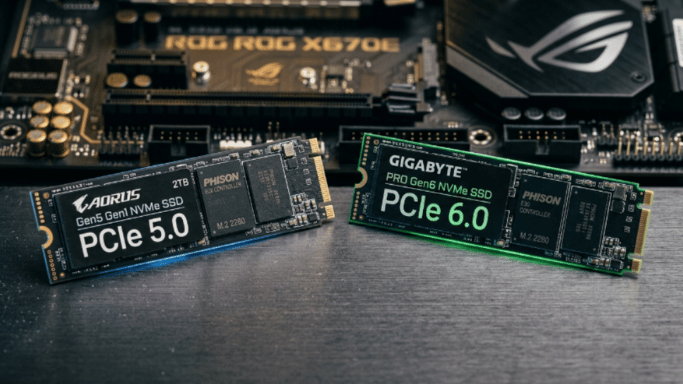

Storage technology rarely moves in a straight line, but right now it feels like it is sprinting. Just as PCIe 5.0 SSDs started showing up in gaming rigs, workstations, and high-performance laptops, the industry began buzzing about PCIe 6.0 and what it promises to bring to the table. For most people, the natural question is a straightforward one: do these faster drives actually make a difference in everyday life, or is the upgrade just another spec sheet number that sounds impressive but feels invisible in practice? The answer, as with most things in technology, depends on who you are and what you actually do with your machine.
Storage has always been the quiet bottleneck in computing. Whether you are loading a creative project, booting an operating system, or handling massive data pipelines, the speed at which your drive reads and writes data shapes the entire experience. Bulk Solid-State Drives have evolved dramatically over the past decade, moving from SATA-era speeds that maxed out around 550 MB/s to NVMe drives that now push well beyond 10,000 MB/s. With PCIe 5.0 already redefining what fast storage looks like and PCIe 6.0 arriving to push those limits even further, understanding the real-world difference between the two generations has never been more important.
Understanding the PCIe Standard and Why It Matters for SSDs
Before diving into a direct PCIe 5.0 vs PCIe 6.0 comparison, it helps to understand what the PCIe standard actually controls. PCIe, or Peripheral Component Interconnect Express, is the high-speed interface that connects your SSD directly to your CPU and motherboard. Each new generation of PCIe doubles the bandwidth available per lane compared to its predecessor. This doubling effect is the fundamental reason why each generational leap produces such dramatic headline speed numbers.
PCIe 4.0 SSDs, which became mainstream around 2020, delivered sequential read speeds of roughly 7,000 MB/s. PCIe 5.0 doubled that ceiling to approximately 14,000 MB/s. PCIe 6.0 promises to double it once more, pushing theoretical maximums toward 28,000 MB/s for a four-lane drive. These figures sound extraordinary in isolation, but the real story lies in how those numbers translate into tasks you can actually feel.
PCIe 5.0 SSDs: What They Deliver Today
PCIe 5.0 SSDs have been commercially available since 2023, with drives from brands like Crucial, Corsair, Samsung, and Seagate leading early adoption. These drives use the x4 interface and deliver sequential read speeds that typically land between 12,000 and 14,000 MB/s in controlled benchmarks.
Real-World Performance Gains from PCIe 5.0
In synthetic benchmarks, the jump from PCIe 4.0 to PCIe 5.0 is undeniable. CrystalDiskMark and similar tools paint an impressive picture of raw throughput. However, in real-world tasks such as loading games, transferring files, or booting Windows, the gains are more modest. Game load times, for instance, see improvements of a few seconds at best because the bottleneck often shifts to the game engine, CPU, or RAM rather than the SSD itself.
Where PCIe 5.0 genuinely shines is in professional workflows. Video editors working with uncompressed 4K or 8K RAW footage, 3D artists handling massive scene files, and data scientists processing large datasets all experience meaningful time savings. For these users, the faster random read and write speeds reduce wait times in ways that compound across an entire workday.
One challenge that accompanied early PCIe 5.0 drives was heat generation. The controllers required to sustain those speeds ran noticeably hotter than PCIe 4.0 counterparts, leading manufacturers to equip their drives with larger heatsinks. Thermal throttling was a concern in early models, though firmware updates and better thermal design have largely addressed those issues in second-generation PCIe 5.0 products.
PCIe 6.0 SSDs: The Next Leap Forward
PCIe 6.0 was ratified by the PCI-SIG consortium in 2022, but consumer storage products built on the standard are only beginning to emerge as of 2025 and 2026. The specification introduces a new signaling technology called PAM4 (Pulse Amplitude Modulation with 4 levels), which allows more data to be transmitted per signal cycle compared to the NRZ (Non-Return-to-Zero) encoding used in PCIe 5.0.
What PAM4 Signaling Changes
PAM4 effectively allows PCIe 6.0 to transmit two bits of information per signal transition instead of one. This is how the standard achieves its bandwidth doubling without simply increasing clock frequencies, which would generate more heat and signal noise. The tradeoff is increased complexity in the signal processing hardware, which requires more sophisticated error correction to maintain data integrity at those speeds.
For consumer SSDs, this means that PCIe 6.0 x4 drives can theoretically sustain sequential read speeds approaching 28,000 MB/s. Even accounting for real-world overhead, drives hitting 20,000 MB/s or beyond are an achievable target for mature PCIe 6.0 products.
PCIe 5.0 vs PCIe 6.0: Breaking Down the Key Differences
When you place PCIe 5.0 vs PCIe 6.0 directly side by side, several important distinctions emerge beyond the raw bandwidth numbers.
Bandwidth and Sequential Speed
The most obvious difference is peak sequential throughput. PCIe 5.0 tops out at around 14,000 MB/s for an x4 drive. PCIe 6.0 doubles that ceiling to approximately 28,000 MB/s. For sequential workloads such as copying large video files or writing database archives, this gap is real and measurable.
Latency
Interestingly, sequential speed is not the only metric that matters. Random read and write latency, which governs how quickly the drive responds to small, scattered requests, does not improve proportionally with bandwidth increases. PCIe 6.0 drives are expected to offer similar or slightly better random latency compared to PCIe 5.0, but the improvement in this category will be far less dramatic than the sequential speed numbers suggest.
Thermal Efficiency
PCIe 6.0 was designed with power efficiency as a priority, partly because of its data center origins. Early indications suggest that consumer PCIe 6.0 SSDs may run cooler relative to their performance output than first-generation PCIe 5.0 drives did. Whether this advantage is maintained at the consumer level will depend heavily on controller and NAND flash implementation choices made by individual manufacturers.
Compatibility
PCIe 6.0 SSDs require a motherboard with PCIe 6.0 slots to operate at full speed. Most current consumer motherboards, including those released with Intel’s 12th, 13th, and 14th generation platforms and AMD’s Ryzen 7000 series, support PCIe 5.0 at best. Upgrading to PCIe 6.0 storage at full speed means also upgrading your motherboard and potentially your CPU, which significantly raises the total cost of the transition.
Who Should Actually Upgrade to PCIe 6.0?
This is where the practical reality of the PCIe 5.0 vs PCIe 6.0 debate becomes most important. The majority of everyday users, including gamers, students, and general productivity workers, are unlikely to feel any perceptible difference between the two generations in their day-to-day tasks. Operating system responsiveness, browser speed, and application launch times are influenced far more by RAM capacity, CPU performance, and software optimization than by whether your SSD runs at 14,000 MB/s or 28,000 MB/s.
The users who have a genuinely compelling case for early PCIe 6.0 adoption include professionals in post-production who regularly scrub through high-bitrate RAW footage in real time, AI researchers and engineers who load and save large model checkpoints frequently, engineers working with simulation or CAE software that streams large datasets continuously, and enterprise-adjacent power users managing extremely large file libraries with frequent access patterns.
For everyone else, a high-quality PCIe 5.0 drive purchased today represents an excellent balance of performance and value. Prices on PCIe 5.0 SSDs have dropped significantly since their debut, and the drives available from established manufacturers are mature, stable, and well-optimized.
Pricing and Value Considerations
At launch, PCIe 5.0 SSDs carried a substantial premium over PCIe 4.0 alternatives. That premium has narrowed considerably, and a 2TB PCIe 5.0 drive can now be found for prices competitive with PCIe 4.0 flagships from just two years ago. PCIe 6.0 drives, being in their early commercial phase, currently carry a significant price premium that is unlikely to narrow quickly. Early adopters should expect to pay two to three times the cost per gigabyte compared to equivalent PCIe 5.0 options.
Additionally, the supporting hardware costs must be factored in. A new motherboard with PCIe 6.0 support, combined with a compatible CPU and the drive itself, represents a substantial platform investment that makes sense for new builds but is difficult to justify as a standalone upgrade for most existing systems.
The Future Outlook for PCIe 6.0 Storage
Looking ahead, PCIe 6.0 is clearly the direction the industry is heading. Data centers have already begun adopting PCIe 6.0 infrastructure for enterprise NVMe storage arrays, and that trickle-down effect will eventually reshape the consumer market. By 2027 and 2028, PCIe 6.0 is likely to become the standard in high-end consumer platforms the same way PCIe 4.0 became standard between 2020 and 2022.
It is also worth noting that PCIe 7.0 specifications are already in development, with the PCI-SIG targeting another bandwidth doubling for that generation. This cycle reinforces the practical wisdom of not chasing the absolute leading edge of storage technology unless your workload specifically demands it. The drives that represent the sweet spot of performance, price, and ecosystem maturity are rarely the newest ones on the market.
Conclusion
The PCIe 5.0 vs PCIe 6.0 conversation ultimately comes down to timing and purpose. PCIe 5.0 SSDs are fast, mature, increasingly affordable, and more than capable of handling virtually any consumer or prosumer workload today. PCIe 6.0 drives offer genuinely impressive peak throughput that will matter to a specific category of professional user, but the broader ecosystem of compatible motherboards and CPUs is still catching up, and the price premium remains steep.
If you are building a new system today and your budget allows for a PCIe 5.0 drive, that remains the smart choice for almost everyone. If you are an early adopter building a platform specifically around the most current technology and your workflow involves the kinds of sustained high-throughput workloads that can actually saturate PCIe 5.0 bandwidth, then PCIe 6.0 deserves a serious look. For everyone else, the upgrade is a future investment, one that will make more sense in a year or two when prices normalize and platform support broadens. The technology is impressive. The question is whether you need it right now, and for most people, the honest answer is not yet.