
If you spend even a short time around power projects, one thing becomes clear very quickly. The real work doesn’t just happen in wires or transformers. It stands on steel. Quite literally.
Gantry structures are one of those elements people rarely notice unless they are directly involved in power transmission or substation work. Yet, without them, a large part of electrical infrastructure would struggle to function the way it does today.
These tall, rigid frames quietly carry a lot of responsibility.
Holding the Backbone of Substations
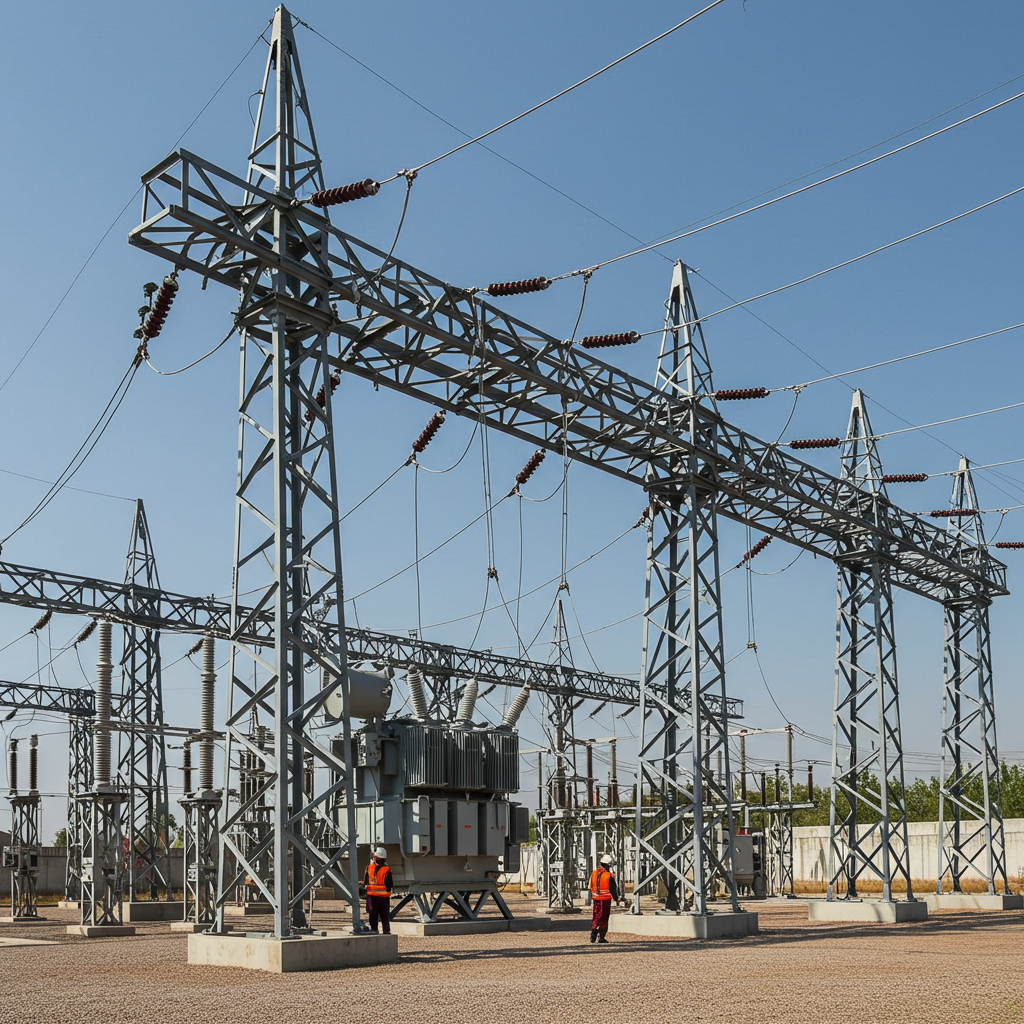
Walk into any substation, and you’ll see a network of conductors stretched across carefully spaced structures. Those horizontal beams supported by vertical columns? That’s where gantry structures come into play.
They act as mounting frameworks for incoming and outgoing transmission lines. Not just that. They also support equipment like isolators, busbars, and sometimes even circuit breakers.
There’s a practical reason behind this design. Elevating conductors ensures safe clearance from the ground and other equipment. It also allows technicians to inspect and maintain systems without constant obstruction.
In many high-voltage substations, especially above 132 kV, gantry systems become almost unavoidable. Trying to manage that scale without structured elevation would be messy. And unsafe.
Managing High Voltage Line Entry and Exit
Now think about where transmission lines meet substations. That transition point matters more than it looks.
Gantry structures guide these high-voltage lines into the substation in a controlled way. They hold the conductors steady and maintain proper spacing between phases. Without that spacing, electrical faults become more likely.
There’s also mechanical stress involved. Long transmission lines carry tension, especially across large spans. Gantries absorb and redistribute that force so it doesn’t directly impact sensitive equipment.
You don’t want a live conductor swinging freely near a transformer. That’s a situation nobody wants to deal with.
Supporting Busbar Arrangements
Busbars are like highways inside a substation. They distribute electrical power between different circuits. And just like highways need proper support systems, busbars rely on stable mounting.
Gantry structures provide that support at an elevated level. This keeps the layout organized and reduces the risk of accidental contact.
Different configurations exist. Single bus, double bus, ring bus. Each setup demands specific structural arrangements. Gantries adapt to these variations without requiring a complete redesign every time.
That flexibility saves both time and effort during project execution.
Creating Safe Electrical Clearances
Electricity doesn’t forgive mistakes. Especially at high voltage levels.
One of the less talked about roles of gantry structures is maintaining clearances. Distance between live parts, distance from ground, distance from nearby equipment. All of it matters.
According to standard substation design practices, clearance requirements increase with voltage level. For example, a 400 kV system needs significantly more spacing than a 33 kV setup.
Gantry structures help achieve these distances in a controlled and repeatable way. Instead of improvising layouts on-site, engineers rely on predefined structural designs.
It brings consistency. And that consistency reduces risk.
Acting as Equipment Mounting Platforms
Some equipment simply needs to be elevated. Not for convenience, but for function.
Wave traps, lightning arresters, and certain measurement devices often sit on gantry structures. Placing them at height improves their effectiveness and integration with transmission lines.
Take wave traps, for instance. They are installed on incoming lines to block high-frequency signals used in communication systems. Mounting them on gantries ensures they are positioned correctly within the line path.
It’s not random placement. Every height, every angle serves a purpose.
Handling Mechanical Loads and Environmental Stress
Steel structures in open environments face constant exposure. Wind loads, temperature variations, even seismic activity in some regions.
Gantry structures are designed to handle these conditions. Their geometry distributes forces evenly, reducing the chances of structural failure.
In areas with strong winds, the design becomes even more critical. Engineers calculate load factors carefully, ensuring the structure remains stable under pressure.
There’s a quiet reliability here. You don’t notice it unless something goes wrong. And when designed properly, things rarely do.
Temporary Support During Construction
Here’s something not everyone talks about.
During the construction phase of power projects, gantry structures often serve as temporary support systems. Before the final arrangement is fully in place, they help hold conductors and equipment safely.
This reduces the need for makeshift solutions on-site. Which, honestly, tend to create more problems than they solve.
Having a structured support system during installation speeds up the process. It also keeps safety risks in check.
Integration with Modern Power Systems
Power infrastructure isn’t standing still. New technologies are constantly being introduced. Smart grids, automation, remote monitoring.
Even with these changes, gantry structures continue to play a role. They adapt to new layouts and equipment requirements without losing their core function.
In GIS (Gas Insulated Substations), their role is reduced due to compact designs. But in AIS (Air Insulated Substations), they remain essential.
And considering the scale of power demand in countries like India, AIS setups are still widely used.
Why Their Role Still Matters
It’s easy to focus on advanced technologies and forget the physical systems holding everything together.
Gantry structures don’t process data. They don’t optimize load flow. They don’t “think.”
But they make all of that possible.
They provide the physical framework that supports transmission, distribution, and control systems. Without them, even the most advanced electrical components would struggle to function in a stable environment.
Sometimes, the simplest elements carry the heaviest responsibility.
And if you stand inside a substation for a few minutes, look up. You’ll see them doing exactly that.