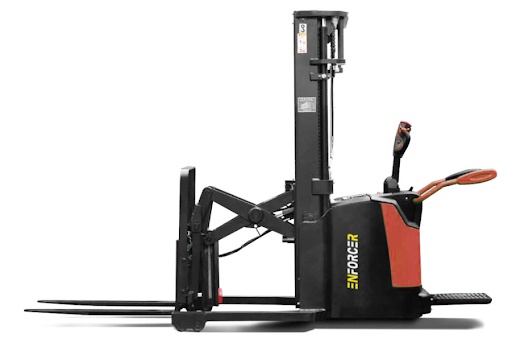

Spend enough time around warehouse managers and a pattern shows up fast. The floor plan made perfect sense when it was drawn. Then SKU counts grew. A few extra pallets appeared. Racking got added wherever there was room. Before long, the whole layout is a compromise, and the equipment originally chosen for it no longer fits the operation it is supposed to serve. That gap — between the warehouse that exists and the one that was planned — is exactly where the walkie stacker tends to prove its worth. Not with drama. Just with quiet, daily usefulness that adds up.
The Racking Rows You Never Knew You Lost
Most operations running wide-aisle forklifts have made a trade-off they never consciously agreed to. Wide turning circles eat floor space. That space gets subtracted from racking rows, often silently, just absorbed into the layout as a dead corridor. A stacker changes the maths. Because the operator walks rather than rides, the machine itself sits narrower, turns tighter, and fits into configurations that a seated forklift simply cannot. Businesses that have made the switch often find they can install extra racking rows in the same footprint — not because the building changed, but because the machine stopped claiming space it did not need.
Visibility That Actually Prevents Incidents
There is a tendency to frame pedestrian-operated equipment as less capable than seated alternatives. In terms of lift height, that can be true. But in terms of situational awareness, the walkie stacker has a genuine advantage. The operator is on the floor, moving through the same space as every other person in the warehouse. They see what is coming. They feel the environment rather than observing it from inside a cab. Near-miss incidents involving seated forklifts often trace back to limited sightlines at low heights, or misjudged clearances on corners. Walking operators tend to catch those situations earlier. It is not a minor distinction — safety consultants and insurers are starting to notice it properly.
Cold Storage and Why It Changes the Conversation
Cold storage environments expose problems that never show up in a standard warehouse setting. LPG and petrol machines produce exhaust, which means ventilation requirements increase sharply. Components corrode faster in condensing environments. Maintenance cycles shorten. The electric stacker sidesteps most of this. No exhaust, a simpler mechanical structure, and sealed battery systems that handle temperature variation without the fuss. There is also a subtler point worth making: operators move quicker on foot in cold environments than they do settling into a chilled cab and adjusting controls. Every second a freezer door stays open costs money. Faster, more fluid movement through those zones matters more than most facilities account for.
When One Sick Day Stops the Warehouse
Counterbalance forklift licences take time and regulatory effort to obtain. When a business has only a handful of certified drivers, losing one to illness, resignation, or leave creates a real operational problem. It happens more often than anyone plans for. Walkie stacker training is shorter, more accessible, and opens certification to a wider pool of staff. During busy seasons, when headcount fluctuates, and temporary workers are common, that flexibility matters enormously. An operation that is not entirely dependent on a small group of licensed drivers is simply more resilient. That resilience rarely shows up on a spec sheet, but it shows up very clearly on a difficult Tuesday.
Charging Between Breaks — What Most People Get Wrong
Battery anxiety still puts some managers off electric equipment. The concern is understandable but slightly misdirected. Modern lithium-ion batteries are built around real shift patterns. A quick top-up during a lunch break does not damage capacity — that is the old lead-acid rule, and it no longer applies. Lithium-ion tolerates partial charging without issue, which means the machine is ready when the operator is. Over the working life of the equipment, this translates into considerably less downtime and far more predictable performance than many operations expect when they first make the switch.
Conclusion
The walkie stacker does not try to replace every machine on the floor. It does not need to. What it does is solve specific, recurring problems — cramped layouts, limited certified staff, cold environments, and safety blind spots — more cleanly than the alternatives. Operations that treat it as a stopgap tends to underuse it. Those that look honestly at where their current equipment falls short often find it becomes the most consistently useful thing in the building. The transformation it brings is not loud. But in warehousing, the changes that stick rarely are.